
The paper under review
This page reviews a single conference paper on the UK medical device industry openly, naming it throughout. A clearly attributed one-paper summary is a useful exercise in reading reviews critically.
| Item | Detail |
|---|---|
| Authors | Matthew Edge, Sid Ghosh and Danni Liang, Bournemouth University |
| Title | The evolution of virtual trade shows: A literature review from the UK medical device industry |
| Venue | EMAC 2020 Regional Conference (European Marketing Academy), held online, September 2020 |
| Type | Conference paper presenting a literature review; no primary data |
| Research questions | How organisations perceive conventional trade shows; whether medical device firms could meet marketing objectives through virtual shows; what drives attendance at virtual shows |
What the paper argues
Edge et al. (2020) start from a practical problem. Medical device firms have long used international trade shows to promote products, follow industry trends and build relationships that influence buyers. Physical shows, however, are expensive, their return on investment is uncertain, and the COVID-19 pandemic halted them in 2020. The authors ask whether virtual trade shows, online platforms where buyers and sellers meet without travelling, offer an effective alternative.
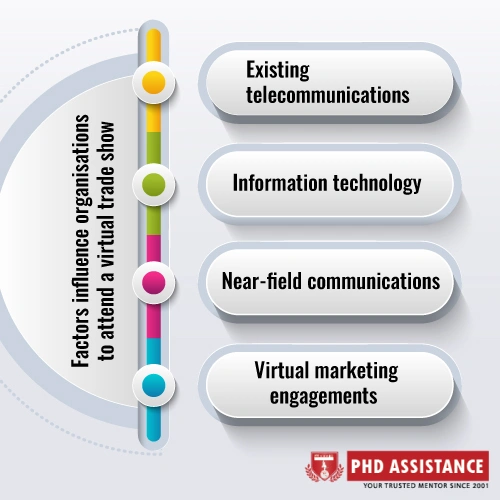
The paper argues that conventional shows remain powerful tools for building relationships but suffer from high participation fees and unfavourable locations, which reduce delegate attendance. Virtual shows are presented as an extension of online marketing that firms already practise, relying on technologies many exhibitors already use. The claimed advantages and constraints are summarised below.
| Claimed advantages of virtual shows | Claimed constraints |
|---|---|
| Lower costs, with no travel or accommodation | Difficulty measuring interaction quality and return on investment |
| Access to subject experts across time zones | Unequal IT access and bandwidth, especially in some regions |
| Richer delegate data for performance indicators | Weaker social interaction than face-to-face meetings |
| Translation tools that reduce language barriers | Risks such as online intruders and unprofessional conduct |
The paper concludes that market access, sales revenue, return on investment and brand loyalty are the likely drivers of participation, and invites the healthcare industry to explore virtual show features further (Edge et al., 2020). It does not propose a formal framework, hypotheses or testable propositions, and describes itself as groundwork for a proposed study.
Strengths
The paper asks a timely and practical question. It was written when physical events had stopped, and it frames virtual shows not as a novelty but as part of the wider marketing communications mix, linking them to established work on why firms and buyers attend exhibitions. Its three research questions are clear and move logically from perceptions of conventional shows, to whether objectives can be met online, to the drivers of attendance.
The balance of advantages against constraints is also useful. Rather than treating virtual shows as simply better, the authors recognise that measurement, connectivity and social interaction remain unresolved. These tensions are exactly where empirical doctoral research could add something.
Limitations and methodological issues
The most serious limitation is method. A literature review is a research method in its own right, and its credibility depends on how sources are identified, selected and synthesised (Snyder, 2019). The paper has no method section and does not say which databases were searched, which terms were used, which period was covered or why particular sources were included. A reader therefore cannot judge whether the advantages and constraints it lists are representative of the literature or a selection that supports the argument. Even narrative reviews, which do not need a full systematic protocol, are expected to justify the literature they cover and to support key statements with appropriate evidence (Baethge et al., 2019).
- Thin sector evidence. Most cited sources concern trade shows, events and online marketing in general. Little of the evidence is specific to medical devices, so the sector framing in the title is stronger than the evidence base.
- Reliance on one empirical study. Much of the argument about virtual marketing capability draws on a single earlier study of exhibitors, which limits how far the conclusions can be generalised.
- Citation inconsistencies. One source is cited in the text but missing from the reference list, one is cited with a different year from its listing, and at least one is cited for a claim its title does not concern. Errors of this kind weaken trust in a review.
- Weak trend evidence. A decline in public search interest in UK trade shows is used as background, but search interest is not a measure of exhibitor participation or spending.
- No stated limitations. The paper does not discuss the boundaries of its own conclusions.
A further issue belongs to the original blog post rather than the paper. It described medical device categories and risk classes using the language of the former EU Medical Device Directive and did not mention later change. The EU has since moved to the Medical Devices Regulation, and Great Britain regulates devices through the Medicines and Healthcare products Regulatory Agency under its own rules. Any review that uses regulation as background should check the regime that currently applies to the market studied.
How the paper sits in the wider literature
Later work has taken the review of virtual trade shows further. Gani et al. (2021) critically reviewed studies of virtual trade shows drawn from several databases, compared the features of earlier findings, set out the antecedents and consequences examined so far, and identified under-explored areas with potential for theory development. Set beside that review, the paper by Edge et al. (2020) is best read as an early, sector-focused position paper rather than a comprehensive synthesis.
The contrast illustrates a broader point about review types. Grant and Booth (2009) distinguish fourteen kinds of review, from critical and narrative reviews to scoping and systematic reviews, each with different expectations for search, appraisal and synthesis, and Gough et al. (2012) show how review designs differ in aims and methods. In management research, systematic review procedures were adapted from medicine to make reviews more transparent and reproducible (Tranfield et al., 2003), and protocols such as SPAR-4-SLR set out the decisions a reviewer should report (Paul et al., 2021). An integrative review, by contrast, aims to synthesise diverse sources into new frameworks or perspectives (Torraco, 2005). A doctoral review on virtual trade shows would need to choose one of these designs explicitly. For a worked comparison of reviewing strategies, see theorising through literature reviews.
Worked example: a transparent review protocol (illustrative)
Suppose a doctoral researcher wants to answer the paper's second question properly: can medical device firms meet their marketing objectives through virtual or hybrid trade shows? A hypothetical protocol might run as follows.
- State the review type and why: a systematic scoping review, because the evidence is new and scattered (Grant & Booth, 2009).
- Define the concepts: virtual, hybrid and physical trade shows; exhibitor and visitor objectives; business-to-business medical technology markets.
- Name the databases, search strings, date range and languages, and record the date each search was run.
- Set inclusion criteria, for example empirical studies of exhibitors or visitors, any sector, with medical device studies coded separately.
- Screen titles, abstracts and full texts, ideally with a second screener for a sample, and record reasons for exclusion.
- Extract data into a concept matrix, with concepts as columns and studies as rows (Webster & Watson, 2002).
- Synthesise by objective (sales, relationships, information gathering, brand building) and compare evidence for virtual and physical formats.
- Identify gaps systematically, for example where medical device evidence is absent or where only perceptions, not outcomes, have been measured (Müller-Bloch & Kranz, 2015).
A protocol of this kind turns the paper's list of claimed advantages into questions that can be answered. It may also lead the researcher beyond gap-spotting to question the assumptions behind earlier work, for example the assumption that virtual shows mainly substitute for physical ones rather than serving different purposes (Sandberg & Alvesson, 2011).
What to report in a doctoral literature review
| Element | What to state | Present in Edge et al. (2020)? |
|---|---|---|
| Review type | Narrative, integrative, scoping or systematic, with a reason | Stated as a literature review only |
| Search | Databases, terms, dates, languages | No |
| Selection | Inclusion and exclusion criteria, numbers screened and included | No |
| Appraisal | How the quality of sources was judged | No |
| Synthesis | How findings were compared and combined | Thematic discussion by research question |
| Limitations | Boundaries of the evidence and the review | No |
| Contribution | Framework, propositions or agenda | General call for further exploration |
Implications for doctoral researchers and common mistakes
The paper is a reasonable starting point for anyone interested in virtual events in business-to-business marketing, but it should be cited as a conference position paper, not as evidence that virtual shows meet medical device firms' objectives. The claims it gathers are best treated as propositions to test.
- Summarising one source and presenting it as a review of a whole field.
- Leaving out the search and selection method, even in a narrative review.
- Treating lists of advantages drawn from earlier writing as findings.
- Using general event or marketing evidence to support sector-specific claims without saying so.
- Carrying regulatory background forward without checking that it is still current.
- Allowing citation errors to accumulate; check every in-text citation against the reference list.
For help locating a gap after the review, see types of research gap, and for the relationship marketing theory that underpins trade show research, see trust and commitment in relationship marketing.
Key takeaways
- Edge, Ghosh and Liang (2020) argue that virtual trade shows could help UK medical device firms reach markets at lower cost, while noting problems of measurement, connectivity and interaction (Edge et al., 2020).
- The paper reports no search, selection or appraisal method, so its conclusions are best read as propositions (Snyder, 2019; Baethge et al., 2019).
- A later review drawing on several databases maps the virtual trade show literature more fully and identifies room for theory development (Gani et al., 2021).
- A doctoral review should name its type and report its protocol, using established guidance from management and other fields (Grant & Booth, 2009; Tranfield et al., 2003; Paul et al., 2021).
- Any source that a summary relies on must be named; attribution is the honest form of a one-paper summary.