
The short answer
Academic research and professional research both investigate questions systematically, collect and analyse evidence and draw conclusions. They differ mainly in why the research is done, who it is for and how its quality is judged. Academic research aims to add to a shared body of knowledge, is judged by peers in a discipline and is normally published. Professional research aims to inform a decision or improve practice in a particular organisation or profession, is judged by whether it is useful and credible to those who commissioned or will use it, and is often kept internal.
The distinction is a continuum, not a wall. Research methods textbooks describe a range from basic research, which seeks general understanding, to applied research, which addresses a specific practical problem, and place most studies somewhere between the two (Saunders et al., 2023). A doctoral study can sit anywhere on that range, provided it makes a contribution to knowledge.
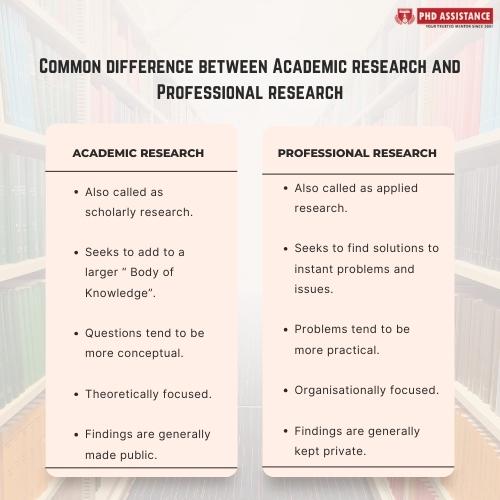
How the two differ
Each row describes a typical tendency rather than a rule.
| Aspect | Academic research | Professional research |
|---|---|---|
| Main purpose | Add to a shared body of knowledge; develop or test theory | Inform a decision or improve practice in a specific setting |
| Question focus | Conceptual and general | Practical and situated |
| Orientation | The discipline and its theories | The organisation, client or profession |
| Disclosure of findings | Generally public | Often private or restricted |
| Use of results | Prompts further research and debate | Supports internal decisions and strategy |
| Quality judged by | Peer review and disciplinary standards | Usefulness and credibility to the client or profession |
| Dissemination | Theses, journal articles, conferences, books | Internal reports, briefings, professional conferences |
| Typical doctoral route | PhD | Professional doctorate (for example DBA, EdD) or practice-based PhD |
Business research textbooks make a related point: management research must satisfy both academic rigour and practical relevance, and the tension between the two is a recurring debate in the field (Bell et al., 2022). A study that is rigorous but irrelevant to practice and a study that is useful but cannot be trusted both fall short.
Practitioner research and action research
A large body of work treats research by practitioners as a form of inquiry in its own right. Action research, which Lewin (1946) described as research that links the study of a social problem to action on it, proceeds in cycles of planning, acting, observing and reflecting. In education, practitioner research has been defended as a stance through which teachers generate knowledge about their own practice (Cochran-Smith & Lytle, 2009), and Anderson and Herr (1999) argued that such knowledge can meet standards of rigour if those standards are suited to its aims, such as whether it leads to change and whether it is credible to practitioners.
Action research can also be doctoral research. Coghlan (2007) describes insider action research doctorates, in which managers study change in their own organisations and generate actionable knowledge, and Herr and Anderson (2015) set out how such a dissertation can be designed and examined. The challenge in these projects is to show a contribution beyond the single organisation.
Where professional doctorates fit
Professional doctorates, such as the Doctor of Business Administration (DBA), the Doctor of Education (EdD) and doctorates in fields such as nursing and engineering, were created for experienced practitioners who want to research problems from practice. A systematic review of research on professional doctorates found a literature concerned with their purpose, their relationship to the PhD and their impact on practitioners and organisations (Hawkes & Yerrabati, 2018). In management, Banerjee and Morley (2013) argue for a practice-based approach in which the doctorate builds on the candidate's professional experience.
Studies comparing the two routes in business have examined how DBA and PhD dissertations differ in focus and method (MacLennan et al., 2018), and a survey of business professional doctorates described them as a channel that carries knowledge between academia and practice (Gill & Hoppe, 2009). Both routes are doctorates and both require an original contribution; they differ in the kind of contribution they foreground.
Worked example (illustrative)
A hospital manager is asked to find out why discharge is delayed on two wards. As professional research, the study would map the process, interview staff, analyse discharge times and recommend changes in an internal report. As academic research, the same problem would be framed by asking what the case shows about coordination between professional groups, reviewing the literature on care transitions, choosing a theory, and writing up findings that other hospitals and researchers could use. As an insider action research doctorate, the manager would do both: lead cycles of change on the wards and analyse them to produce knowledge that holds beyond the hospital.
Questions to place your own study
If you are unsure where your project sits, answer the following questions before you write a proposal. The answers shape your literature review, design, ethics application and choice of programme.
- Who is the primary audience? A discipline, a profession, an organisation, or more than one of these?
- What counts as success? A tested explanation, a changed practice, a decision made, or a combination?
- Who owns the data and findings? Can you publish them, and on what terms?
- How general should the conclusions be? Do they need to hold beyond the setting you study?
- What is your position? Are you an outsider, or an insider with a role in the setting you study?
Insider status deserves particular care. Researching your own workplace brings access and understanding, but also power relations with colleagues, risks to confidentiality and a pull towards the employer's preferred answer. Ethics committees will ask how you will obtain free consent from people you manage, how you will protect organisational data and what you will do if findings are unwelcome. Agreeing these terms in writing with the organisation before data collection protects both the research and your position.
Funding also shapes the balance. Research commissioned and paid for by an organisation usually comes with expectations about questions, timing and disclosure, whereas research funded through a studentship or by the researcher has more freedom. Neither is wrong, but the terms should be clear from the start.
Common mistakes
- Assuming that applied topics cannot lead to a PhD.
- Submitting a consultancy report as a thesis without a literature review, theory or contribution to knowledge.
- Ignoring confidentiality: organisational data may need permission before they can appear in a public thesis.
- Using definitions of research copied from textbooks without citing them.
- Choosing a doctoral route without comparing what the PhD and the professional doctorate require.
Key takeaways
- Academic and professional research share methods but differ in purpose, audience, ownership and quality judgement.
- Basic and applied research form a continuum, and doctoral research can sit anywhere on it (Saunders et al., 2023).
- Practitioner and action research can be rigorous when judged by criteria suited to their aims (Anderson & Herr, 1999; Lewin, 1946).
- Professional doctorates foreground contributions to practice; the PhD foregrounds contributions to a discipline (Hawkes & Yerrabati, 2018; Banerjee & Morley, 2013).
- A workplace problem becomes doctoral research when it is framed to contribute knowledge beyond one organisation (Coghlan, 2007).