
Deep Learning Models for High-Resolution Regional Climate Forecasting
Info: Deep Learning Models for High-Resolution Regional Climate Forecasting Topics I phdassistance.com
Published: 26th September in Deep Learning Models for High-Resolution Regional Climate Forecasting Topics I phdassistance.com
Share this:
Related Services
Our academic writing and marking services can help you
Introduction
Regional climate forecasting plays an important role in understanding local climate risks, extreme events, and future climate changes. However, generating high-resolution regional predictions remains challenging due to limitations in spatial resolution, regional variability, uncertainty, and the complexity of atmospheric processes. Recent advances in deep learning have created new opportunities for improving climate downscaling and prediction. However, challenges related to accurately representing extreme events, improving model generalisation across regions, reducing computational costs, and incorporating physical climate information continue to require further investigation.
For PhD researchers, selecting a suitable research topic in deep learning-based climate forecasting requires evaluating the research gap, available datasets, methodological feasibility, computational requirements, and potential scientific contributions to ensure the study is both impactful and achievable. A well-defined PhD research topic should also be evaluated based on dataset availability, methodological feasibility, computational requirements, and the potential to generate meaningful scientific contributions. This article explores emerging PhD research topics in high-resolution regional climate forecasting, focusing on areas such as extreme-event modelling, diffusion-based approaches, transfer learning, domain adaptation, and physics-informed AI.
Proposed PhD Topic 1: Extreme-Aware Deep Learning Downscaling for Improving High-Resolution Regional Temperature and Precipitation Extremes
Background Context:
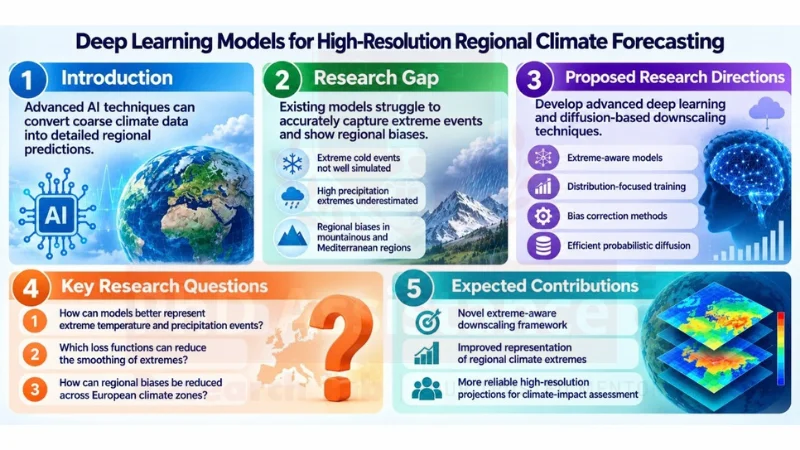
The deep learning model used by Fuentes–Franco et al. (2025) for high-resolution European climate downscaling showed satisfactory performance in reproducing temperature and precipitation patterns. However, it showed limitations in simulating extreme cold conditions and high precipitation extremes, with regional biases particularly evident in mountainous and Mediterranean regions. This is critical because extreme events drive major climate risks and require reliable fine-scale information for impact assessment and adaptation planning. Baño-Medina et al. (2022) demonstrated the potential of deep learning-based statistical downscaling through the DeepESD framework applied to CORDEX EUR-44 climate projections, while Wang et al. (2021) showed that deep residual networks can improve the representation of local temperature and precipitation extremes.
Together, these studies highlight an unresolved challenge: developing deep learning downscaling models that can better represent regional temperature and precipitation extremes without compromising overall downscaling performance.
Identified research gap:
The key research gap is the limited ability of conventional deep learning downscaling approaches to accurately represent rare temperature and precipitation extremes. Models trained primarily to minimise average prediction errors may smooth extreme events and underestimate their intensity or frequency. It remains necessary to determine how extreme-aware training strategies can improve the representation of these events while maintaining overall downscaling accuracy.
Potential Novelty:
A PhD study could develop an extreme-aware deep learning framework using tail-sensitive loss functions, extreme-event weighting, and region-specific evaluation strategies to improve the representation of temperature and precipitation extremes.
Possible Research Direction:
The study could compare conventional and extreme-aware training approaches using high-resolution climate datasets. Model performance could be evaluated for both general climate conditions and selected extreme-event indicators across contrasting European climate regions.
Research Questions:
- How can deep learning models better represent extreme temperature and precipitation events?
- Which loss functions and training strategies can reduce the smoothing of climate extremes?
- How can regional biases be reduced across different European climate zones?
Expected Original Contribution:
- Development of an extreme-aware deep learning downscaling framework.
- Improved representation of regional temperature and precipitation extremes.
- Improved reliability of high-resolution climate projections for climate-impact assessment.
Expected Original Contribution:
Data Requirement: Reanalysis and high-resolution climate datasets.
Computational Requirement: High, due to model training and regional experiments.
Potential Methodology: Comparative modelling, loss-function analysis, ablation studies, and extreme-event evaluation.
Potential Narrowing: Selected European regions, precipitation and temperature, and specific extreme-event types.
Suggested Readings:
Fuentes–Franco, R., Krus, K., Ivanov, M., Koenigk, T., Wang, F., & Aldama–Campino, A. (2025). Pan-European high-resolution downscaling using deep learning. Journal of Geophysical Research: Machine Learning and Computation, 2, e2025JH000630.
Wang, F., Tian, D., Lowe, L., Kalin, L., & Lehrter, J. (2021). Deep learning for daily precipitation and temperature downscaling. Water Resources Research, 57(4), e2020WR029308. https://doi.org/10.1029/2020WR029308
Baño-Medina, J., Manzanas, R., Cimadevilla, E., Fernández, J., González-Abad, J., Cofiño, A. S., & Gutiérrez, J. M. (2022). Downscaling multi-model climate projection ensembles with deep learning (DeepESD): Contribution to CORDEX EUR-44. Geoscientific Model Development, 15, 6747–6766. https://doi.org/10.5194/gmd-15-6747-2022
Proposed PhD Topic 2: Efficient Probabilistic Diffusion Downscaling for Uncertainty-Aware High-Resolution Regional Climate Projections
Background Context:
Guan et al. (2026) demonstrated diffusion-based downscaling of a lightweight climate emulator from coarse resolution to approximately 25–28 km, showing that diffusion models can generate multiple plausible high-resolution climate states rather than a single deterministic state. Ling et al. (2024) similarly demonstrated diffusion-based probabilistic downscaling for generating multiple high-resolution ensemble members, highlighting the potential of diffusion models for representing uncertainty in regional climate simulations. Mardani et al. (2025) further demonstrated diffusion-based atmospheric downscaling to much finer spatial resolution, highlighting the potential of generative approaches for high-resolution climate applications. Together, these studies demonstrate the potential of diffusion models for both high-resolution generation and probabilistic climate representation, but challenges remain in computational cost, sampling efficiency, and scalability. Taken together, these studies indicate an unresolved problem concerning how diffusion-based downscaling can provide reliable uncertainty estimates while maintaining computational efficiency and scalability across different spatial resolutions.
Identified Research Gap:
The key research gap is the difficulty of generating reliable probabilistic climate ensembles without creating high computational and sampling costs. Existing diffusion approaches can produce multiple plausible climate states, but the efficiency, scalability, and reliability of these ensembles require further investigation.
Potential Novelty
A PhD study could develop an efficient probabilistic diffusion framework that combines improved sampling strategies with uncertainty calibration for high-resolution regional climate projections.
Possible Research Direction
The study could train a diffusion-based downscaling model and generate multiple regional climate realisations. Different sampling and calibration strategies could then be compared to determine whether they improve computational efficiency while maintaining ensemble diversity and reliability.
Research Questions:
- How can diffusion models generate reliable probabilistic regional climate projections?
- How does distribution shift between training and inference data affect downscaling performance?
- How can probabilistic ensemble generation be made computationally efficient?
Expected original contribution:
- Development of an efficient probabilistic diffusion-based downscaling framework.
- Methods for addressing training–inference distribution differences.
- Improved uncertainty quantification for Climate Forecasting with AI.
Feasibility Assessment:
Data Requirement: Climate-emulator outputs, reanalysis data, and high-resolution regional climate datasets.
Computational Requirement: High, due to diffusion training and ensemble generation.
Potential Methodology: Diffusion modelling, probabilistic evaluation, sampling analysis, and calibration experiments.
Potential Narrowing: Selected atmospheric variables and one regional domain.
Suggested Readings:
Guan, H., Darman, M., Chakraborty, D., Arcomano, T., Chattopadhyay, A., & Maulik, R. (2026). High-resolution climate projections using diffusion-based downscaling of a lightweight climate emulator. arXiv preprint arXiv:2602.13416.
Ling, F., Lu, Z., Luo, J.-J., Bai, L., Behera, S. K., Jin, D., Pan, B., Jiang, H., & Yamagata, T. (2024). Diffusion model-based probabilistic downscaling for 180-year East Asian climate reconstruction. npj Climate and Atmospheric Science, 7, 131. https://doi.org/10.1038/s41612-024-00679-1
Mardani, M., Brenowitz, N., Cohen, Y. et al. Residual corrective diffusion modeling for km-scale atmospheric downscaling. Commun Earth Environ 6, 124 (2025). https://doi.org/10.1038/s43247-025-02042-5
Proposed Dissertation topic 3: Geographic Generalisation of Conditional Diffusion Models for High-Resolution Regional Precipitation Downscaling Across Diverse Climate Regions
Background Context:
Shidqi et al. (2023) investigated conditional diffusion models for generating high-resolution regional precipitation from low-resolution climate data, demonstrating their potential for reconstructing fine-scale precipitation structures. Wang et al. (2021) showed that deep learning can support precipitation downscaling across different spatial resolutions and geographic settings. Rampel et al. (2022) also highlighted that precipitation downscaling models can perform differently across hydroclimatically distinct regions, suggesting that geographic shifts can affect model generalisation. These studies demonstrate the potential of deep learning and diffusion approaches for high-resolution precipitation downscaling, but their ability to maintain performance across geographically and hydroclimatically different regions remains less understood. Taken together, these studies indicate an unresolved problem: how conditional diffusion models can maintain reliable precipitation downscaling performance across geographically and hydroclimatically different regions.
Identified Research Gap:
The key research gap is the limited understanding of how geographic and hydroclimatic differences affect the generalisation of conditional diffusion models when applied to previously unseen regions. Differences in precipitation patterns, atmospheric conditions, and spatial characteristics may reduce downscaling performance in target regions. It remains unclear which factors contribute most to this performance degradation and whether domain-adaptation strategies can improve cross-regional performance without extensive retraining.
Potential Novelty:
A PhD study could develop a conditional diffusion framework that incorporates geographic or climate-domain adaptation strategies to improve precipitation downscaling across different regions.
Possible Research Direction:
The study could train a conditional diffusion model using one or more source regions and evaluate its performance in geographically and hydroclimatically different target regions. Domain-alignment or adaptation strategies could then be investigated to determine whether they improve cross-regional generalisation.
Research Questions:
Expected Original Contribution:
Feasibility Assessment
Potential Scope: Moderate
Data Requirement: Multi-region precipitation and atmospheric datasets.
Computational Requirement: High, due to diffusion-model training and cross-regional experiments.
Potential Methodology: Conditional diffusion modelling, cross-regional evaluation, domain adaptation, and ablation studies.
Potential Narrowing: Two source regions and one previously unseen target region, with precipitation as the primary variable.
Suggested Readings:
Shidqi, N., Jeong, C., Park, S., Zeller, E., Nellikkattil, A.B., & Singh, K. (2023). Generating High-Resolution Regional Precipitation Using Conditional Diffusion Model. ArXiv, abs/2312.07112. https://doi.org/10.48550/arXiv.2312.07112
Wang, F., Tian, D., Lowe, L., Kalin, L., & Lehrter, J. (2021). Deep learning for daily precipitation and temperature downscaling. Water Resources Research, 57(4), e2020WR029308. https://doi.org/10.1029/2020WR029308
Rampal, N., Gibson, P. B., Sood, A., Stuart, S., Fauchereau, N. C., Brandolino, C., Noll, B., & Meyers, T. (2022). High-resolution downscaling with interpretable deep learning: Rainfall extremes over New Zealand. Weather and Climate Extremes, 38, 100525. https://doi.org/10.1016/j.wace.2022.100525
Proposed Dissertation Topic 4: Transfer Learning and Domain Adaptation for Generalisable High-Resolution Regional Climate Prediction Across Diverse Climate Zones
Background Context:
Loganathan et al. (2025) demonstrated deep learning approaches for projected temperature extremes across Nordic climate regions. Wang et al. (2021) showed that deep learning downscaling models can be transferred between regions, demonstrating the potential of transfer learning for climate applications. Wang et al. (2026) further investigated domain-adaptive climate downscaling under temporal distribution shift and showed that domain adaptation can improve the robustness of high-resolution climate projections under changing climate conditions. Taken together, these studies indicate an unresolved problem concerning how climate-domain differences affect cross-regional model generalisation and how domain-adaptation strategies can reduce performance degradation when models are transferred across different climate conditions.
Identified Research Gap
The key research gap is the limited understanding of how climate-domain shifts affect the performance of transferred downscaling models. Models trained in data-rich regions may experience performance degradation when applied to climatically different or data-limited regions. It remains necessary to determine how domain-adaptation strategies can reduce this degradation and improve transferability.
Potential Novelty
A PhD study could develop and evaluate transfer-learning and domain-adaptation strategies for transferring regional climate downscaling models from data-rich to data-limited regions.
Possible Research Direction
The study could train a deep learning downscaling model using a data-rich source region and evaluate it in one or more target regions. Different transfer-learning and domain-adaptation strategies could then be tested under varying amounts of target-region data.
Research Questions:
- How does climate-domain shift affect the cross-regional generalisation of transformer, convolutional and recurrent downscaling architectures across climatically dissimilar regions?
- To what extent can domain-adaptation strategies reduce performance degradation when models trained in data-rich regions are transferred to data-limited climate zones?
Expected research contribution:
- Development of a transferable regional climate prediction framework.
- Novel transfer-learning and domain-adaptation strategies.
- Comparative assessment of deep learning architectures across climate zones.
Feasibility Assessment
Data Requirement: Multi-region reanalysis and high-resolution climate datasets.
Computational Requirement: Medium to High.
Potential Methodology: Transfer learning, domain adaptation, cross-regional evaluation, and ablation studies.
Potential Narrowing: Two or three climate regions and one target variable such as temperature.
Suggested Readings:
Loganathan, P., Zea, E., Vinuesa, R., & Otero, E. (2025). Deep learning-driven downscaling for climate risk assessment of projected temperature extremes in the Nordic region. arXiv. https://doi.org/10.48550/arXiv.2511.03770
Wang, F., Tian, D., Lowe, L., Kalin, L., & Lehrter, J. (2021). Deep learning for daily precipitation and temperature downscaling. Water Resources Research, 57(4), e2020WR029308. https://doi.org/10.1029/2020WR029308
Wang, S., Yadav, N., & Ganguly, A. R. (2026). Domain-adaptive climate downscaling under temporal distribution shift. arXiv. https://arxiv.org/abs/2607.05645
Proposed Dissertation Topic 5: Physics-Informed Multi-Scale Graph Neural Networks for Improved Global-to-Regional High-Resolution Climate Forecasting and Extreme Event Prediction
Background Context:
Gao et al. (2025) introduced OneForecast using multi-scale graph structures and nested grids for global and regional forecasting. Chen et al. (2024) demonstrated the use of physical information within GNN-based precipitation forecasting, while Seol et al. (2024) integrated physical equations into graph-based weather forecasting. These studies demonstrate the potential of combining graph-based learning with physical information for improving weather and climate prediction. Taken together, these studies indicate an unresolved problem concerning how physical constraints and multi-variable atmospheric information can be integrated into multi-scale graph networks for improved global-to-regional climate forecasting.
Identified Research Gap:
The key research gap is the limited integration of physical constraints and multi-variable atmospheric relationships within multi-scale graph-based global-to-regional forecasting. Existing approaches demonstrate the value of graph structures or physical information, but their combined use for regional forecasting remains less developed.
Potential Novelty:
A PhD study could develop a physics-informed multi-scale GNN incorporating multiple atmospheric variables, physical constraints, and nested regional graph structures.
Possible Research Direction:
The study could extend a multi-scale GNN framework by incorporating multiple atmospheric variables and physically motivated constraints. Ablation experiments could then assess the contribution of physical constraints, multi-variable coupling, and nested graph structures to regional forecast performance.
Research Questions:
- How can atmospheric physical constraints be incorporated into multi-scale Graph Neural Networks?
- How can global and regional atmospheric information be coupled more effectively?
- Can physics-informed nested grids improve long-term regional climate forecasts?
Contributions at the PhD-Level:
Feasibility Assessment:
Data Requirement: Multi-variable atmospheric reanalysis and high-resolution regional datasets.
Computational Requirement: High, due to graph-based model training and multi-variable experiments.
Potential Methodology: Graph neural networks, physics-informed learning, nested graph modelling, and ablation studies.
Potential Narrowing: Two or three atmospheric variables, one regional domain, and a defined forecast horizon.
Suggested Readings:
Ready to turn AI innovation into meaningful climate research? Finding a focused PhD topic in high-resolution regional climate forecasting can be challenging. From predicting climate extremes to improving downscaling and uncertainty estimation, exciting opportunities exist to develop AI-driven solutions for more accurate regional climate projections.
Selecting a PhD topic in AI-based climate modelling requires alignment between research gaps, available datasets, computational feasibility, and methodological novelty. Our research consultants provide guidance in topic refinement, literature-gap identification, research-question development, and methodology planning.
Contact us to begin one-on-one topic development and refinement with PhD Assistance Research Lab.
FAQs:
- What are the main challenges in high-resolution regional climate forecasting?
Deep learning approaches have demonstrated potential to improve regional climate modelling; however, challenges remain in uncertainty quantification, physical consistency, computational efficiency, and generalisation across regions.
- How can deep learning improve regional climate downscaling?
Deep learning can learn relationships between coarse climate data and fine-scale regional patterns. Transformers, diffusion models, and graph neural networks can improve spatial detail and accuracy, while further research is needed to better represent extremes and reduce regional biases.
- What is Deep learning climate downscaling?
Deep learning climate downscaling uses deep learning to transform coarse-resolution climate information into higher-resolution regional climate fields. It aims to provide detailed temperature and precipitation information while maintaining consistency with large-scale atmospheric conditions.
- How can AI models improve regional climate extreme prediction?
AI models can improve extreme-event prediction using specialised architectures, extreme-aware loss functions, physical constraints, and probabilistic approaches. These methods can help reduce the smoothing of rare temperature and precipitation events and improve their representation.
- How can regional climate prediction models become more transferable?
Regional climate prediction models can become more transferable through transfer learning, domain adaptation, probabilistic forecasting, and physics-informed modelling. These approaches can help models adapt across climate zones while reducing the need for large amounts of region-specific training data.
Share this:
Cite this work
PhD Assistance. (n.d.). Deep learning for regional climate forecasting. Retrieved September 10, 2026, from PhD Assistance.
PhD Assistance. “Deep Learning for Regional Climate Forecasting.” PhD Assistance, n.d. Web. 10 Sept. 2026.
PhD Assistance. “Deep Learning for Regional Climate Forecasting.” PhD Assistance. Web. 10 Sept. 2026.
PhD Assistance (n.d.) Deep Learning for Regional Climate Forecasting. Available at: PhD Assistance – Deep Learning for Regional Climate Forecasting (Accessed: 10 September 2026).
PhD Assistance. Deep Learning for Regional Climate Forecasting [Internet]. [cited 2026 Sep 10]. Available from: PhD Assistance – Deep Learning for Regional Climate Forecasting
PhD Assistance. “Deep Learning for Regional Climate Forecasting.” PhD Assistance. Retrieved September 10, 2026, from PhD Assistance – Deep Learning for Regional Climate Forecasting
PhD Assistance, ‘Deep Learning for Regional Climate Forecasting’ (PhD Assistance, n.d.) https://www.phdassistance.com/topic/deep-learning-for-regional-climate-forecasting accessed 10 September 2026.
Study Resources
Free resources to assist you with your university studies!