

How to Overcome PhD Data Analysis Challenges in Cambridge Quantum Materials Research: Fixing Errors in Superconductivity Modelling
July 30, 2026Why UK PhD Biomedical Manuscripts Get Rejected Before Journal Peer Review
- July 31, 2026
- Manuscript
Introduction
For many PhD researchers in the UK, completing a publication-ready biomedical paper can be one of the most challenging parts of their PhDs. This is a typical scenario whereby the work done is good and novel but not reflected in the written manuscript. Poor scientific writing skills, poor organisation of the manuscript, failure to follow the guidelines provided by journals, and inability to communicate the novelty of the research are some of the common causes why manuscripts are rejected before peer review.
Publication of research findings in reputable medical journals is highly crucial to the dissemination and validation of medicine. Prior to the article being submitted to the peer-review process, the editorial board of the journal evaluates the scientific value, novelty, ethics, and fitness for the journal of the research paper. As per the ICMJE (2024), “a good manuscript will have sound methodology, presentation, and ethics.”
Knowing the common reasons why the editors reject a manuscript is useful for UK PhD biomedical researchers to enhance their research articles before submitting it. This blog discusses the common reasons for rejection of the manuscript prior to peer review along with some effective strategies to achieve successful publication. The experts at PhD Assistance Research Lab offer reliable PhD Manuscript Writing Support in UK that critically develops and edits the biomedical manuscript for researchers.
What you will learn from this blog?
- Why biomedical manuscripts are rejected before peer review.
- Common editorial screening criteria used by journals.
- Practical strategies to improve manuscript quality.
- How professional manuscript writing support can increase publication readiness.
Why Does Biomedical Manuscript support Matter Before Peer Review?
Editorial screening is the initial stage and one of the most important stages of the entire publication process of the journal. Before manuscripts are subjected to external peer review, the editors of journals assess whether they fall within the journal scope, whether they are novel, whether they adhere to ethics and reporting guidelines and whether they are well-written. Manuscripts which fail to satisfy any of the above conditions are generally not subjected to peer review.
UK PhD biomedical researchers must spend their time creating an excellent manuscript because this is one of the ways to increase publication chances. A well-written manuscript is not only a good tool for conveying results of the research but also a proof of the credibility of the study. So, considering professional Biomedical Manuscript Support in UK before peer review can avoid rejection from editors.
Why Do UK PhD Biomedical Manuscripts Get Rejected Before Journal Peer Review?
1. Submitting to the Wrong Journal
The selection of a suitable journal is among the critical parts of the whole publishing process. Before the process of external peer review, it is decided by the journal editors whether the manuscript fits into the journal scope, is scientifically novel, complies with ethics, and is properly written. Those manuscripts that fail to fulfil all the criteria are usually not subjected to peer review at all.
In addition to the suitability of the selected journal, another issue that will be considered by the editor is whether the authors have adhered to all the submission guidelines of the journal. Mistakes in formatting, incorrect citation style, exceeding the word limit, and many other problems may make a bad impression about the article at once.
What research shows:
According to Powel et al., 2016, several papers have been rejected at the editorial screening stage, since authors tend to submit papers to journals whose scope does not correspond to the author’s area of research and which do not conform to the submission criteria. Hence, an editor tends to favour papers that correspond to the journal’s scope and conform to all the guidelines. Thus, choosing a proper journal and following all the author guidelines may help to move on to the next stage.
Tips:
- Review the journal’s aims and scope carefully.
- Follow the author guidelines and formatting requirements.
- Use the appropriate reporting checklist for your study.
- Compare your manuscript with recently published articles in the journal.
2. Weak Study Design and Methodology
An effective research methodology is critical to the development of an article that is fit for publication in the field of biomedical sciences. The appropriateness of the study design, methods used for data collection, sample sizes, and statistical analysis techniques to solve the research problem are evaluated by the editors.
Most often, a poor methodology is also a reason why many manuscripts get rejected. Lack of detailed information about how participants were selected, experiments performed, analytical methods used, and the type of statistical tests employed does not help the editors assess the scientific worth of a manuscript.
What research shows:
According to the EQUATOR Network, it is crucial to report clearly the methods employed in research as a key approach to improving the quality, credibility, and reproducibility of the results of biomedical research. This means that authors are required to provide detailed information regarding the design, the choice of subjects, the data collection method, and the statistical approaches utilised. Such an article will be refereed.
Tips:
- Clearly explain the study design and methodology.
- Justify sample size and statistical analyses.
- Describe data collection and analysis procedures thoroughly.
- Acknowledge any study limitations transparently.
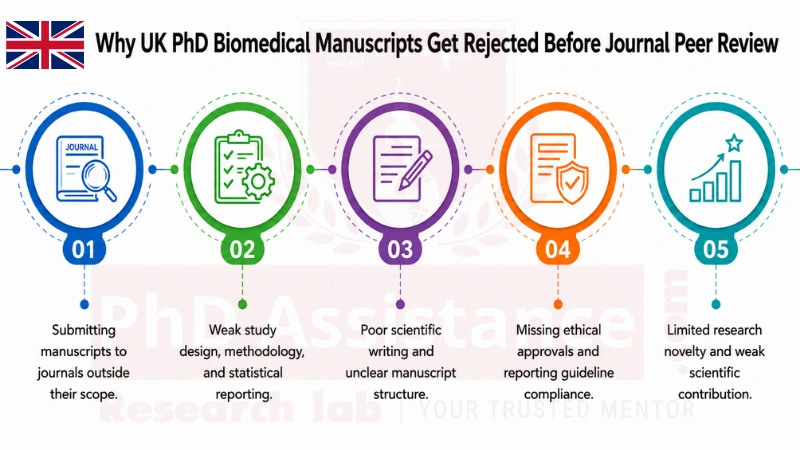
3. Poor Scientific Writing and Manuscript Structure
The authors of biomedical papers are required by editors to professionally and logically report their findings. Inadequate grammar, inconsistent terminology, and disorganisation can make it difficult to understand even the best research work. If a paper is poorly written, the editors will realise that the work needs more work before submission for peer review.
In a well-written manuscript, the introduction and the conclusion should have a logical sequence that makes it easier for the reader to grasp the research objectives, research methodologies, results, and implications. Effective editing and proofreading would ensure that there are no errors in language, making the manuscript more readable and leaving a better impression on the editors. Researchers often get support from structured expert assistance to improve their manuscript quality and ensure manuscript publication.
What research shows:
In addition, the European Association of Science Editors (EASE) points out that clear scientific writing is very important when it comes to evaluating the manuscript. Manuscripts that are structured well and have a good logical flow will help the editors evaluate the scientific content better. Good writing not only helps in making the content readable but also helps in getting it reviewed.
Tips:
- Use clear and concise scientific language.
- Maintain a logical structure across all sections.
- Ensure consistency in terminology and formatting.
- Proofread thoroughly before submission.
4. Ethical and Reporting Compliance Issues
Ethics and transparency play an extremely critical role in biomedical journals. During the initial stage of reviewing, the editors ascertain whether the authors have obtained the necessary ethical clearance, informed consent where necessary, and declared the source of their funding. Ethical clearance problems may indicate problems with the integrity of the study and may result in automatic rejection.
In addition to meeting the requirements of ethics, journals require the application of proper reporting guidelines relevant to the study design used by the authors. Incomplete reporting of research methodology, data on participants, or results obtained makes it harder for the editors to evaluate the validity and replicability of the results obtained. The demonstration of ethical and reporting integrity enhances the credibility of the manuscript for the peer review process.
What research shows:
According to the International Committee of Medical Journal Editors (ICMJE), ethical compliance needs to be considered during the editorial process by biomedical journals to protect the integrity of research and safeguard participants from potential harm. Some studies indicate that manuscripts that include complete ethical disclosures have higher chances of being peer-reviewed and published.
Tips:
- Include ethics committee approval details.
- Report informed consent procedures where applicable.
- Declare funding sources and conflicts of interest.
- Follow recognised reporting guidelines relevant to your study.
Explore the PhD Manuscript Writing Services in UK at PhD Assistance Research Lab to write a well-structured and journal-compliant manuscript for your biomedical researchers.
5. Limited Novelty and Scientific Contribution
Manuscripts that can contribute substantially to the existing pool of biomedical knowledge are the ones sought by the editors. Research studies that simply repeat what has already been known in terms of results, methodology, and practical applications do not make a good starting point for editorial evaluation. It is thus crucial to clearly show how the research fills in the knowledge gap that exists.
A successful manuscript will have to stress the uniqueness of the research and justify why the results are significant from the perspective of advancing biomedical knowledge and/or clinical practice.
Example: Nature Masterclasses says that originality and scientific importance continue to be among the two most important criteria for editorial assessment. There is a greater chance that the paper will be submitted for peer review if authors can explain their research problem and scientific importance.
Tips:
- Clearly identify the research gap your study addresses.
- Highlight the originality of your findings.
- Explain the scientific or clinical significance of the research.
- Compare your findings with recent literature to demonstrate their contribution.
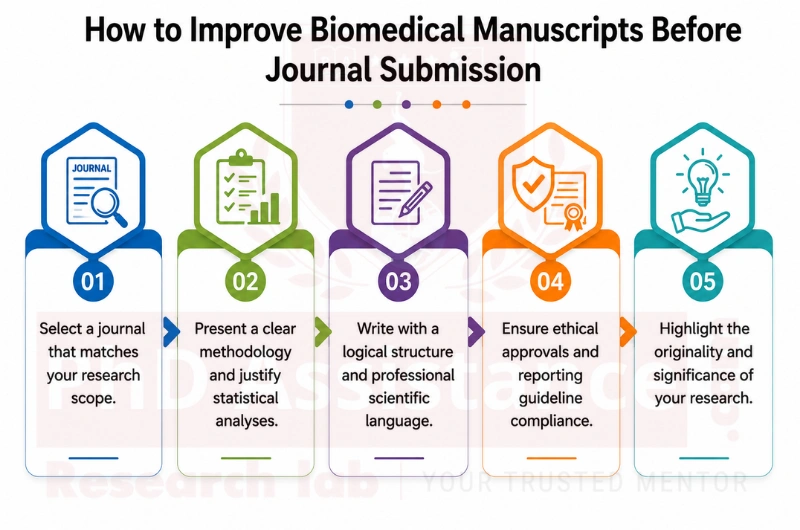
Strategies to Reduce Editorial Rejection of Biomedical Manuscripts
- Choose a journal that matches the focus and objectives of your study.
- Adhere to the writing rules of that journal.
- Describe your research method clearly and concisely.
- Use professional scientific language in your writing.
- Get all the necessary approvals for your study.
- Showcase the significance of your study results.
Conclusion
Before the peer review process, editorial rejection of the manuscript is an obstacle faced by many PhD biomedical researchers in the United Kingdom, but it is often avoidable. Elements such as wrong choice of journal, poor methodology, bad scientific writing, ethical concerns in reporting, and lack of research novelty are just some of the elements that keep a paper from going to the review stage.
With the knowledge about editorial requirements and implementation of best practices during preparation of their biomedicine research manuscripts, PhD students from the UK can substantially enhance the quality and suitability for publication of their manuscripts. Attention to such issues as methodological rigour, clarity, ethics, and scientific writing will help bring manuscripts in line with international publishing standards.
Concerned that your biomedical manuscript may not pass editorial screening? Our academic experts assist researchers in strengthening biomedical manuscript writing by improving the presentation of experimental and clinical findings and compliance with journal guidelines to enhance publication readiness.
Book a Free Expert Consultation and receive personalised PhD Manuscript Editing Services in UK for German biomedical research.
References
- European Association of Science Editors (EASE). (2023). EASE Guidelines for Authors and Translators of Scientific Articles. https://ease.org.uk/publications/author-guidelines-authors-and-translators/
- EQUATOR Network. (2024). Enhancing the Quality and Transparency of Health Research. https://www.equator-network.org/
- International Committee of Medical Journal Editors (ICMJE). (2024). Recommendations for the Conduct, Reporting, Editing, and Publication of Scholarly Work in Medical Journals. https://www.icmje.org/news-and-editorials/updated_recommendations_jan2024.html
- Nature Masterclasses. (2023). Writing and Publishing a Scientific Paper. https://www.springernature.com/gp/librarians/products/services/nature-masterclasses
- Powell, K. (2016). Does it take too long to publish research? Nature, 530, 148–151. https://pubmed.ncbi.nlm.nih.gov/26863966/
FAQs:
1. Why are biomedical manuscripts rejected before peer review?
Biomedical manuscripts are often rejected due to poor journal fit, methodological weaknesses, ethical compliance issues, weak scientific writing, or limited research novelty.
2. How can UK PhD researchers improve their manuscript acceptance rate?
Researchers can improve their chances by selecting the right journal, following submission guidelines, strengthening methodology, and presenting their findings clearly.
3. Why is manuscript structure important during editorial screening?
A well-structured manuscript improves clarity, helping editors assess the research efficiently and increasing the chances of peer review.
4. What role does ethical compliance play in biomedical publishing?
Ethical approval, informed consent, and conflict of interest disclosures are essential to demonstrate research integrity and meet journal requirements.
5. How can professional manuscript writing support help researchers?
Professional manuscript writing support helps improve scientific writing, manuscript structure, journal compliance, and overall publication readiness.
