
The source and why it matters
This review examines Fan et al. (2026), "Bridging the compliance gap: Effective and efficient detection of non-compliant behaviors in Android applications", an open-access article in Tsinghua Science and Technology (volume 31, issue 4). The authors work at the State Key Laboratory of Blockchain and Data Security at Zhejiang University and at partner research and industry organisations.
The paper tackles a practical problem. Data protection laws, among them the EU General Data Protection Regulation, California's consumer privacy law and China's Personal Information Protection Law, set rules for how apps handle personal data, and regulators and app stores must check vast numbers of apps against them. Earlier research showed that Android apps frequently request or use more privileges than they need (Felt et al., 2011) and that their code can contradict their own privacy policies (Slavin et al., 2016).
Developers are not always well placed to close this gap. Many cannot say what the third-party code bundled in their apps does, or what the law requires of them (Alomar, 2024). Automated detection therefore serves three audiences at once: regulators who enforce the rules, stores that police their catalogues, and developers who want to comply.
What the paper proposes
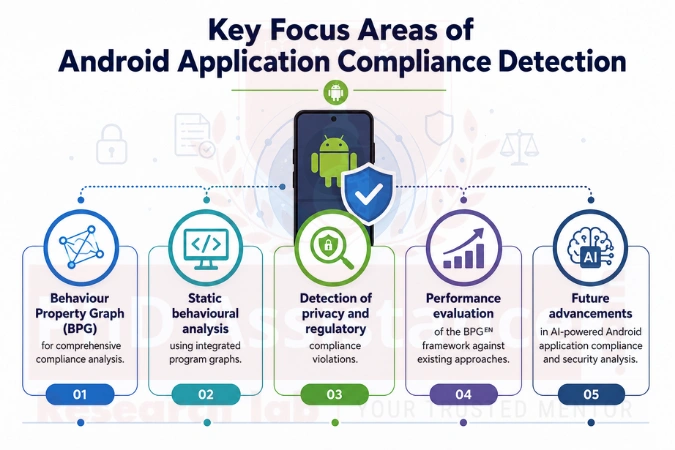
Fan and colleagues begin by naming two weaknesses in existing methods. Taint analysis asks the analyst to declare sources and sinks for every kind of violation, so each new question means another round of analysis. Dynamic monitoring watches an app as it runs, but it only sees the paths that happen to be exercised and so misses violations (Fan et al., 2026). To overcome both problems, the authors propose a new program representation, the Behaviour Property Graph (BPG), which folds features of five standard graph representations into a single structure.
| Representation | What it captures | Why it helps compliance checking |
|---|---|---|
| Abstract syntax tree (AST) | The syntactic structure of each statement and expression | Identifies the exact API calls and arguments involved |
| Control flow graph (CFG) | The order in which statements can execute within a method | Shows whether a check (for example, consent) happens before an action |
| Call graph (CG) | Which methods can call which | Links behaviour across methods and components |
| Program dependency graph (PDG) | Data and control dependencies between statements | Shows which values and conditions influence an action |
| Pointer assignment graph (PAG) | Which objects variables may refer to | Tracks data through object references |
Detection works by querying the BPG with behavioural patterns drawn from real-world apps. The authors implemented the idea in a prototype called BPGen and tested it on seven types of non-compliant behaviour across 200 real-world apps. BPGen found 14 violations in 13 apps that had not previously been reported as non-compliant, and the authors conclude that the tool detects compliance violations both efficiently and effectively (Fan et al., 2026).
Where the paper sits in the literature
BPGen joins a long line of analysis tools for Android. The table sets it beside well-known predecessors, describing each at the level its own authors use.
| Approach | Type of analysis | Main purpose | Known trade-off |
|---|---|---|---|
| TaintDroid (Enck et al., 2010) | Dynamic taint tracking on a modified platform | Real-time monitoring of privacy-sensitive data flows | Only sees paths exercised during execution |
| FlowDroid (Arzt et al., 2014) | Static taint analysis | Precise, lifecycle-aware detection of flows from sources to sinks | Sources and sinks must be specified |
| Amandroid (Wei et al., 2014) | Static inter-component data flow analysis | Security vetting across app components | Built around data flows rather than general behaviour |
| FlowCog (Pan et al., 2018) | Static flow analysis plus context semantics | Judging whether information flows are justified by app context | Depends on extracting meaningful context from the app |
| Slavin et al. (Slavin et al., 2016) | Policy-to-code mapping with static analysis | Detecting conflicts between privacy policies and code | Requires a mapping from policy phrases to API calls |
| BPGen (Fan et al., 2026) | Static analysis over a merged graph | Querying behaviour patterns for compliance violations | Depends on the quality and coverage of the patterns |
Other recent work pushes in a different direction. Yue et al. (2025) pair static analysis with large language models to detect, and explain, gaps between what apps actually do and what their interfaces lead users to expect, across 10,878 Google Play apps. Seen against this background, the distinctive move in BPGen is to let one representation answer many behavioural questions, rather than repeating a taint analysis for every pair of source and sink.
Strengths
- A sharply defined problem. The authors identify concrete shortcomings of taint analysis and dynamic monitoring and design the BPG to answer them.
- Built on proven foundations. Merging the AST, CFG, CG, PDG and PAG reuses well-understood program analysis instead of introducing an untested abstraction.
- Detection as querying. Because violations are expressed as patterns, new requirements can in principle be added without rebuilding the analysis, a useful property when regulations change.
- Findings in the wild. Uncovering violations in apps never before reported as non-compliant shows that the method can surface problems of practical importance.
- Open access. Free availability supports replication and makes the paper usable in teaching.
Limitations and methodological issues
What "effective" rests on
Fourteen new violations demonstrate that BPGen finds real problems, but they say little about its accuracy. For each behaviour type, a reader needs to know what share of reported violations were confirmed (precision) and what share of genuine violations were caught (recall), both measured against a ground truth assembled independently of the tool. Missed violations are the hardest to estimate and matter most for compliance, because a clean report is easily read as assurance. Security researchers have documented how evaluations of this kind can mislead, for instance through unrepresentative samples or labels that leak information from the method under test (Arp et al., 2022).
The ground truth question has become sharper since the paper was accepted. Two large 2024 studies found that the privacy disclosures developers publish on Google Play are often inconsistent or incomplete (Khandelwal et al., 2024; Arkalakis et al., 2024). Any benchmark that labels apps from what they declare, rather than from what their code or traffic shows, would therefore be unreliable.
Sample and patterns
Two hundred apps is a sensible scale for a prototype but small beside a modern app store. Readers should establish how the apps were selected, from which markets, and whether the behavioural patterns were derived from any of the apps later used for evaluation. Overlap of that kind would inflate performance on unseen apps. A held-out set, ideally drawn from another market or time period, would reveal how well the patterns generalise.
Newer measurement work adds a further reason for caution. When a dynamic study of almost 5,000 apps reports that 81% misrepresent their data practices (Arkalakis et al., 2024), a detector that flags 13 of 200 apps invites the question of whether its seven patterns cover enough behaviour. The two studies define non-compliance differently, so the figures are not directly comparable, but the contrast is worth raising when reading the paper.
Limits of static analysis
Static analysis sidesteps the coverage gap of dynamic monitoring yet has blind spots of its own. Behaviour introduced at run time, through dynamically loaded code, reflection or native libraries, is hard to model, and heavy obfuscation can defeat pattern matching. Recent evidence shows how common the first of these is: in an analysis of 38,344 apps, Bhan et al. (2025) found dynamic class loading in roughly half of them and reported that conventional tools are poorly equipped to handle such code. Static tools can also report paths that exist in the graph but never run. A clear statement of which of these cases BPGen handles would help readers judge where its findings hold.
From law to pattern
Every compliance detector carries an interpretation of the law. Requirements differ from one jurisdiction to another, and behaviour that is lawful under one regime may breach another. Readers should check which legal texts or standards underpin the seven behaviour types and whether legal expertise shaped their translation into patterns, since this decides where the findings carry weight.
Ethical and practical considerations
Because static analysis inspects an app without running it on real users' devices, it is less intrusive than live monitoring. Errors still have consequences. A false positive can burden a developer or prompt a store to remove a lawful app, while a false negative can leave a harmful app on sale. Since many developers do not know what the third-party libraries in their apps are doing (Alomar, 2024), findings are most useful when they point to the code path responsible, the approach that Yue et al. (2025) take. Reporting how newly found violations were disclosed to developers or stores is also good practice.
That suits the venue, yet compliance detection also concerns lawyers, regulators and product teams. One worked case, tracing a single violation through its code path to the requirement it breaches, would open the contribution to these readers and show how the output could be acted on.
What newer research adds (2024 to 2026)
Fan and colleagues submitted their paper in August 2024. Work published since then tests several of its assumptions. The table summarises seven studies, two of which are preprints and are marked as such.
| Study | Design and data | Key finding | What it means for the reviewed paper |
|---|---|---|---|
| Khandelwal et al. (2024) | Measurement of Google Play Data Safety sections for about 1.1 million apps, a longitudinal analysis and a developer study | Declared practices contain internal inconsistencies and both over- and under-reporting; developers were still adjusting their labels | Self-declared disclosures cannot serve as ground truth; detectors need to work from code or behaviour |
| Arkalakis et al. (2024) | Automated dynamic analysis of almost 5,000 apps compared with their Data Safety sections | 81% of apps misrepresented their data collection or sharing | Non-compliance is widespread; dynamic methods now scale and are a natural baseline for BPGen |
| Zhang et al. (2024) | PICOSCAN static analysis of 65 privacy-configurable SDKs and over 48,000 Google Play apps | Many apps misuse SDK privacy APIs, and wrapper SDKs often fail to pass privacy settings on | Compliance often hinges on how third-party SDKs are configured, which BPG patterns would need to model |
| Bhan et al. (2025) | Hybrid static and dynamic framework (DLCDroid) applied to 38,344 benign and malicious apps | Dynamic class loading is common, and conventional tools handle such code poorly | Reinforces the static-analysis blind spot; BPGen's handling of loaded code should be reported |
| Alecci et al. (2025) | Exploratory study of whether large language models can check GDPR compliance in Smali bytecode | Initial experiments suggest LLMs may help link legal requirements to code; methods still need development | Offers an alternative route for the law-to-pattern step that BPGen performs by hand |
| Zhang et al. (2025) (preprint) | CompliBench: six LLMs asked to locate and classify compliance violations in Android code under LGPD, PDPA and PIPEDA | Performance varied widely; the best overall consistency score was 0.3295 | LLMs are not yet a reliable replacement for structured analyses such as BPG |
| Amaral Cejas et al. (2024) (preprint) | Systematic review of 60 software engineering studies against 56 GDPR-related information types | Research concentrates on third-party sharing, consent and data collection; data subject rights receive little attention | BPGen's seven behaviour types should be mapped against such a model to show regulatory coverage |
Taken together, the newer studies confirm the premise of the paper. Non-compliance in Android apps is not a rare edge case: it appears at scale in self-reported labels (Khandelwal et al., 2024), in observed behaviour (Arkalakis et al., 2024) and in the way apps configure third-party SDKs (Zhang et al., 2024). The case for automated, code-level detection is therefore stronger now than when the paper was written.
The same studies also raise the bar for evaluation. The prevalence reported in dynamic measurement makes it harder to interpret 14 violations in 200 apps without recall figures, and the scale of dynamic class loading (Bhan et al., 2025) sharpens the question of what a purely static method can see. The dynamic approach that Fan and colleagues treat as limited by coverage has meanwhile been applied to thousands of apps, so a head-to-head comparison on shared apps would be informative.
Large language models are the most visible new direction. Early work suggests they could help translate legal text into checks on code (Alecci et al., 2025), but the first benchmark results are modest (Zhang et al., 2025). A plausible reading is that explicit program representations such as the BPG and language models will be complementary, with the graph supplying precise paths and the model helping to interpret requirements. Whether that combination improves accuracy remains an open question, as does how well any detector covers neglected obligations such as data subject rights (Amaral Cejas et al., 2024).
What it means for doctoral researchers
For anyone building or assessing a program analysis tool, the paper shows how to motivate a new representation and is a reminder of the evaluation evidence reviewers will expect. Community standards for empirical software engineering set out what such studies should report (Ralph et al., 2020). The newer literature adds two expectations: a ground truth that does not rely on developer declarations, and a comparison with at least one dynamic or LLM-based baseline. The worked plan below is illustrative.
- Define each behaviour type in writing, citing its legal source and giving one test case that violates it and one that does not.
- Assemble a labelled benchmark by manual analysis of code and traffic, kept apart from the apps used to write patterns, and do not use store labels as labels.
- Run the tool alongside baselines, for example a taint analysis configured for the same behaviours and a dynamic or LLM-based checker, on the same apps.
- Report precision and recall per behaviour type, run time per app, apps that failed to analyse and apps that load code dynamically.
- Apply the tool to a larger unlabelled sample, manually confirm a random subset of findings, and describe how new violations were disclosed.
| Element | What to report |
|---|---|
| Requirements | Legal source of each behaviour type and how it was translated into a pattern |
| Dataset | App sources, selection criteria, dates, versions and any overlap with pattern development |
| Ground truth | How violations were labelled, by whom, and agreement between labellers |
| Accuracy | Precision, recall and confusion counts per behaviour type, with baselines |
| Efficiency | Analysis time per app, failures and time-outs |
| Artefacts | Tool, patterns and benchmark released for replication where licences allow |
There is also a research gap here. Third-party SDK configuration (Zhang et al., 2024), dynamically loaded code (Bhan et al., 2025) and under-studied legal obligations (Amaral Cejas et al., 2024) are each places where current detectors are weakest, and each could anchor a doctoral contribution.
In a literature review, cite Fan et al. (2026) for the BPG representation and for its detection of previously unreported violations, and avoid attributing accuracy figures or a regulatory scope that the abstract does not state. Guidance on identifying research gaps and on fixing flawed methodology in cybersecurity research may help you position your own contribution.
Common mistakes when evaluating analysis tools
- Reporting only the number of new findings, with no precision or recall.
- Writing patterns from the same apps used for testing.
- Treating store privacy labels as ground truth.
- Comparing against baselines configured differently or run on different apps.
- Dropping apps the tool failed to analyse, which inflates apparent coverage.
- Leaving unstated which legal requirements the tool encodes and for which jurisdiction.
- Withholding the tool and benchmark, so that results cannot be reproduced.
Key takeaways
- Fan et al. (2026) merge five program representations into a Behaviour Property Graph and query it for non-compliant behaviour in Android apps.
- The method targets the repeated runs of taint analysis (Arzt et al., 2014) and the coverage gaps of dynamic monitoring (Enck et al., 2010).
- Finding 14 violations in 13 previously unreported apps shows practical value but is not, on its own, evidence of accuracy.
- Studies from 2024 show that non-compliance is widespread and that store labels are unreliable as ground truth (Khandelwal et al., 2024; Arkalakis et al., 2024).
- Strong evaluations report precision and recall against an independent ground truth, compare with dynamic or LLM-based baselines and avoid known pitfalls (Arp et al., 2022).
- Compliance tools embed an interpretation of the law, so the legal basis and jurisdiction must be stated.