Room-Temperature Superconducting Thin Films for Low-Loss Quantum Circuit Interconnects
Info: Room-Temperature Superconducting Thin Films for Low-Loss Quantum Circuit Interconnects Topics I phdassistance.com
Published: 29th July in Room-Temperature Superconducting Thin Films for Low-Loss Quantum Circuit Interconnects Topics I phdassistance.com
Share this:
Related Services
Our academic writing and marking services can help you
Introduction
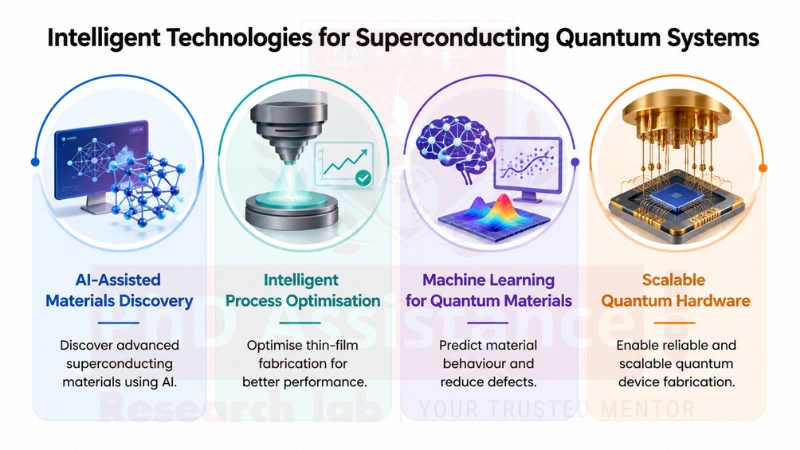
Superconducting quantum computing is revolutionizing next generation information processing by providing computational capability using high-coherence quantum devices. With recent advancements in superconducting thin film materials, artificial intelligence (AI) and intelligent process optimisation technology, there have been new possibilities in developing scalable quantum hardware with high performance and reliability. The use of AI for discovering Room-Temperature Superconducting Thin Films has gained increasing importance for accelerating thin film design, process optimisation, and performance of superconducting quantum materials. There are still many issues to be addressed when considering material property optimisation, fabrication defect reduction, microwave performance enhancement, and data-driven manufacturing processes for large-scale quantum hardware development. The current state of literature on the subject calls for an integrated approach combining artificial intelligence, material science, and process optimisation technology.
Proposed PhD Topic 1: Advanced Tantalum Thin-Film Engineering for High-Coherence Quantum Signal Transmission in Superconducting Computing Architectures
Background Context:
Superconducting quantum computing has proven to be among the top candidates in the race to design fault-tolerant quantum computers due to the impact of the material quality on the qubit coherence, signal fidelity, and reliability of the device. The material tantalum (Ta) has received much attention due to the remarkable high-temperature superconductivity properties of Ta, chemical stability, and minimal dielectric losses when compared to traditional superconductors. Van Schijndel et al. (2024) proved that cryogenic synthesis methods could be used to grow high-quality α-Ta thin films with low microwave losses and improved coherence properties for superconducting circuitry. While this research marks a huge step forward in the field of superconducting materials development, the process of synthesis is based on cryogenic deposition conditions that make it difficult to scale up and commercialise. Developing more sophisticated thin-film engineering techniques at room temperature that could deliver similar superconductivity properties of Ta could benefit the manufacturing process.
PhD-Level Verification:
Research in the area has predominantly concentrated on cryogenic techniques of depositing tantalum superconducting films. Nevertheless, there has been little research conducted on the possibility of forming such films using room temperature techniques where not only superconductivity, but crystal phase stability, microwave loss parameters, and film morphology are optimised at once.
Research Questions:
Contributions at the PhD-Level:
Suggested Readings:
van Schijndel, T. A. J., McFadden, A. P., Engel, A. N., Dong, J. T., Yáñez-Parreño, W. J., Parthasarathy, M., Simmonds, R. W., & Palmstrøm, C. J. (2024). Cryogenic growth of tantalum thin films for low-loss superconducting circuits.
Proposed PhD Topic 2: Self-Healing Gallium-Based Conductive Networks for Reconfigurable Inter-Chip Connectivity in Modular Quantum Computing Systems
Background Context:
Modular designs used for superconducting Quantum Computing Materials require stable and low-loss inter-chip interfaces to preserve coherence of the qubits and ensure efficient quantum information flow. Liquid metal superconducting interconnects are viewed as a promising replacement for traditional solid-state interconnects due to their flexibility, reconfigurability, and capability of accommodating cryogenic thermal expansion. Perin et al. (2025) proved that liquid gallium-based interconnects can serve as low-loss electrical paths between quantum devices with the possibility of modular superconducting circuit integration. Even though these results may be considered a breakthrough in the quantum packaging area, there are still some issues that should be addressed in future research, such as precise fabrication, operational reliability, electrical stability, and large-scale integration. The development of self-healing gallium-based conductive structures able to restore themselves during mechanical deformation and maintain their superconducting properties may help to solve these problems.
PhD-Level Verification:
Earlier literature has mostly shown the feasibility of superconducting liquid-metal interconnects for modular quantum circuits. Yet, no considerable effort has been put forward in terms of research on self-repairing architectures with good conductivity that can help maintain the electrical connectivity while limiting any interconnect wear and tear and allowing for sustained functioning in quantum information processing.
Research Questions:
PhD-Level Contributions:
Suggested Readings:
Perin, G., et al. (2025). Low-loss liquid metal interconnects for superconducting quantum circuits.
Proposed Dissertation topic 3: Interface Engineering of A15 Nb₃Al Superconductors for High-Temperature Quantum Device Integration and Microwave Performance Enhancement
Background Context:
The development of superconducting quantum technologies will need superconducting materials that can maintain very good superconducting properties, as well as scalable fabrication and operation of devices at high temperatures. Superconducting materials like A15 niobium aluminide (Nb₃Al) have garnered quite a bit of interest due to the high critical temperature and great electrical conductivity they provide, along with having desirable microwave properties. Takamura et al. (2025) were able to fabricate Nb₃Al films that possess desirable superconducting properties. However, there is still insufficient knowledge about how interface chemistry, thin film structure, and defect creation affect microwave loss and the reliability of the devices. Advanced interface engineering techniques can help greatly improve superconductor properties, reducing energy losses and aiding in the scalability of high-performance superconducting materials in quantum computers.
PhD Level Verification:
There have been significant successes in demonstrating superconductivity in Nb₃Al thin films; nevertheless, little research has been done concerning the effects of interface engineering on microwave loss, material stability, and reliability of such devices during operation. This provides a possibility to create a general framework of materials engineering for the incorporation of A15 superconductors in future quantum technologies.
Research Questions:
PhD-Level Contributions:
Suggested Readings:
Takamura, Y., et al. (2025). Nb₃Al superconducting thin films for quantum device applications.
Proposed Dissertation Topic 4: Scalable Niobium Air-Bridge Microstructures for High-Density Quantum Processor Routing and Crosstalk Suppression
Background Context:
As superconducting quantum computers become more complex, the need for small, lossless interconnect structures that allow for high-density circuit routing is becoming more relevant. Air-bridges made of niobium (Nb) are a very promising way to decrease wiring congestion, improve circuit integration, and maintain quantum coherence in large-scale superconductors. Hassel et al. (2025) found that niobium air bridges can serve as lossless elements in superconducting quantum hardware, providing better routing capabilities and fabrication tolerance. However, there are still issues with the optimisation of the bridge structure, fabrication repeatability, mechanical robustness, and electromagnetic properties that could help avoid crosstalk in highly integrated quantum processors. Improved niobium air-bridges with better physical and electrical properties would allow to improve routing capabilities and performance of superconducting quantum computing systems.
PhD-Level Verification:
Feasibility of niobium air bridges in superconducting quantum circuits has been proven through existing research, yet there has not been much analysis of the effect of microstructure optimisation, precision in manufacture, and geometry of the air bridge on electromagnetic interference and signal cross-talk in large quantum processors. This is a step towards developing scalable interconnects for quantum computing systems in the future.
Research Questions:
Contributions at the PhD-Level:
Suggested Readings:
Hassel, J., et al. (2025). Niobium Air Bridges as Low-Loss Components for Superconducting Quantum Hardware.
Proposed Dissertation Topic 5: Artificial Intelligence-Assisted Materials Discovery and Process Optimisation for Next-Generation Superconducting Quantum Hardware
Background Context:
Rapid progress in superconducting quantum computing technology has led to growing requirements for thin-film materials with a low defect density, minimal microwave losses, and reproducibility. Meeting such requirements is not an easy task since fluctuations in substrate treatment, contamination, deposition procedures, and quality of the interfaces may have a significant impact on the performance and stability of the devices. Brecht et al. (2025) showed that optimisation of the deposition of the niobium thin films and substrate preparation procedures can greatly help to decrease microwave losses and increase superconducting resonator performance. Although this work sheds light on the possibilities of the optimisation of fabrication procedures, existing techniques mostly include time-consuming experiments based on trial and error. Integration of artificial intelligence in the development of new materials can be helpful in predicting optimal fabrication parameters and uncovering connections between process and materials properties.
PhD-Level Verification:
Several previous studies have been able to enhance the performance of superconducting thin films by means of the optimisation of the process parameters. Few studies have investigated the use of artificial intelligence for modelling such complicated relationships among process, structure, and properties to make predictions about material performance and achieve automated optimisation of superconducting thin film fabrication processes.
Research Questions:
PhD-Level Contributions:
Suggested Readings:
Brecht, T., et al. (2025). Low-Loss Nb on Si Resonators: Surface Preparation and Fabrication Optimisation for Superconducting Quantum Circuits.
Need assistance finalising your dissertation topic? Selecting a strong, researchable topic can be challenging — but you don’t have to do it alone.
Our research consultants can help refine your ideas, identify literature gaps, and guide you toward a topic that aligns with current academic trends and your programme requirements.
Contact us to begin one-on-one topic development and refinement with PhdAssistance.com Research Lab.
Share this:
Cite this work
PhDAssistance. (n.d.). Cybersecurity in business Dissertation Topics Retrieved January 28th, from https://phdassistance.com/topic/cybersecurity-business/
Jalolova, M., and Musawwir, M. “Cybersecurity in business Dissertation Topics for PhD Scholars.” PhDAssistance, https://phdassistance.com/topic/cybersecurity-business/ Accessed 28th January 2026.
Jalolova, M., and Musawwir, M. “Cybersecurity in business Dissertation Topics for PhD Scholars.” PhDAssistance, PhDAssistance, Web. 28th January 2026.
Jalolova, M., and Musawwir, M., n.d. Cybersecurity in business Dissertation Topics for PhD scholars. [online] Available at: https://phdassistance.com/topic/cybersecurity-business/ [Accessed 28th January 2026].
Jalolova M., Musawwir M. Cybersecurity in business Dissertation Topics for PhD scholars [Internet]. PhDAssistance; [cited 2026 28th January]. Available from: https://phdassistance.com/topic/cybersecurity-business/
Jalolova, M., and Musawwir, M. (n.d.). Cybersecurity in business Dissertation Topics for PhD scholars. Retrieved 28th January 2026, from https://phdassistance.com/topic/cybersecurity-business/
Jalolova, M., and Musawwir, M., Cybersecurity in business Dissertation Topics (n.d.) https://phdassistance.com/topic/cybersecurity-business/ accessed 28th January 2026.
Study Resources
Free resources to assist you with your university studies!