
Quantum-Enhanced Cybersecurity Frameworks for Securing Next-Generation Aerospace Systems Dissertation Topics I phdassistance.com
Info:Quantum-Enhanced Cybersecurity Frameworks for Securing Next-Generation Aerospace Systems Dissertation Topics I phdassistance.com
Published: 22th june in Quantum-Enhanced Cybersecurity Frameworks for Securing Next-Generation Aerospace Systems Dissertation Topics I phdassistance.com
Share this:
Related Services
Our academic writing and marking services can help you
Introduction
Quantum computing is attracting substantial attention in aerospace engineering owing to its power to solve very difficult computational problems that are almost impossible for classical computing. Applications such as mission optimisation, autonomous navigation, aerospace cyber security, intelligent communication networks, and simulation for systems will make extensive use of quantum technology. Several research efforts have been done to report the increasing application potential of Quantum Computing in Aerospace Engineering to improve decisions, operations and systems performance in aircraft, space flight and UAV operations and some new findings. Despite promising prospects, there are few investigations dedicated to the successful integration of quantum computing into real-world aerospace operations and consider some issues such as scalability, implementation, policy, and readiness level. Increasing autonomous, connected and data-driven characteristics of aerospace systems require the development of holistic frameworks toward a comprehensive quantum computing integration approach into the future aerospace domain.
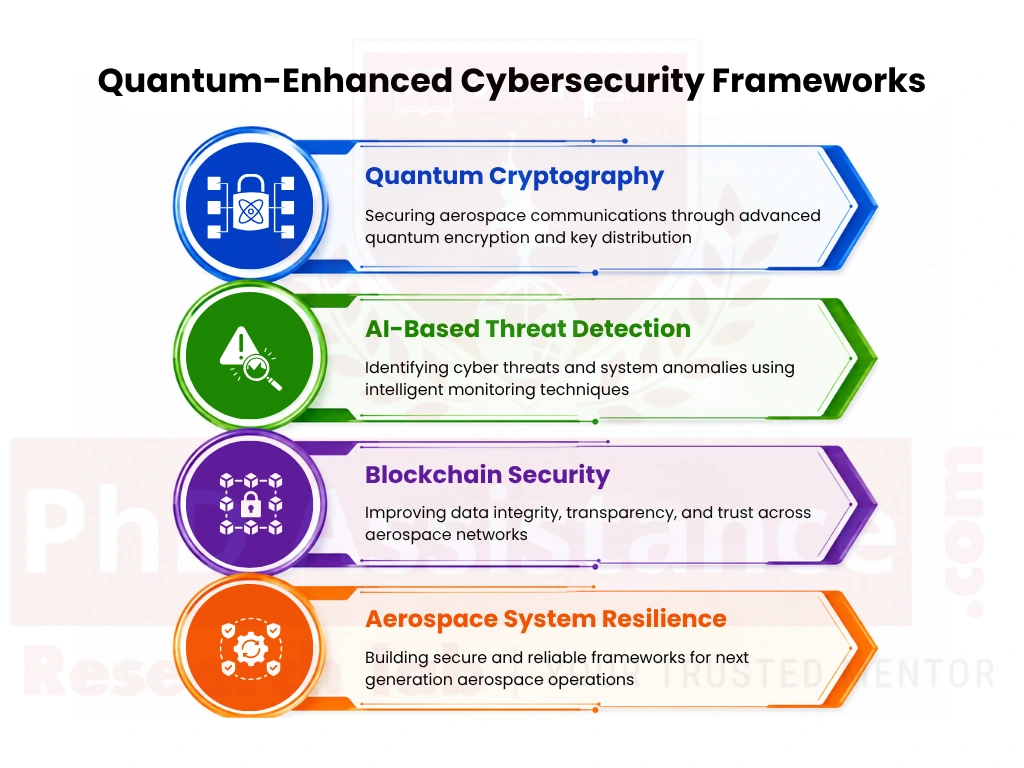
Proposed PhD Topic 1: Quantum-Enhanced Cybersecurity Frameworks for Securing Next-Generation Aerospace Systems
Background Context:
Modern aerospace operations are faced with numerous cybersecurity risks due to the growing use of satellites, UAVs and the interconnectedness of communications networks. In Bakyt et al. (2025), an integral security solution was suggested by integrating quantum cryptography, artificial intelligence-based anomaly detection and blockchain. Although effective in securing LEO communications, the research concentrated only on the implementation and did not consider issues such as future governance, scalability, and operational use within N-GAS. Moreover, the wide implementation of these sophisticated communication architectures further exacerbates the need for security frameworks, which are designed to tackle the next-generation aerospace settings. Little attention has been given to integrating these quantum-based security frameworks throughout these intricate aerospace architectures, balancing security, performance and operational survivability.
PhD-Level Verification:
Current research has focused on quantum cryptography, AI-based anomaly detection and blockchain security in isolation. There have, however, been only a few attempts to develop integrated cybersecurity architectures for Next-Generation Aerospace Systems. Furthermore, there is limited empirical evidence of how a quantum-enhanced security architecture may increase resilience in complex aerospace communication networks.
Research Questions:
PhD-Level Contributions:
Suggested Readings:
Bakyt et al. (2025). Advanced Cybersecurity Framework for LEO Aerospace: Integrating Quantum Cryptography, Artificial Intelligence Anomaly Detection, and Blockchain Technology.
Proposed PhD Topic 2: Quantum Decision-Support Frameworks for Autonomous Aerospace Navigation and Mission Optimisation
Background Context:
In space missions and satellite operations, as well as advanced mission control and automated missions, the utilisation of autonomous aerospace systems is now of great importance. As Andriola (2025) mentioned, the capabilities of quantum computing in future space missions include optimising trajectories, autonomous decision-making, resource allocation and adaptive machine learning, but the paper mainly concentrated on the theory and discussed practical problems on scale, error correction and operations in aerospace mission design. In space missions, there are now more complex problems, and optimisation with traditional methods cannot effectively handle so many dynamic variables. Yet there are few studies about the practical applications to integrate a quantum-assisted decision-support system into operational aerospace environments, which could enhance navigation accuracy, mission efficiency and autonomous capabilities.
PhD-Level Verification:
PhD-Level Verification:
In the present studies, quantum optimisation and autonomous operation have been addressed individually without any integration between quantum computing and autonomous aerospace application design. An obvious research gap exists concerning the design and verification of quantum-based decision support models for autonomous aerospace systems.
Research Questions:
PhD-Level Contributions:
Suggested Readings:
Andriola (2025). A Review of Quantum Computing for Space Exploration and Mars Colonisation.
Proposed Dissertation topic 3: Quantum Digital Twin Architectures for Advanced Aerospace Simulation and Predictive Engineering
Background Context:
The development of digital twins has had a major impact on aerospace engineering. This is due to the capabilities of real-time simulation, predictive analytics and the monitoring of systems through intelligent techniques. The advances that IBM has made in quantum computing and its diverse applications across multiple sectors were summarised by AbuGhanem (2025). These applications included optimisation, simulation and complex calculation modelling. This demonstrated that quantum processors are being increasingly developed but failed to mention their impact on aerospace digital twin applications. Due to the increasing quantity of data in an aerospace system, it is proving to be very difficult to computationally analyse the increasingly complex operational environments through simulation. It would seem appropriate, therefore, to study the application of quantum computing in advancing the simulation accuracy, predictive maintenance and engineering decision processes.
PhD Level Verification:
Quantum computing and aerospace simulations are two independent fields and exist; studies analysing those fields separately. Little research on applying quantum computing in aerospace digital twin systems for real-time simulation and predictive analysis has been carried out. The absence of a validated framework for quantum computing integration in aerospace digital twins is identified as a potential research opportunity at the doctoral level.
Research Questions:
PhD-Level Contributions:
Suggested Readings:
AbuGhanem (2025). IBM Quantum Computers: Evolution, Performance, and Future Directions.
Proposed Dissertation Topic 4: Adaptive Quantum Communication Frameworks for Intelligent UAV and Aviation Networks
Background Context:
Emergence of UAV communication, edge computing and cloud-enabled aviation systems further increases the need for secure and adaptive communication architecture. Shab and Alhosban (2025) have suggested an AI-powered quantum key management framework for UAV communication systems, where intelligent access control and adaptive encryption policies are employed. However, their work primarily dealt with communication security and did not emphasize on the system level integration and operational scalability. With the increase of autonomy and interconnectivity in aviation networks, there is a need for an adaptive communication framework enabling secure and intelligent aviation operations. Future research needs to study quantum-enabled communication frameworks to enhance their reliability, efficiency and resilience.
PhD-Level Verification:
PhD-Level Verification:
Previous studies focused only on machine learning applications or quantum computing development; few studied quantum machine learning frameworks used for aerospace health monitoring and predictive maintenance applications. The experimental validation for the techniques has not yet been explored.
Research Questions:
Contributions at the PhD-Level:
Suggested Readings:
AbuGhanem (2025). IBM Quantum Computers: Evolution, Performance, and Future Directions.
Proposed Dissertation Topic 5: Strategic Adoption and Innovation Frameworks for Quantum Computing Integration in Aerospace Engineering
Background Context:
The maturation of quantum computing technologies is anticipated to revolutionise industry due to the enabling capabilities, such as computational speed and problem-solving approaches. Aithal and Aithal (2025) presented on the future co-existence of quantum computing, artificial intelligence and singularity in terms of innovations that quantum computing may facilitate. However, this article only gave a theoretical development in terms of quantum-enabled technologies and did not describe how they may be adopted by sector. While integrating new technologies into the operational landscape, aerospace organisations require information concerning the factors of success at the organisational, strategic and technological level. Developing frameworks for adoption will enable organisations to foster innovations while overcoming implementation issues and enhancing organisational readiness.
PhD-Level Verification:
Most of the research on the adoption of Quantum Computing applications is focused on technology evolution. Few studies were conducted on organisational adoption, governance and implementation approaches to Quantum Computing Applications in Aerospace. Lack of a holistic framework for adoption represents a major research gap.
Research Questions:
PhD-Level Contributions:
Suggested Readings:
AbuGhanem (2025). IBM Quantum Computers: Evolution, Performance, and Future Directions.
Need assistance finalising your dissertation topic? Selecting a strong, researchable topic can be challenging — but you don’t have to do it alone.
Our research consultants can help refine your ideas, identify literature gaps, and guide you toward a topic that aligns with current academic trends and your programme requirements.
Contact us to begin one-on-one topic development and refinement with PhdAssistance.com Research Lab.
Share this:
Cite this work
PhDAssistance. (n.d.). Cybersecurity in business Dissertation Topics Retrieved January 28th, from https://www.phdassistance.com/topic/cybersecurity-business/
Jalolova, M., and Musawwir, M. “Cybersecurity in business Dissertation Topics for PhD Scholars.” PhDAssistance, https://www.phdassistance.com/topic/cybersecurity-business/ Accessed 28th January 2026.
Jalolova, M., and Musawwir, M., n.d. Cybersecurity in business Dissertation Topics for PhD scholars. [online] Available at: https://www.phdassistance.com/topic/cybersecurity-business/ [Accessed 28th January 2026].
Jalolova M., Musawwir M. Cybersecurity in business Dissertation Topics for PhD scholars [Internet]. PhDAssistance; [cited 2026 28th January]. Available from: https://www.phdassistance.com/topic/cybersecurity-business/
Jalolova, M., and Musawwir, M. (n.d.). Cybersecurity in business Dissertation Topics for PhD scholars. Retrieved 28th January 2026, from https://www.phdassistance.com/topic/cybersecurity-business/
Jalolova, M., and Musawwir, M., Cybersecurity in business Dissertation Topics (n.d.) https://www.phdassistance.com/topic/cybersecurity-business/ accessed 28th January 2026.
Study Resources
Free resources to assist you with your university studies!