
- / Title
Homomorphic Encryption in Zero-Trust Edge ComputingDissertationTitles | phdassistance.com
Info: Homomorphic Encryption in Zero-Trust Edge Computing DissertationTitles | phdassistance.com
Published: 11th June 2026 in Homomorphic Encryption in Zero-Trust Edge Computing DissertationTitles | phdassistance.com
Share this:
Related Services
Introduction
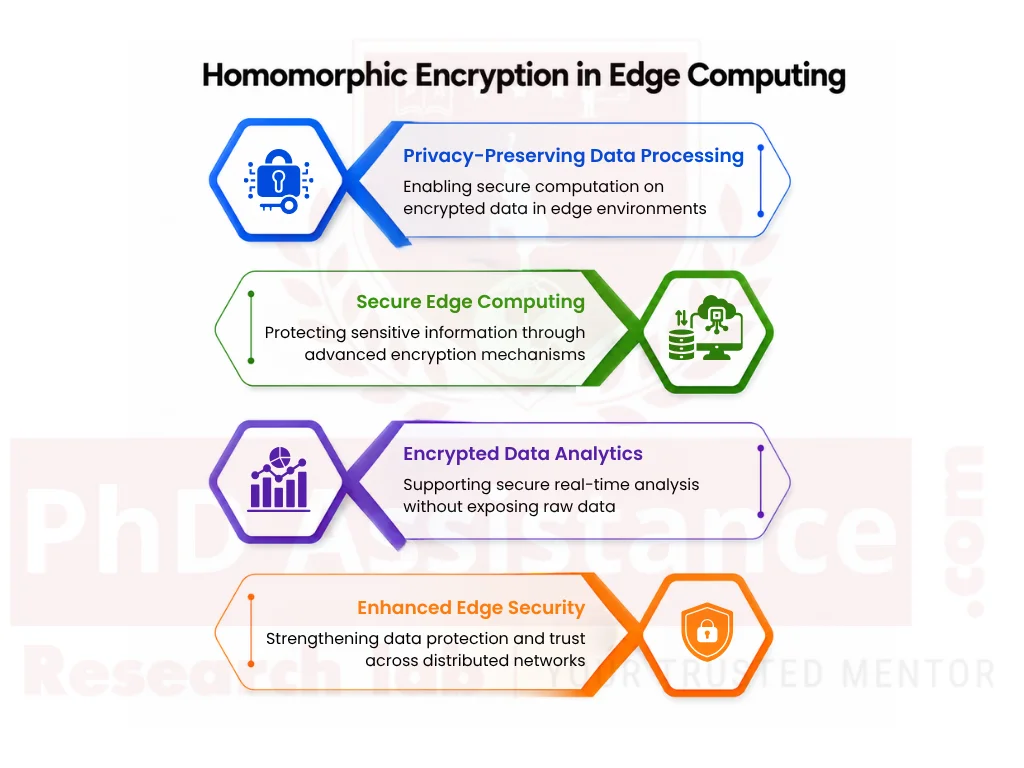
Edge computing has revolutionised the contemporary digital environment due to the exponential development of its technology. The implementation of edge computing has made it possible to process enormous volumes of data in real time and closer to data sources, thereby lessening its latency and enhancing efficiency. However, with the mounting quantity of sensitive information processed on these edge devices and applications, critical privacy and security issues are posed. Conventional edge computing approaches require data decryption to be performed, creating loopholes for security attacks and unauthorised access. Here, Homomorphic Encryption in Edge Computing acts as an efficient solution that enables secure processing on encrypted data without revealing the data. Advanced Encryption Framework will enable both computational integrity and data privacy and thereby augment security and enhance trust.
Proposed PhD Title 1: Hybrid Homomorphic Encryption and Federated Learning Framework for Privacy-Preserving Computation in Zero-Trust Edge Computing Environments
Edge computing is an area of rapidly growing technology that has drastically changed the way in which data are collected, analysed and processed on distributed systems. Despite the exponential rise of private sensitive data on IoT devices and edge nodes, there comes an unparalleled level of security, privacy and regulatory complexity. Advanced Encryption Framework is a promising cryptographic approach that enables Data Processing without access to the plaintext data, and Federated Learning supports federated model training by leaving data at the data source. Recently, Bollikonda (2025) designed a Federated Zero-Trust Analytics framework based on federated learning, differential privacy, and homomorphic encryption to achieve private analytics on the distributed cloud. This paper showed that privacy-preserving technologies can largely improve the security and trust of decentralized system and obtain comparable analytical performance. This represents promising directions for privacy computation and secure computing in Zero-Trust environments.
Problem Statement:
Current edge computing systems make extensive use of federated learning for preserving sensitive information, but there is a significant risk of data leakage during aggregation and communication stages. While HE enables privacy computation, the available schemes have high overhead and are not integrated into Zero-Trust edge systems. Consequently, most systems fail to achieve a balance between security, privacy and efficiency.
Research Gap:
Even with the adoption of FL and HE technologies, there has been very little research towards a unified architecture integrating these two technologies in the Zero-Trust framework for the real-time edge scenario. Most studies target cloud-based architectures and ignore the challenges of collaborative security, homomorphic aggregation of model updates, and scalable edge security in edge networks.
Research Question:
How can an integrated Advanced Encryption Framework and Federated Learning-based framework enhance Privacy-Preserving Computation, Secure Computing and Computing Security in Zero-Trust scenarios?
Outcome:
This study would produce a framework capable of encrypted model training and support Privacy Computation, data processing, and edge security in edge computing systems.
Reference:
Bollikonda, M. (2025). Federated Zero-Trust: Privacy-Preserving Analytics Across Multi-Cloud Environments.
Proposed PhD Title 2. Lightweight Homomorphic Encryption-Based Secure Edge Computing Architecture for Resource-Constrained IoT Devices under Zero-Trust Security
The widespread adoption of IoT devices and edge computing infrastructure has generated a growing demand for efficient and privacy-preserving data processing methods. Although the Advanced Encryption Framework is an effective way of achieving Privacy Computation in that operations can be conducted on encrypted data itself, its real-time implementation in the edge environment is hindered by high computational complexity and limited resources. In Rodrguez and Popescu (2025), it is recognised that AI privacy-preserving methods such as Advanced Encryption Framework help protect the sensitive data generated and processed within the cloud-edge ecosystem. However, it is stated in the work that current cryptographic techniques have overhead issues that hinder real-time application deployment. As IoT devices and edges grow, with the increased amount of sensitive data being handled and processed, there arises the demand for lightweight cryptographic methods to ensure Secure Edge Computing.
Problem Statement:
The encryption framework is computationally intensive, high-memory consuming, and time-consuming, making it difficult to use for many constrained edge devices. It leads to either organization being compromising on security and/or performance, exposing sensitive information.
Research Gap:
While the capability of the Encryption Framework in increasing privacy is evident, very little research has been conducted on lightweight encryption schemes designed specifically for edge computing platforms. Although research has addressed privacy protection in cloud settings, it does not cover efficient real-time data processing in IoT-based Zero Trust environments.
Research question:
Can the development of a lightweight Encryption Framework architecture contribute to enhancing the performance of Privacy Computation and Secure Computing in terms of computation load?
Result:
This research project is expected to deliver an efficient Encryption Framework that facilitates efficient Data Processing, improves Privacy, and secures Edge Computing without degrading resource-constrained devices’ performance.
Reference:
Rodríguez, A., & Popescu, E. (2025). Privacy-Preserving AI Models for Cloud and Edge Computing Security.
Proposed PhD Title 3. Hybrid CNN-Transformer Clinical Decision Support Systems for Early Detection of Neurodegenerative Disorders Using Multimodal Neuroimaging Data
The paradigm of Zero-Trust has revolutionised contemporary cybersecurity, paving the way for an era of continual validation and distributed security controls. Currently, blockchain has been implemented as an effective technology to manage distributed trust and facilitate identity verification and tamper-proof data sharing. Nie et al. (2025) presented a blockchain-based zero-trust access control system built upon decentralised identity management and encryption to enhance the security of IoT systems, highlighting the potential to enhance trust and access control significantly. While blockchain improves authentication and authorisation issues within a distributed environment, computation on sensitive data still presents an open research area. Using an Advanced Encryption Framework alongside blockchain technology could enable Privacy and Data Processing in an environment of distributed trust management in Secure Computing environments.
Problem Statement:
Currently, most Zero-Trust systems focus on identity and access management only offer rudimentary support for secure data processing. It is often required to decrypt the sensitive data before processing, raising risks to the privacy of the data and the possibility of data leakage.
Research Gap:
While Blockchain and Advanced Encryption Framework have been researched thoroughly individually, integrated frameworks enabling decentralised trust management coupled with privacy are not yet readily available. There has not been sufficient investigation into collaborative secure data processing, encrypted analytics and secure Computing within Zero-Trust edge ecosystems.
Research Question:
Will an encryption framework-enabled blockchain framework increase the efficacy of decentralised trust management, Privacy Computation and Secure Computing in a Zero-Trust environment?
Outcome:
The proposed research is expected to build a decentralised security infrastructure enabling secure encrypted computation, trusted data sharing and increased Edge Computing Security while keeping privacy and scalability intact.
Reference:
Nie, S., Ren, J., Wu, R., Han, P., Han, Z., & Wan, W. (2025). Zero-Trust Access Control Mechanism Based on Blockchain and Inner-Product Encryption in the Internet of Things in a 6G Environment.
Proposed PhD Title 4. Explainable Privacy-Preserving Threat Detection Using Homomorphic Encryption in Zero-Trust Edge Computing Networks
With sophisticated cyberattacks becoming commonplace in distributed edge environments, intelligent threat detection frameworks have seen an increase in adoption. The latest frameworks use machine learning, AI and others to detect malicious activities, bolstering cybersecurity in these architectures. Al-Sharafi et al. (2025) developed an attack detection model for strengthening Zero-Trust security on IoT devices using Federated learning. The authors also highlighted that the model preserves user privacy. Privacy-preserving machine learning models can achieve high attack detection rates without leaking sensitive user data. Many of these latest models depend on decrypted data during the security analysis process, thereby risking information exposure and privacy violations. This can be mitigated by employing an encryption framework, which will permit analysis on encrypted data, while explainable AI will assist the user in establishing trust in the decision made by the machine learning model. This will bolster Privacy Computation, Edge Security and Zero-Trust frameworks.
Problem Statement:
Existing frameworks for threat detection mandate decrypting the sensitive data before analysis, thus raising concerns of unauthorised disclosure or internal threat. Further, several AI-based security systems act as black boxes, thus not allowing administrators to justify or trust the security decisions.
Research Gap:
The existing literature is limited in integrating an encryption framework, Explainable AI and Privacy Computation, even with advancements in AI-based cybersecurity, and lacks transparency and encrypted analytics capability.
Research Question:
Could an adaptive HE framework offer better dynamic policy enforcement, PP computation, and secure Computing in a ZT network?
Outcome:
This study aims to create a risk-aware security framework performing Data Processing on policy enforcement, improving the PP computation and enhancing Edge Computing in a distributed edge system.
Reference:
Al-Sharafi, A. M., Alrayes, F. S., Alruwais, N., Maray, M., et al. (2025). Ensuring Zero Trust Security in Consumer Internet of Things Using Federated Learning-Based Attack Detection Model.
Proposed PhD Title 5. Adaptive Risk-Aware Homomorphic Encryption Framework for Dynamic Policy Enforcement in Zero-Trust Edge Computing
Zero-Trust architecture provides adaptive mechanisms for evaluating user behaviour and the trustworthiness of devices before allowing resource access. Since edge computing is expected to be a distributed system in the distant future, adaptive security mechanisms will be in high demand to protect sensitive data and provide better system performance. Koshiya (2025) has presented a data-centric Zero-Trust architecture for edge AI systems based on dynamically enforcing policies, attestation and micro-segmentation of resources to provide better security on a distributed system. While these methods help in controlling access and managing risk, protecting sensitive data during computation is a challenging issue. An encryption framework is a candidate to achieve privacy-preserving data processing with dynamic policy enforcement on secure computing.
Problem Statement:
Current mechanisms for enforcement of Zero-Trust policies use continuous monitoring and risk assessment but necessitate unencrypted plaintext of sensitive attributes, which may pose a privacy threat and vulnerability when evaluating and making policy enforcement decisions.
Research Gap:
The advances in security management by adaptive Zero-Trust systems have contributed significantly to the management of Zero-Trust security, yet there is very limited study on the incorporation of an encryption framework within risk-aware Zero-Trust policy enforcement architectures
Research Question:
Could an adaptive HE framework offer better dynamic policy enforcement, PP computation, and secure Computing in ZT networks?
Outcome:
This study aims to create a risk-aware security framework performing Encrypted Data Processing on policy enforcement, improving the PP computation and enhancing Computing Security in a distributed edge system.
Reference:
Koshiya, P. G. (2025). Data-Centric Zero-Trust Architecture for Edge AI Systems.
Need assistance finalising your dissertation topic? Selecting a strong, researchable topic can be challenging — but you don’t have to do it alone.
Our research consultants can help refine your ideas, identify literature gaps, and guide you toward a topic that aligns with current academic trends and your programme requirements.
Contact us to begin one-on-one topic development and refinement with PhdAssistance.com Research Lab.
Share this:
Cite this work
PhDAssistance. (n.d.). Virtual Influencers Dissertation Titles Retrieved 30th January 2026, from https://www.phdassistance.com/title/virtual-influencers/
“Virtual Influencers Dissertation Titles, https://www.phdassistance.com/title/virtual-influencers/
“Virtual Influencers Dissertation Titles” PhDAssistance, PhDAssistance, Tuesday, January 30th,2026.
PhDAssistance, n.d. Virtual Influencers Dissertation Titles[Online]. Available at: https://www.phdassistance.com/title/virtual-influencers/ [Accessed January 30th, 2026].
PhDAssistance. Virtual Influencers Dissertation Titles[Internet]. PhDAssistance; [cited 2026 January 30th]. Available from: https://www.phdassistance.com/title/virtual-influencers/
PhDAssistance (n.d.).
Virtual Influencers Dissertation Titles. Retrieved January 30th, 2026, from https://www.phdassistance.com/title/virtual-influencers/
PhDAssistance, Virtual Influencers Dissertation Titles(PhDAssistance, n.d. January 30th accessed 2026.
Study Resources
Free resources to assist you with your university studies!