
Bias Mitigation Techniques in Responsible AI and Predictive Data Systems Dissertation Topics I phdassistance.com
Info: Bias Mitigation Techniques in Responsible AI and Predictive Data Systems Dissertation Topics I phdassistance.com
Published: 09th june in Bias Mitigation Techniques in Responsible AI and Predictive Data Systems Dissertation Topics I phdassistance.com
Share this:
Related Services
Our academic writing and marking services can help you
Introduction
The application of AI and predictive data systems has a significant impact across industries such as healthcare, finance, recruitment, education and public services. Among others, helping organisations gain efficiency in many ways and enhance decision-making based on data. In fact, their swift introduction has led to serious concerns about their potential for algorithmic bias, as well as transparency, fairness and accountability. For instance, biased data sets and/or design choices in models may generate discrimination, affecting people’s trust towards AI-based systems. It is this context that is raising the stakes for the increasing demand for AI Bias Mitigation Services that will address identification, detection, monitoring and reduction of bias at all stages of AI systems’ lifecycle. Despite recent rapid growth in AI fairness, governance and explainability, how the application of a comprehensive bias mitigation system affects the reliability and accountability of predictive data systems has been the subject of little research.
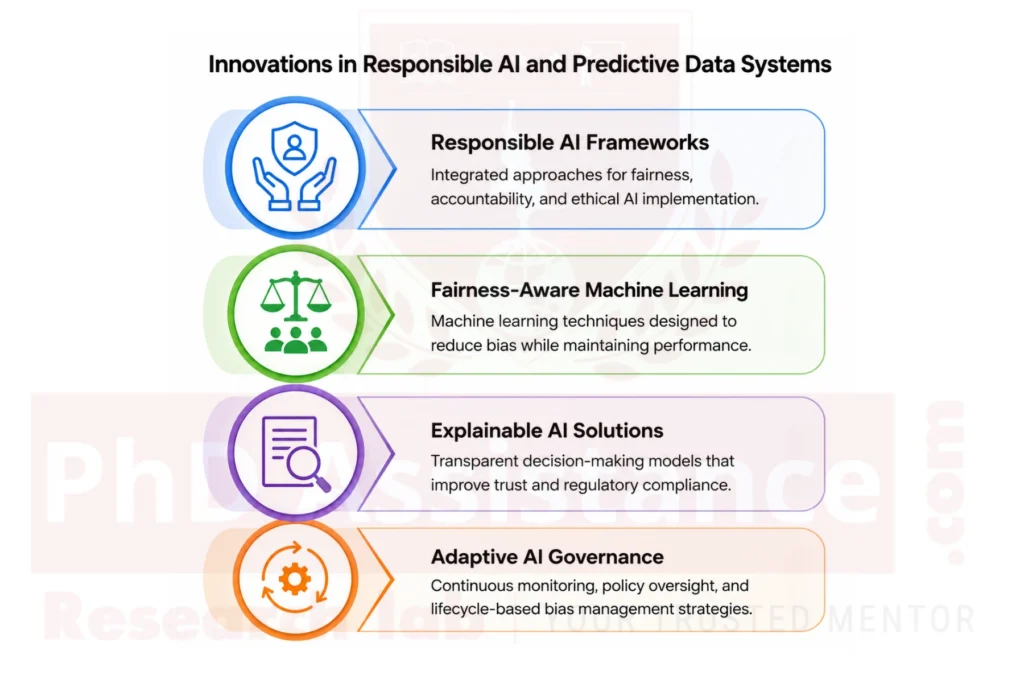
Proposed PhD Topic 1: An Integrated Responsible AI Framework for Bias Mitigation in Predictive Data Systems
Background Context:
AI and predictive analytics are transforming decision-making processes in health care, finance, recruitment, education and the public sector. The application of such techniques enables organisations to glean vast amounts of data from big data and achieve greater efficiency. At the same time, “Bias in Predictive Data Systems” is also of increasing concern due to biased data sets, decision design of algorithms, and non-representative populations. Bahangulu & Owusu-Berko (2025) noted that algorithmic bias is a significant obstacle for fair, transparent, and regulatory-compliant use of AI analytics in practice. Khan (2025) highlights the importance of the principle of governability, explainability and accountability in Responsible AI. Several techniques have been suggested to mitigate AI bias. However, these are generally considered as standalone systems that do not help in achieving a great effect. Therefore, there is a need for a single system where all the biases are tackled effectively for Responsible AI and at the same time trustworthiness, explainability and fairness of the decisions can be ensured.
PhD-Level Verification:
Current work by Bahangulu & Owusu-Berko (2025) and Khan (2025) analyses algorithmic fairness, governance, explainability and bias mitigation in a piecemeal way. Limited work has been conducted to investigate the possibility of providing a coherent framework that could realise sustainable Responsible AI Bias Reduction in prediction systems. Limited validation has been done for such an integrated framework, hence suggesting it as a worthy area of doctoral research.
Research Questions:
PhD-Level Contributions:
- Development of an Integrated Responsible AI Bias Mitigation Framework.
- Creation of lifecycle-based fairness assessment models.
- Policy and governance recommendations for ethical predictive analytics deployment.
Suggested Readings:
Theodorakopoulos et al. (2025). Cognitive Bias Mitigation in Executive Decision-Making: A Data-Driven Approach Integrating Big Data Analytics, AI, and Explainable Systems.
Proposed PhD Topic 2: Explainable AI and Fairness-Aware Machine Learning for Responsible Bias Reduction in Automated Decision Systems
Background Context:
In various domains like finance, healthcare, hiring, insurance, and public administration, the adoption of Automated Decision Systems (ADSs) is being encouraged for efficiency and decision accuracy. Nevertheless, issues related to Fair Artificial Intelligence (Fair AI) continue to persist on account of the non-transparent nature of the algorithms, unfair training data, and discriminatory output. As per Khan (2025), there exist three pillars- explainability, transparency, and accountability which serve as essentials of ethical and accountable deployment of AI. Simultaneously, machine learning methods that ensure fairness have also been proposed, which further encourage and empower AI Bias Reduction. Although many efforts and advancements have been made, balancing between fairness and predictive performance while maintaining the interpretability of models is a difficult task for many organisations. Consequently, there is a growing demand for integrated approaches that enhance trustworthiness, accountability and decision-making through both explainable AI and adequate AI Bias Mitigation Techniques.
PhD-Level Verification:
The existing literature tends to study explainable AI and fairness-aware ML in different contexts; we have little empirical evidence of how explainability directly benefits Bias Mitigation in Responsible AI systems and enhances fairness outcomes. There is a considerable research opportunity to combine the two in a framework during doctoral studies.
Research Questions:
PhD-Level Contributions:
Suggested Readings:
Khan, N. (2025). Ensuring Ethical and Responsible Use of Artificial Intelligence.
Proposed Dissertation topic 3: Governance-Driven AI Bias Mitigation Techniques for Ethical Business Analytics and Predictive Decision-Making
Background Context:
AI has increasingly been leveraged in business analytics and applied to business problems such as customer profiling, recruitment, credit scoring, fraud detection and risk evaluation. Despite its extensive operational and strategic benefits, issues of algorithmic bias, ethical compliance and accountability hinder widespread implementation. Bahangulu and Owusu-Berko (2025) suggest that fairness, transparency and regulation are key in effective deployment of AI in a business context. Despite being offered as AI Bias Mitigation Techniques, the present ones are isolated from corporate governance and policy. With increasing regulations, there needs to be a governance-oriented approach to address technical bias mitigation and embed the efforts into corporate ethics and supervision to enhance Fair AI and foster stakeholder confidence.
PhD Level Verification:
Most current research either addresses AI governance or AI technical bias reduction in isolation. However, there is insufficient research regarding how governance processes can proactively assist AI Bias Reduction across the AI lifecycle. The absence of an integrated governance model and its empirical validation is an important doctoral research gap.
Research Questions:
- How can governance frameworks facilitate bias mitigation in AI systems?
- Which governance mechanism is most efficient for reducing bias in Predictive Data?
- What are the effects of regulatory compliance on fairness results in AI-based business analytics?
PhD-Level Contributions:
Suggested Readings:
Bahangulu & Owusu-Berko (2025). Algorithmic Bias, Data Ethics, and Governance: Ensuring Fairness, Transparency and Compliance in AI-Powered Business Analytics Applications.
Proposed Dissertation Topic 4: Lifecycle-Based Bias Detection and Mitigation Frameworks for Fairness in AI Systems
Background Context:
For high-stakes decision-making and increased adoption of AI, issues of fairness and responsibility appear at different places in the lifecycle of the AI – data gathering, feature selection, training, deployment, and ultimately, the AI lifecycle itself. To combat this bias, Kamatala et al. (2025) say we require a holistic approach covering data pre-processing, fairness-aware algorithms, fairness metrics, and ethical AI deployment. While there are numerous AI Bias Mitigation Techniques available, such as adversarial debiasing, and fairness constraints, most methods operate in a disconnected manner. This disconnect between techniques is the most important reason for maintaining the continued effectiveness of achieving and sustaining Fairness in AI Systems. Therefore, AI bias detection, monitoring, and mitigation need to be life-cycle-based.
PhD-Level Verification:
Research often looks at sustainability, blockchain, and decentralised finance separately, not together under one governance framework. There aren’t many studies on how a Blockchain Regulatory Framework could help with Asset Governance while keeping both innovative and compliant goals in mind. Since no model balances financial, environmental, and regulatory work, there’s a big chance for further PhD research in this area.
Research Questions:
Contributions at the PhD-Level:
Suggested Readings:
Kamatala et al. (2025). Mitigating Bias in AI: A Framework for Ethical and Fair Machine Learning Models.
Proposed Dissertation Topic 5: Adaptive Fairness Governance for Responsible AI in High-Stakes Predictive Systems
Background Context:
Increasingly, AI systems are being integrated into high-impact sectors-such as autonomous transportation, health care, financial services, criminal justice, and public services-in which algorithmically driven decision-making could result in extensive social and economic impacts. Tiwari and Farag (2025) observe that despite considerable development in Responsible AI approaches, many of them adopt a static evaluation framework which may not sufficiently tackle dynamically shifting fairness concerns. New types of Bias in Predictive Data may also emerge as predictive systems continually adapt to new environments with shifting data over time. Consequently, there will be an increasing requirement for governance methods that allow continuous Bias Mitigation in AI. These efforts can be used to maintain fairness, increase responsibility and foster public confidence in high-stakes AI applications.
PhD-Level Verification:
The existing frameworks for responsible AI largely concentrate on a static approach to governance and an ongoing process of fairness checks at predefined intervals, whereas there is very little research being done on adaptive models for governance, which are capable of detecting and mitigating new bias risks on the fly in predictive systems. The research space is, therefore, a promising area for a PhD study of dynamic fairness models of governance.
Research Questions:
PhD-Level Contributions:
Suggested Readings:
Tiwari & Farag (2025). Responsible AI Framework for Autonomous Vehicles: Addressing Bias and Fairness Risks.
Need assistance finalising your dissertation topic? Selecting a strong, researchable topic can be challenging — but you don’t have to do it alone.
Our research consultants can help refine your ideas, identify literature gaps, and guide you toward a topic that aligns with current academic trends and your programme requirements.
Contact us to begin one-on-one topic development and refinement with PhdAssistance.com Research Lab.
Share this:
Cite this work
PhDAssistance. (n.d.). Cybersecurity in business Dissertation Topics Retrieved January 28th, from https://www.phdassistance.com/topic/cybersecurity-business/
Jalolova, M., and Musawwir, M. “Cybersecurity in business Dissertation Topics for PhD Scholars.” PhDAssistance, https://www.phdassistance.com/topic/cybersecurity-business/ Accessed 28th January 2026.
Jalolova, M., and Musawwir, M., n.d. Cybersecurity in business Dissertation Topics for PhD scholars. [online] Available at: https://www.phdassistance.com/topic/cybersecurity-business/ [Accessed 28th January 2026].
Jalolova M., Musawwir M. Cybersecurity in business Dissertation Topics for PhD scholars [Internet]. PhDAssistance; [cited 2026 28th January]. Available from: https://www.phdassistance.com/topic/cybersecurity-business/
Jalolova, M., and Musawwir, M. (n.d.). Cybersecurity in business Dissertation Topics for PhD scholars. Retrieved 28th January 2026, from https://www.phdassistance.com/topic/cybersecurity-business/
Jalolova, M., and Musawwir, M., Cybersecurity in business Dissertation Topics (n.d.) https://www.phdassistance.com/topic/cybersecurity-business/ accessed 28th January 2026.
Study Resources
Free resources to assist you with your university studies!