
Why topic choice is different in the life sciences
The general logic of choosing a doctoral topic, narrowing an area into a problem, typing the gap and testing feasibility, is covered in How to choose a PhD topic. This article concentrates on what makes the decision distinctive in biology and the life sciences.
Three features stand out. First, experiments are slow and expensive: breeding lines, culturing cells, collecting field samples or recruiting patients can take months before the first usable data. Second, many topics depend on a small number of influential findings, and if those do not hold, the project falters. Third, access to organisms, tissues, genetic resources and specialised equipment is often controlled by others. A topic that ignores any of these can look excellent on paper and still fail.
Alon (2009) argues that choosing a problem is one of the most important and least taught skills in science, and suggests judging candidate problems on two axes: how feasible they are and how interesting the answer would be. For a first project he recommends problems that are relatively easy and still of real interest, because early progress builds the skills and confidence needed for harder questions.
Four qualities of a good life-science topic
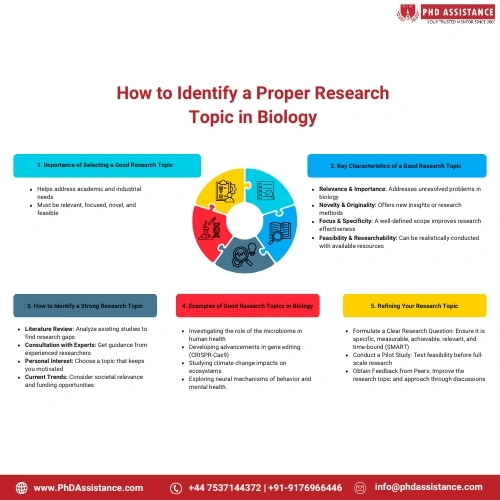
Relevance
A relevant topic addresses an unresolved problem that matters to the field, to health, to agriculture or to the environment. Marine biology offers a clear case: rising carbon dioxide and climate change alter temperature, circulation, stratification, oxygen and acidity, with consequences for populations and community structure (Doney et al., 2012). Each of those drivers opens specific, answerable questions about particular species, regions and processes.
Novelty
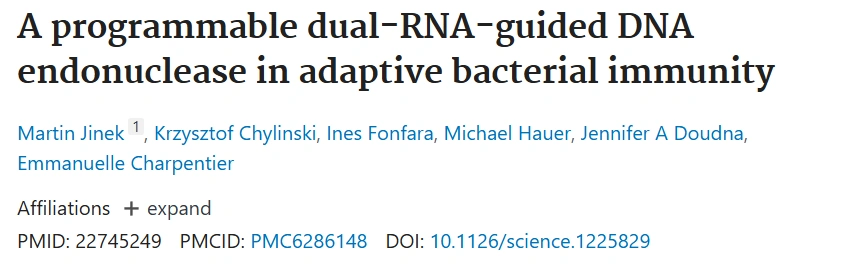
Novel topics ask something that has not been answered, or ask it in a new system or with a new method. New tools create such openings: the demonstration that Cas9 is a programmable, dual-RNA-guided DNA endonuclease (Jinek et al., 2012) made targeted genome editing practical in many organisms (Doudna & Charpentier, 2014). A technique alone is not a topic, though; the novelty lies in the biological question the tool lets you answer.
Focus
A focused topic is narrow enough to be investigated in depth within the doctorate. "Cancer" is a field; "microRNAs in cancer" is still an area, since microRNAs influence many stress and disease pathways (Mendell & Olson, 2012). A doctoral-sized question names a molecule, a mechanism and a model, as in the work linking microRNA-10b, via HOXD10 and RHOC, to invasion and metastasis in breast cancer models (Ma et al., 2007).
Feasibility
A feasible topic can be completed with the organisms, samples, data, equipment, skills and time available. In biology this includes statistical power: small samples reduce the chance of detecting a true effect and increase the chance that a significant result is false or exaggerated (Button et al., 2013). If the sample size a question needs cannot be reached, the question needs to change.
Choosing the system
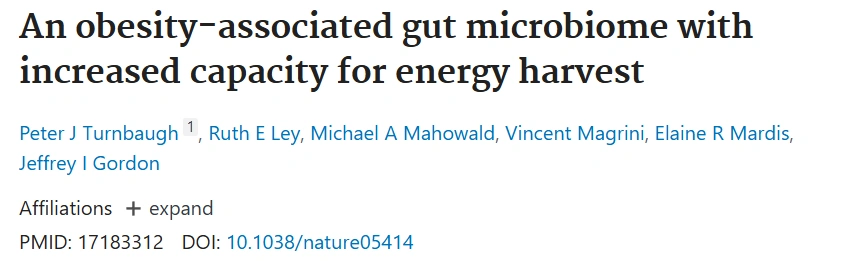
Feasibility in biology also depends on the system in which the question is asked. Cell lines are quick and cheap but may not behave like tissues; model organisms such as yeast, worms, flies, zebrafish and mice offer genetic tools and controlled conditions but differ from humans; human cohorts answer human questions directly but are slow, costly and constrained by consent and ethics review; field studies capture natural variation but depend on seasons, sites and permits. The mouse experiments of Turnbaugh et al. (2006) could transfer a microbiome into germ-free animals, something no human study could do, but the price was uncertainty about how far the result applied to people.
A useful exercise is to write down, for each candidate topic, the system you would use, the main technique, the number of independent biological replicates you would need, how long one experimental cycle takes, and who in your group already uses that system. If the answers reveal that one cycle takes six months and nobody nearby has done it before, the topic may still be right, but the plan needs a simpler first chapter that can produce data while the harder work develops.
Check that the foundations are solid
Before building a doctorate on a finding, check whether others have confirmed it. When scientists at a biotechnology company tried to confirm 53 landmark preclinical cancer studies, they reported that the findings were confirmed in only 6 cases (Begley & Ellis, 2012). The figure comes from one company's internal attempts, but it shows why a single striking paper is a risky foundation.
Both headline examples illustrate the point. Turnbaugh et al. (2006) showed in mice that an obesity-associated gut microbiome had a greater capacity to harvest energy and that the trait could be transferred to germ-free mice. Yet a later analysis of large human datasets, including the Human Microbiome Project and MetaHIT, found no simple taxonomic signature of obesity, with differences between studies exceeding differences between lean and obese people (Finucane et al., 2014). Similarly, the miR-10b association with metastasis (Ma et al., 2007) was not found in a cohort of 219 breast cancer patients (Gee et al., 2008).
Neither case makes the topic a bad one. Both show that contested findings can be excellent doctoral topics if the project is designed to resolve the disagreement, for example by testing the conditions under which an effect appears, rather than assuming the original result.
- Search for citing papers that replicate, extend or contradict the key finding.
- Note the model system, sample size and methods of the original and of later studies.
- Ask your supervisor whether the result has been reproduced in your own laboratory.
- Where findings conflict, consider making the conflict itself your question.
Where life-science topics come from
Most good topics come from reading, conversation and data rather than inspiration. Recent reviews map a field and usually end with open questions; Mendell and Olson (2012), for instance, organises microRNA biology around stress responses and disease, which points to many unexplored pathways. Supervisors and senior laboratory members know which questions are tractable with the group's models and equipment. Seminars, conferences and funders' calls show which problems are attracting attention.
Public data resources are another source, especially for computational topics. Wright et al. (2025) evaluated 45 human molecular interaction networks and found that large composite networks performed best for identifying disease genes, while smaller curated networks were better at predicting new interactions. They also found that coverage in experimental networks was strongly correlated with how often a gene had been cited, a bias towards well-studied genes. That finding is itself a source of topics: poorly studied genes and functions are under-represented and may repay attention.
Personal interest matters too. A doctorate lasts years and includes failed experiments; a question you care about makes that easier to sustain. Interest, however, should follow the feasibility check, not replace it.
Three example topics, examined
Here are three examples of strong biological research. Each is a published landmark rather than a doctoral topic, so the table suggests how a doctoral-sized follow-on question might look and what to check first. The follow-on questions are illustrative.

| Landmark | Illustrative doctoral question | Check before committing |
|---|---|---|
| Obesity-associated microbiome in mice (Turnbaugh et al., 2006) | Does a defined dietary change alter the energy-harvesting functions of the gut microbiome in a specified human cohort? | Conflicting human evidence (Finucane et al., 2014); access to samples; sequencing budget; power |
| Cas9 as a programmable endonuclease (Jinek et al., 2012) | Can targeted knockout of a candidate gene confirm its role in a defined trait in a tractable organism? | Transformation protocols for the organism; off-target assessment; biosafety approval |
| Evaluation of interaction networks (Wright et al., 2025) | Do network-based predictions recover known disease genes for an under-studied disorder, and which predictions survive experimental testing? | Citation bias in networks; availability of validation data; computing skills |
Refine and test the topic
Once a candidate topic survives the checks above, sharpen it. The SMART test is a useful discipline for objectives. In its original form, Doran (1981) asked for objectives that are specific, measurable, assignable, realistic and time-related; later versions usually read "achievable" and "relevant". The FINER criteria (Hulley et al., 2013) add a check on novelty and ethics.
A pilot study is often the best test of feasibility. Thabane et al. (2010) describe pilot studies as a way to assess the processes, resources, management and scientific aspects of a planned study, such as recruitment, protocol adherence, equipment and the variability needed for a sample size calculation, rather than to test the main hypothesis.
Check access and permissions early. Work with animals, human samples or genetically modified organisms needs institutional approvals. Work with genetic resources from another country may fall under the Nagoya Protocol, which makes access subject to the prior informed consent of the providing country, unless it decides otherwise, and to mutually agreed terms, while encouraging simplified access for non-commercial research (Secretariat of the Convention on Biological Diversity, 2011). Permits and agreements can take months, so they belong in the topic decision, not after it.
- Write the question in one sentence that names the organism or system, the mechanism and the outcome.
- List the two or three findings it depends on and check whether they have been replicated.
- Estimate the sample size needed and confirm that it is achievable.
- Confirm access to organisms, samples, data and equipment, and the approvals each requires.
- Run a small pilot of the most uncertain step.
- Agree the question and the fallback plan with your supervisor.
Common mistakes
- Choosing a topic because of a fashionable technique without a clear biological question.
- Building the whole project on one unreplicated result.
- Planning experiments without a power calculation.
- Assuming access to tissue, patient samples, field sites or foreign genetic resources.
- Treating a result in a model organism as if it settled the human question.
- Leaving pilot work until after the proposal is approved.
Key takeaways
- Judge candidate problems on both feasibility and the interest of the answer, and start with one that allows early progress (Alon, 2009).
- Check whether the findings your topic depends on have been replicated, since some landmark results are not (Begley & Ellis, 2012; Gee et al., 2008).
- Statistical power is part of feasibility: an underpowered study cannot answer its question reliably (Button et al., 2013).
- Public data resources can suggest topics, including under-studied genes that current networks under-represent (Wright et al., 2025).
- Pilot work and early checks on approvals and access to genetic resources protect the topic before you commit (Thabane et al., 2010; Secretariat of the Convention on Biological Diversity, 2011).