
The paper under review
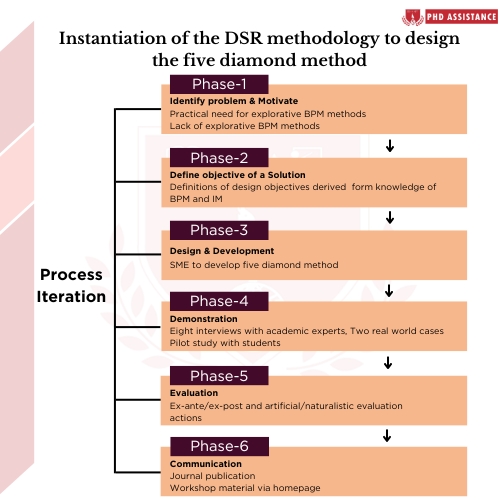
This review examines Grisold et al. (2022), "The Five Diamond Method for explorative business process management", published in Business & Information Systems Engineering, volume 64, issue 2, pages 149 to 166. Its seven authors are established researchers in business process management (BPM) and information systems. The paper is a design science study: it builds a method, an artefact in design science terms, and evaluates it (Hevner et al., 2004).
What the paper argues and builds
The problem: exploration in BPM
BPM has traditionally been exploitative: it documents, analyses and improves existing processes for efficiency and quality. The authors argue that this is no longer enough, because changing customer needs and digital technologies can make a process's value proposition obsolete however efficiently it runs. Explorative BPM aims to create new processes with new value propositions, and organisations that can do both are described as ambidextrous. The authors note that research on explorative BPM had been mostly conceptual, with little guidance on how to do it (Grisold et al., 2022). The argument connects with work on dynamic capabilities, which treats sensing and seizing new opportunities as a source of competitive advantage (Teece, 2007), and with research on digital transformation (Vial, 2019).
The method
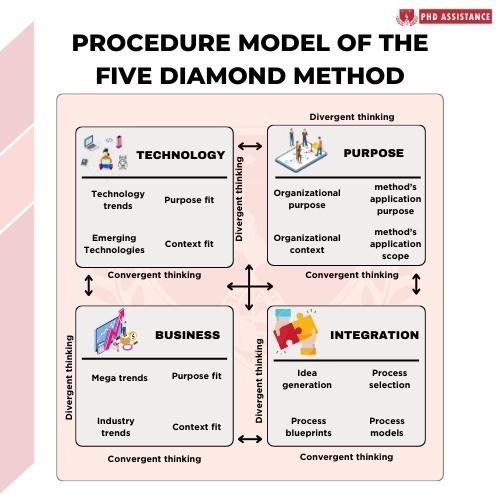
Using design science research together with situational method engineering, the authors develop the Five Diamond Method, which helps organisations identify opportunities arising from business and technology trends and integrate them into processes with novel value propositions (Grisold et al., 2022). As its name suggests, the method is organised as diamonds, each opening up options (divergent thinking) and then narrowing them (convergent thinking). An overarching diamond frames the exploration, and four further diamonds address the purpose of the exploration, opportunities from business trends, opportunities from technology trends, and the integration of selected opportunities into a process design.
The design objectives and evaluation
The method was designed against objectives drawn from the literature. As later summarised in a published exchange, the first required the method to address the exploration goal of BPM, and the second required it to follow an innovation process, encourage creativity and treat business and technology trends as sources of opportunity (Gräbe & Laue, 2023). The evaluation combined several components (Grisold et al., 2022).
| Evaluation component | What it can show | What it cannot show on its own |
|---|---|---|
| Comparison with design objectives and competing artefacts (BPM methods, innovation management methods, TRIZ) | Whether the method covers needs that existing methods do not | Whether it works in use |
| Qualitative input from BPM practitioners | Perceived usefulness and gaps in the design | Effects in practice; views may be shaped by how the method is presented |
| Pilot study | Whether the method can be run and where it breaks down | Generalisability |
| Two real-world applications | That organisations can use it to identify opportunities | Whether resulting processes deliver more value than those from other methods |
Strengths
- It addresses a recognised gap: prescriptive guidance for explorative BPM was scarce, and the paper offers a concrete, usable method rather than another conceptual framework.
- It is explicit about its research approach. Grounding the method in design science and situational method engineering, and deriving design objectives from the literature, makes its design rationale open to scrutiny, which is what design science guidance asks of authors (Gregor & Hevner, 2013).
- It brings innovation management knowledge, such as structured divergent and convergent thinking, into a field that has focused on efficiency.
- Its evaluation is multi-part, moving from an artificial comparison to use in organisations, which follows the progression recommended for design science evaluation (Venable et al., 2016).
Limitations and methodological questions
Evaluation depth
The FEDS framework distinguishes artificial from naturalistic evaluation and formative from summative evaluation (Venable et al., 2016). The paper's naturalistic evidence comes from one pilot and two applications. That is a reasonable first evaluation, but it shows that the method can be used, not that it produces better outcomes than alternatives. A summative test would compare processes created with the method against those created another way, over a period long enough to see whether the new value propositions were realised.
Who evaluated the method
As is usual in design science, the developers also evaluated their artefact. When method designers facilitate applications, it is hard to separate the method's contribution from the facilitators' expertise. Action design research makes this entanglement explicit and builds it into the design (Sein et al., 2011); independent applications by other teams would address it from outside.
The comparison with competing artefacts
In a published comment, Gräbe and Laue (2023) argued that the paper's comparison with TRIZ, a method family from engineering, relied on a single introductory source and mischaracterised TRIZ as solving problems rather than seeking opportunities, since TRIZ includes trend-based tools for anticipating how systems evolve. In their response, the original authors accepted that their statement about TRIZ was imprecise and that its treatment could have been fuller, but maintained that, under the assumptions of BPM, which separates problem-driven from opportunity-driven redesign, their evaluation remained sound. For a doctoral reader, the exchange is a useful reminder that an "ex-ante" comparison with competing artefacts is only as strong as the literature used to describe those artefacts.
Where the opportunities come from
A trend-driven method is only as good as the trends that participants bring to it. If a workshop draws on the same consultancy reports and technology headlines as competitors, it may produce the same opportunities they find. The method's divergent phases are meant to widen the search, but the abstract does not report how trend sources were chosen or how their quality was judged. There is also a risk of technology push: starting from what a new technology can do rather than from what customers need. Including a business-trend diamond alongside the technology diamond is the authors' answer to this, and a doctoral study could test whether it succeeds by tracing where each selected opportunity originated.
Generalisability
Two applications cannot show how the method behaves across industries, organisation sizes or cultures. Case study logic allows analytic rather than statistical generalisation (Eisenhardt, 1989), so the claim that can be made is that the method is usable in settings like those studied.
How the paper sits in the wider literature
The paper belongs to a design science tradition in which building and evaluating artefacts is a legitimate route to knowledge (March & Smith, 1995; Hevner et al., 2004). It follows the logic of established process models for design science, from problem identification and objectives to design, demonstration and evaluation (Peffers et al., 2007). Design science is spreading beyond information systems; a critical review of design science in health care quality improvement discusses the same evaluation questions in a different field (Dyers et al., 2025).
What this means for doctoral researchers
| If your project... | Consider | Report |
|---|---|---|
| Applies the method in an organisation | A longitudinal case study that follows opportunities into implementation | Who facilitated, how each diamond was run, what was selected and why, what was implemented |
| Tests the method | A comparison with another opportunity-seeking method on the same process | Outcome measures fixed in advance, and evaluator independence |
| Extends the method | New design objectives, for example for regulated or public-sector settings | Design rationale, an evaluation strategy using FEDS, and limits of the evidence |
| Reviews explorative BPM | Including the published comment and response, not only the original paper | Search strategy and how competing artefacts were characterised |
Worked example (illustrative). A doctoral researcher in a university hospital wants to explore how remote monitoring could create a new outpatient follow-up process. She runs the method with clinicians and managers, records each diamond, and then follows the two selected opportunities for eighteen months. Her contribution is not another demonstration that the method can be used, but evidence on what happens to explorative opportunities after selection, which the original evaluation could not observe.
Common mistakes when citing this paper
- Describing the method as five linear steps.
- Citing the applications as proof that the method improves business outcomes.
- Reproducing the abstract in a literature review instead of summarising and evaluating it.
- Ignoring the published comment and response on the TRIZ comparison.
- Attributing generic limitations, such as resistance to change, to the authors when they come from elsewhere.
Key takeaways
- Grisold et al. (2022) offer a design science method for creating new processes from business and technology trends (Grisold et al., 2022).
- The method is structured as diamonds of divergent and convergent thinking, not as five linear steps.
- Its evaluation shows usability in a pilot and two applications; comparative, summative evidence is still needed (Venable et al., 2016).
- A published exchange questioned the comparison with TRIZ, and the authors accepted that its treatment was imprecise (Gräbe & Laue, 2023).
- Doctoral projects can add value by testing the method independently and following opportunities into implementation.