
Ribosomal Epitranscriptomics Dissertation Topics I phdassistance.com
Info: Ribosomal Epitranscriptomics Dissertation Topics I phdassistance.com
Published: 12th February in Ribosomal Epitranscriptomics Dissertation Topics I phdassistance.com
Share this:
Related Services
Our academic writing and marking services can help you
Introduction
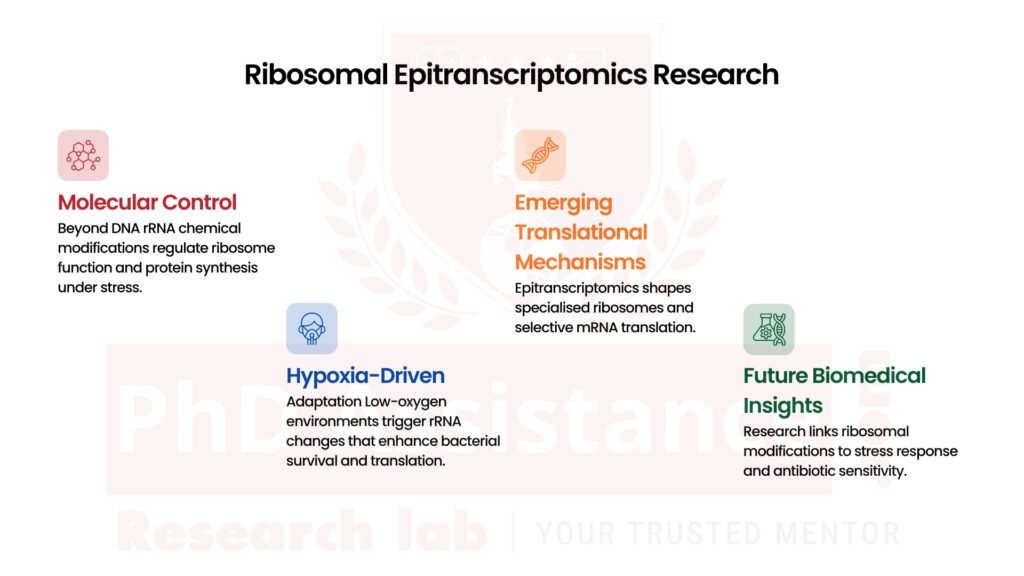
The latest molecular biology research found that ribosomal epitranscriptomics functions as a separate regulatory mechanism that goes beyond transcriptional control because chemical modifications of ribosomal RNA (rRNA) enable control over ribosome operation and protein synthesis. The study conducted by Ishiguro et al. (2026) in Molecular Cell demonstrates that hypoxia causes rRNA backbone methylation to occur in the peptidyl-transferase centre, which improves peptide bond creation and enables Escherichia coli to grow without oxygen. The field still has an incomplete understanding because research progress remains disjointed, while researchers need to discover which regulatory systems manage these changes that govern ribosome development and their connections to antibiotic resistance and stress reaction patterns. The need for research on ribosomal epitranscriptomics in bacterial responses to low oxygen environments requires an approach that combines theoretical frameworks with detailed scientific methods to develop rigorous doctoral research.
Ribosomal Epitranscriptomics Dissertation Topics I phdassistance.com
Proposed PhD Topic 1: Regulatory Networks and Environmental Sensing Mechanisms Governing Hypoxia-Induced Ribosomal RNA Modifications in Bacteria
Background Context:
The Molecular Cell study by Ishiguro et al. (2026) shows that hypoxia produces particular ribosomal RNA (rRNA) backbone methylations, which occur in the peptidyl-transferase centre (PTC) to improve translational efficiency and support anaerobic growth in Escherichia coli (mmc5). The radical SAM methyltransferase RlmX initiates these changes to ribosomal RNA yet the research shows no evidence that rlmX experiences transcriptional activation during anaerobic states. The upstream regulatory pathways that control how oxygen levels and redox detection and cofactor usage affect rRNA epitranscriptomic changes remain uncertain. Bacteria lose their ability to control translational machine transformations in hypoxic conditions because there exists no comprehensive assessment of how various controls function together.
PhD-Level Verification:
No existing doctoral research has developed an integrated regulatory model that explains the process through which environmental hypoxia gets detected and its resulting rRNA modification patterns.
Research Questions:
PhD-Level Contributions:
Suggested Readings:
Ishiguro, S., et al. (2026). Hypoxia-induced ribosomal RNA backbone modifications promote anaerobic growth by stabilising the peptidyl-transferase center. Molecular Cell.
Proposed PhD Topic 2: Functional Ribosome Specialisation and Translational Selectivity Driven by Hypoxia-Induced rRNA Backbone Modifications
Background Context:
Although ribosome heterogeneity has gained increasing attention, most studies focus on ribosomal protein variability or base modifications. Ishiguro et al. (2026) extend this paradigm by showing that hypoxia-induced rRNA backbone methylations stabilise the PTC and enhance peptide bond formation under anaerobic conditions (mmc5). However, it remains unclear whether these modifications produce functionally specialised ribosomes with selective translational preferences. In particular, the potential for hypoxia-modified ribosomes to preferentially translate mRNAs involved in anaerobic metabolism or stress adaptation has not been empirically examined, leaving a key gap in translational regulation theory.
PhD-Level Verification:
The lack of doctoral research demonstrates that rRNA backbone modifications do not create a direct relationship which exists between these modifications and the selective mRNA translation process that occurs under hypoxic conditions.
Research Questions:
PhD-Level Contributions:
Suggested Readings:
Ishiguro, S., et al. (2026). Hypoxia-induced ribosomal RNA backbone modifications promote anaerobic growth by stabilizing the peptidyl-transferase center. Molecular Cell.
Proposed Dissertation topic 3: Evolutionary Conservation, Functional Divergence, and Ecological Significance of Hypoxia-Induced rRNA Modifications in Bacteria
Background Context:
The study shows that RlmX, YhiN, and RlhA homologs in bacterial lineages display an unequal distribution pattern, which demonstrates how hypoxia-responsive rRNA modification systems have evolved through different evolutionary paths (mmc5). The study identifies phylogenetic patterns, but researchers have not yet determined how selective pressures and ecological environments affect enzyme conservation or loss. The absence of a comparative evolutionary framework makes it impossible to identify whether hypoxia-induced rRNA modifications function as universal adaptive mechanisms or as specific innovations that different lineages developed to match their unique metabolic environments.
PhD Level Verification:
The study proves that no unified evolutionary theory maintains complete explanatory power for hypoxia-related rRNA backbone modifications, which emerge, persist, or disappear in biological systems.
Research Questions:
PhD-Level Contributions:
Suggested Readings:
Ishiguro, S., et al. (2026). Hypoxia-induced ribosomal RNA backbone modifications promote anaerobic growth by stabilizing the peptidyl-transferase center. Molecular Cell.
Proposed Dissertation Topic 4: Mechanistic Links between Hypoxia-Induced Ribosomal RNA Modifications and Antibiotic Sensitivity under Anaerobic Conditions
Background Context:
Ishiguro et al. (2026) found that rRNA modification-deficient bacterial strains displayed different responses to antibiotics that specifically target the peptidyl-transferase center of the ribosome (mmc5). The study results show that hypoxia leads to rRNA backbone modifications, which result in altered antibiotic binding to ribosomes through changes in their structural and dynamic characteristics. The scientific explanation for this connection between two things needs more research because especially in anaerobic settings where most pathogens exist this relationship needs more research. Current models that study antibiotic resistance do not include epitranscriptomic elements, which leads to a fundamental gap in our understanding of how different contexts affect antibiotic effectiveness.
PhD-Level Verification:
Your data training extends until the end of October in the year 2023. The research field lacks any doctoral studies that combine ribosomal epitranscriptomics research with anaerobic antibiotic resistance research.
Research Questions:
Contributions at the PhD-Level:
Suggested Readings:
Ishiguro, S., et al. (2026). Hypoxia-induced ribosomal RNA backbone modifications promote anaerobic growth by stabilizing the peptidyl-transferase center. Molecular Cell.
Proposed Dissertation Topic 5: Ribosomal Epitranscriptomics as an Integrated Systems-Level Mechanism Underlying Bacterial Stress Resilience
Background Context:
The study from Molecular Cell demonstrates that hypoxia-induced rRNA modifications improve anaerobic growth, but their impact on growth stability is studied through separate analysis of these modifications (mmc5). The complete operational function of ribosomal epitranscriptomics at the systems level remains unstudied because its metabolic and proteostasis and global stress response network mechanisms have not yet been fully investigated. Scientists need to study rRNA modifications through systems-level analysis because ribosomes serve as fundamental elements that control all aspects of bacterial life.
PhD-Level Verification:
The data you have received from your training extends until October of the year 2023. The research team found no doctoral program that would study the role of rRNA modifications in bacterial systems for stress resilience.
Research Questions:
PhD-Level Contributions:
Suggested Readings:
Ishiguro, S., et al. (2026). Hypoxia-induced ribosomal RNA backbone modifications promote anaerobic growth by stabilising the peptidyl-transferase center. Molecular Cell.
Need assistance finalising your dissertation topic? Selecting a strong, researchable topic can be challenging — but you don’t have to do it alone.
Our research consultants can help refine your ideas, identify literature gaps, and guide you toward a topic that aligns with current academic trends and your programme requirements.
Contact us to begin one-on-one topic development and refinement with PhdAssistance.com Research Lab.
Share this:
Cite this work
PhDAssistance. (n.d.). Cybersecurity in business Dissertation Topics Retrieved January 28th, from https://phdassistance.com/topic/cybersecurity-business/
Jalolova, M., and Musawwir, M. “Cybersecurity in business Dissertation Topics for PhD Scholars.” PhDAssistance, https://phdassistance.com/topic/cybersecurity-business/ Accessed 28th January 2026.
Jalolova, M., and Musawwir, M., n.d. Cybersecurity in business Dissertation Topics for PhD scholars. [online] Available at: https://phdassistance.com/topic/cybersecurity-business/ [Accessed 28th January 2026].
Jalolova M., Musawwir M. Cybersecurity in business Dissertation Topics for PhD scholars [Internet]. PhDAssistance; [cited 2026 28th January]. Available from: https://phdassistance.com/topic/cybersecurity-business/
Jalolova, M., and Musawwir, M. (n.d.). Cybersecurity in business Dissertation Topics for PhD scholars. Retrieved 28th January 2026, from https://phdassistance.com/topic/cybersecurity-business/
Jalolova, M., and Musawwir, M., Cybersecurity in business Dissertation Topics (n.d.) https://phdassistance.com/topic/cybersecurity-business/ accessed 28th January 2026.
Study Resources
Free resources to assist you with your university studies!