
Related Services
Our academic writing and marking services can help you
Introduction
Marine biotechnology is experiencing rapid growth through the combined use of data-driven models, bioinformatics and artificial intelligence technology to investigate marine resources and bioactive compounds. The new technologies enable scientists to study complicated marine biotechnology research with better accuracy, which helps them discover new drugs, protect the environment and create industrial solutions. The existing data problems, combined with restricted access and modelling errors, prevent scientists from predicting biodiversity and establishing trustworthy research outcomes. The existing problems need solutions through the creation of complete systems that can expand to various functions while providing accurate predictions and efficient data management, which will enable both sustainable marine biotechnology use and scientific progress.
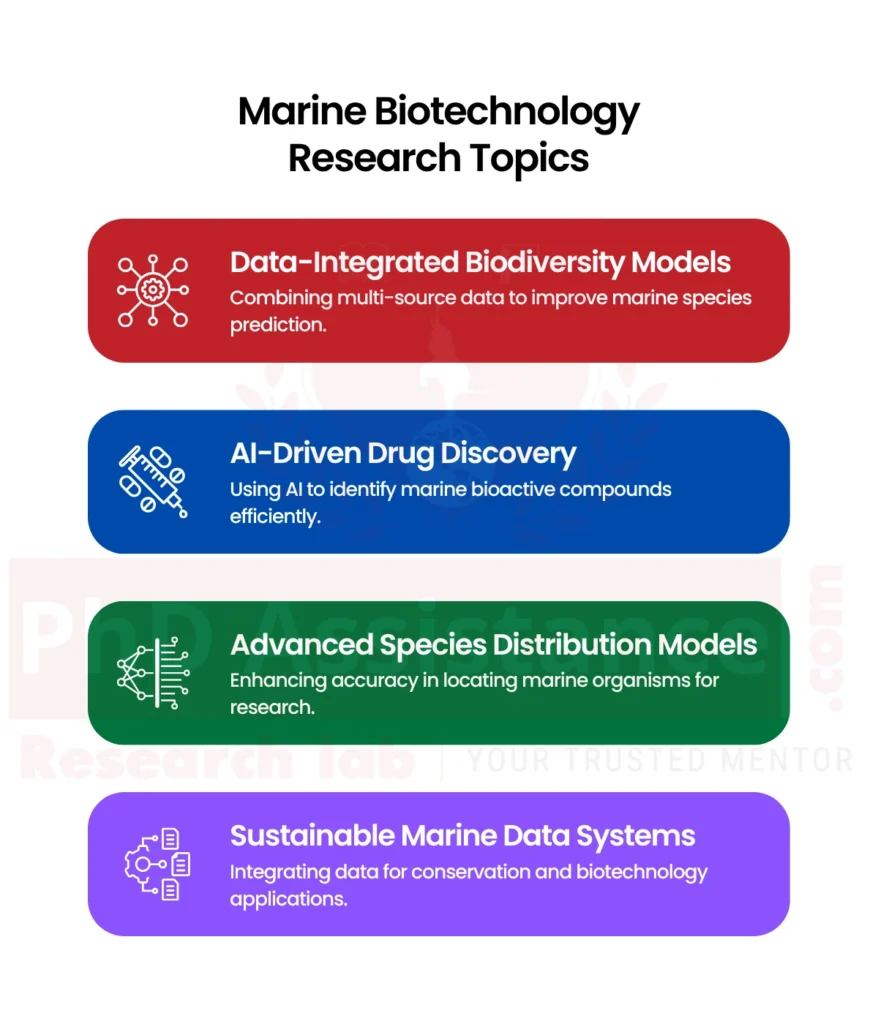
Marine Biotechnology Dissertation Topics I phdassistance.com
Proposed PhD Topic 1: Developing Data-Integrated Marine Biotechnology Models for Accurate Biodiversity Prediction Using Marine Genetic Resources
Background Context:
Researchers in marine biotechnology study marine resources to develop pharmaceutical and industrial products while they search for organisms that create marine bioactive substances. The process requires accurate biodiversity predictions, but current species distribution models use mixed data sources, which include expert maps and opportunistic records to create inconsistent results. Zhang et al. (2025) demonstrate how these distinctions create major impacts on prediction accuracy, which proves especially true for marine environments with restricted data access. The existing limitations of ocean-based drug discovery and marine biotechnology applications require research to develop integrated data-driven models that enhance prediction accuracy and promote sustainable resource management.
PhD-Level Verification:
The existing research fails to create a unified framework that integrates multiple occurrence data sources for studying marine biotechnology. The research gap exists because researchers need dependable data-driven models that improve their ability to predict marine organisms with biotechnological potential.
Research Questions:
- How can integrated data models improve biodiversity prediction in marine biotechnology?
- What role do marine resources play in improving predictive modelling accuracy?
- How can improved models support ocean-based drug discovery?
PhD-Level Contributions:
Suggested Readings:
Zhang, Z., Kass, J. M., Bede-Fazekas, Á., Mammola, S., Qu, J., Molinos, J. G., Gu, J., Huang, H., Qu, M., Yue, Y., Qin, G., & Lin, Q. (2025). Differences in predictions of marine species distribution models based on expert maps and opportunistic occurrences. Conservation Biology, 39, e70015. https://doi.org/10.1111/cobi.70015
Proposed PhD Topic 2: AI-Driven Marine Biotechnology Approaches for Discovering Marine Bioactive Compounds from Underexplored Species
Background Context:
The discovery of marine compounds serves as a fundamental element for marine biotechnology because these compounds have crucial pharmaceutical and industrial applications. The process of discovering valuable species requires comprehensive biodiversity information, yet this information remains unreliable because expert maps and opportunistic observations display different levels of accuracy. Zhang et al. (2025) demonstrate that the existing inconsistencies between drug discovery methods create barriers that impede the successful identification of marine microorganisms and other organisms used in biotechnological research. The existing research gap requires scientists to develop AI-driven data integration methods that will enhance prediction accuracy and enable broader use of marine biotechnology applications.
PhD-Level Verification:
The existing scientific research demonstrates that there is no AI-based system that can utilise trustworthy data to identify marine species with high potential. Researchers need to establish a connection between biodiversity models and their application in discovering marine compounds.
Research Questions:
PhD-Level Contributions:
The research produced artificial intelligence discovery systems that help identify marine compounds. The project achieved better data accuracy for research purposes in marine biotechnology. The project developed better research methods to discover ocean-based drugs. The research work created new developments in pharmaceutical products that use marine resources.
Suggested Readings:
Zhang, Z., Kass, J. M., Bede-Fazekas, Á., Mammola, S., Qu, J., Molinos, J. G., Gu, J., Huang, H., Qu, M., Yue, Y., Qin, G., & Lin, Q. (2025). Differences in predictions of marine species distribution models based on expert maps and opportunistic occurrences. Conservation Biology, 39, e70015. https://doi.org/10.1111/cobi.70015
Proposed Dissertation topic 3: Enhancing Ocean-Based Drug Discovery Through Improved Species Distribution Models in Marine Biotechnology
Background Context:
The research requires complete species distribution data to discover marine organisms which produce ocean-based bioactive compounds. The current models produce inaccurate predictions because they combine different data sources which generate uncertain results for areas that lack sufficient data. Zhang et al. (2025) assert that these variations between different sources create difficulties in locating appropriate habitats which decreases the effectiveness of research in marine biotechnology. The absence of standardized modeling methods decreases system dependability, which creates a demand for better prediction techniques that will enhance marine biotechnology applications and facilitate effective drug discovery.
PhD Level Verification:
Current research does not adequately address the impact of data inconsistency on drug discovery outcomes. The research gap exists because model developers need better methods to identify biologically active marine species.
Research Questions:
PhD-Level Contributions:
Suggested Readings:
Zhang, Z., Kass, J. M., Bede-Fazekas, Á., Mammola, S., Qu, J., Molinos, J. G., Gu, J., Huang, H., Qu, M., Yue, Y., Qin, G., & Lin, Q. (2025). Differences in predictions of marine species distribution models based on expert maps and opportunistic occurrences. Conservation Biology, 39, e70015. https://doi.org/10.1111/cobi.70015
Proposed Dissertation Topic 4: Role of Marine Microorganisms in Biotechnology: Addressing Data Bias in Species Identification and Resource Utilization
Background Context:
Marine microorganisms in biotechnology are essential for producing biofuels and enzymes and pharmaceuticals which makes them the main research target in marine biotechnology studies. The process of identifying them suffers from data bias problems which arise from differences between expert maps and opportunistic records. Zhang et al. (2025) demonstrate that these inconsistencies reduce species prediction accuracy especially in marine regions that remain unexplored. The current situation restricts both the discovery and application of microorganisms while it decreases the effectiveness of marine biotechnology applications thus creating a need for better systems that will reduce bias and improve the management of marine resources.
PhD-Level Verification:
The field of research suffers a gross deficiency in studies that investigate how data bias influences the identification process of marine organisms. The research gap arises from the absence of precise and accurate methodologies for the discovery and utilisation of marine-life forms.
Research Questions:
Contributions at the PhD-Level:
Suggested Readings:
Zhang, Z., Kass, J. M., Bede-Fazekas, Á., Mammola, S., Qu, J., Molinos, J. G., Gu, J., Huang, H., Qu, M., Yue, Y., Qin, G., & Lin, Q. (2025). Differences in predictions of marine species distribution models based on expert maps and opportunistic occurrences. Conservation Biology, 39, e70015. https://doi.org/10.1111/cobi.70015
Proposed Dissertation Topic 5: Integrating Multi-Source Data for Sustainable Marine Biotechnology Applications and Biodiversity Conservation
Background Context:
The study of marine biotechnology, which focuses on sustainable practices, needs reliable biodiversity information to protect environmental resources and drive scientific advancement. Marine ecosystems contain vital genetic materials used for research purposes, yet scientists face difficulties in accessing these materials because they lack the ability to forecast species emergence. Zhang et al. (2025) demonstrate that different data sources produce distinct results in biodiversity modeling which impacts both conservation efforts and biotechnology research. Scientists need better data unification techniques, which will increase marine biotechnology prediction results and operational processes, because existing data systems lack standards that decrease trustworthiness.
PhD-Level Verification:
The research gap exists because there are no integrated data systems that combine multiple data sources to achieve both conservation and biotechnology goals.
Research Questions:
PhD-Level Contributions:
Suggested Readings:
Zhang, Z., Kass, J. M., Bede-Fazekas, Á., Mammola, S., Qu, J., Molinos, J. G., Gu, J., Huang, H., Qu, M., Yue, Y., Qin, G., & Lin, Q. (2025). Differences in predictions of marine species distribution models based on expert maps and opportunistic occurrences. Conservation Biology, 39, e70015. https://doi.org/10.1111/cobi.70015
Need assistance finalising your dissertation topic? Selecting a strong, researchable topic can be challenging — but you don’t have to do it alone.
Our research consultants can help refine your ideas, identify literature gaps, and guide you toward a topic that aligns with current academic trends and your programme requirements.
Contact us to begin one-on-one topic development and refinement with PhdAssistance.com Research Lab.
Share this:
Cite this work
PhDAssistance. (n.d.). Cybersecurity in business Dissertation Topics Retrieved January 28th, from https://phdassistance.com/topic/cybersecurity-business/
Jalolova, M., and Musawwir, M. “Cybersecurity in business Dissertation Topics for PhD Scholars.” PhDAssistance, https://phdassistance.com/topic/cybersecurity-business/ Accessed 28th January 2026.
Jalolova, M., and Musawwir, M., n.d. Cybersecurity in business Dissertation Topics for PhD scholars. [online] Available at: https://phdassistance.com/topic/cybersecurity-business/ [Accessed 28th January 2026].
Jalolova M., Musawwir M. Cybersecurity in business Dissertation Topics for PhD scholars [Internet]. PhDAssistance; [cited 2026 28th January]. Available from: https://phdassistance.com/topic/cybersecurity-business/
Jalolova, M., and Musawwir, M. (n.d.). Cybersecurity in business Dissertation Topics for PhD scholars. Retrieved 28th January 2026, from https://phdassistance.com/topic/cybersecurity-business/
Jalolova, M., and Musawwir, M., Cybersecurity in business Dissertation Topics (n.d.) https://phdassistance.com/topic/cybersecurity-business/ accessed 28th January 2026.
Study Resources
Free resources to assist you with your university studies!