Generative AI in Drug Discovery and Precision Medicine Innovation Dissertation Topics I phdassistance.com
Info:
Generative AI in Drug Discovery and Precision Medicine Innovation Dissertation Topics I phdassistance.com
Published: 19th may in Generative AI in Drug Discovery and Precision Medicine Innovation Dissertation Topics I phdassistance.com
Share this:
Related Services
Our academic writing and marking services can help you
Introduction
Selecting the most appropriate research topic for a PhD study poses several problems for researchers in pharmaceutical innovation. The selected topic for research should be a topic where there is progress going on in the realms of Intelligent Drug Discovery, Personalised Medicine, Predictive Health Care, and Pharmaceutical Innovations. Recently, more effort has been made to use Generative AI in Drug Discovery, which has brought about a revolution in the field of pharmaceutics. Researchers are increasingly concentrating on the development of advanced technology associated with healthcare, precision medicine, predictive toxicology, and intelligent pharmaceutical production. PhD Assistance assists in discovering innovative and publishable subjects that match existing trends within the pharmaceutical world, educational institutions, and industry needs. Research assistance in different fields like personalised medicine, sustainable drug repositioning, health care analytics, pharmaceutical safety evaluation, and intelligent drug discovery systems is also available. The selection of topics by PhD Assistance is aimed at ensuring excellence in academics and research and future innovations in health care.
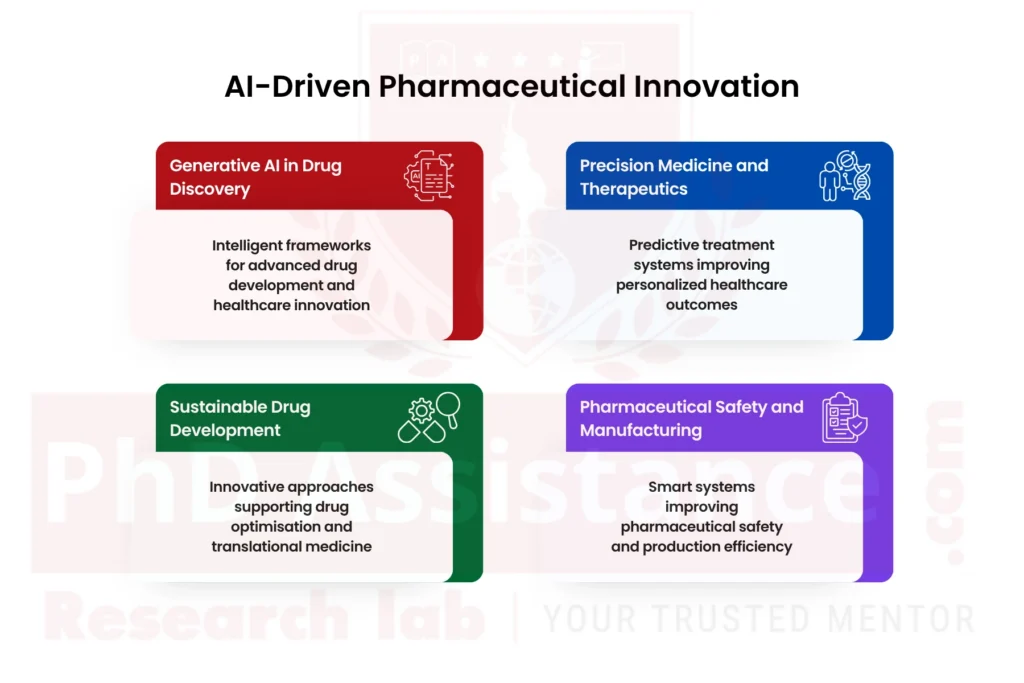
Proposed PhD Topic 1: Generative-AI in Drug Discovery for Precision Medicine and Personalised Cancer Therapeutics
Background Context:
Generative-AI in Drug Discovery technology has revolutionised the way drugs are discovered through intelligent molecular design, biological predictions, and innovation of novel therapies. Traditional methods of drug discovery are associated with increased costs, prolonged clinical trial periods, and low success rates. To address these difficulties, the pharmaceutical sector is employing drug discovery models through AI technology. Improved development processes of personalised medicines that can be used in the treatment of cancer have been made possible by advances in AI techniques such as neural networks. The other area that researchers are exploring is Precision Medicine Innovation, where there is the use of AI in pharmaceuticals regarding genomic testing, biomarkers, and individual treatment prediction. In the opinion of Bassey et al. (2025), AI technologies help shorten development time while increasing accuracy.
PhD-Level Verification:
Research Questions:
PhD-Level Contributions:
Suggested Readings:
Bassey, G. E., et al. (2025). Transformative Role of Artificial Intelligence in Drug Discovery and Translational Medicine: Innovations, Challenges, and Future Prospects.
Proposed PhD Topic 2: AI in Medicine for Predictive Clinical Trial Optimisation and Patient Stratification
Background Context:
The application of AI in Precision Medicine has led to better clinical trial optimisation with the help of predictive analytics, intelligent patient selection, and personalised treatment monitoring. Clinical trials are faced with many problems, including inefficiency in recruiting patients, prolonged validation processes, and rising costs. AI-based predictive technology is currently employed in clinical trials to enhance patient selection, treatment prediction, and decision-making. With machine learning technology and healthcare analytics, researchers are able to examine electronic health records, genomic data, and medical information to choose the right patient pool for treatment trials. Moreover, the use of AI enables adaptive trial optimization and treatment monitoring. As argued by Uriti (2025), AI improves precision medicine by enhancing patient selection and treatment prediction.
PhD-Level Verification:
Current literature focuses on predictive analysis, patient enrolment, and drug response prediction; there is little work combining explainable AI, pharmacogenomics, and adaptive trials in sustainable precision medicine environments. There is also a lack of study regarding ethical patient selection via AI and the use of real-time monitoring technology.
Research Questions:
PhD-Level Contributions:
Suggested Readings:
Uriti, S. V. (2025). A Systematic Review of AI-Driven Innovations in Drug Development, Precision Medicine, and Healthcare.
Proposed Dissertation topic 3: Generative-AI for Healthcare in Sustainable Drug Repurposing and Translational Medicine
Background Context:
Generative AI for Healthcare sector is revolutionising drug discovery through drug repurposing, advanced health analytics, and the translational medicine paradigm. The conventional approach to drug discovery has been described by long drug development times, high costs of drug development, and numerous failures. AI technology is also being explored that could aid researchers in discovering more uses for already existing medications. The use of AI-based technologies to discover other uses of existing medicines is among the many other advantages that scientists have begun considering. New treatments are formulated using machine learning, predictive analysis, and biologic models. The application of generative AI for drug repurposing is capable of reducing experimentation, making treatments more efficient, and speeding up drug approval. According to Malheiro et al. (2025), AI tools enable safe and efficient drug development systems.
PhD Level Verification:
Despite the rise in artificial intelligence-powered drug repurposing studies, there is a lack of studies that focus on combining translational medicine, patient-centric healthcare analytics, and ethical artificial intelligence governance in sustainable healthcare innovation ecosystems. Moreover, there is no comparative framework in existing literature to study AI-enabled therapeutic customisation in various healthcare sectors.
Research Questions:
PhD-Level Contributions:
Suggested Readings:
Malheiro, V., et al. (2025). The Potential of Artificial Intelligence in Pharmaceutical Innovation: From Drug Discovery to Clinical Trials.
Proposed Dissertation Topic 4: AI Drug Discovery Solution for Predictive Toxicology and Intelligent Pharmaceutical Risk Assessment
Background Context:
Modern AI Drug Discovery Solutions are revolutionising the field of predictive toxicology and pharmaceutical safety with sophisticated algorithms of machine learning and intelligent biological simulation technologies. Conventional approaches for assessing drug toxicology are characterised by costly laboratory trials, slow process speeds, and inefficiency in detecting drug reactions. The use of AI-based toxicology approaches enables researchers to predict drug interactions, toxicity levels, and adverse reactions with intelligent computational models. Moreover, researchers have been able to incorporate explainable AI-based solutions to ensure ethical governance of pharmaceutical safety procedures. As stated by Kandregula (2025), AI-based simulation technologies have made great strides in improving lead optimisation and clinical successes.
PhD-Level Verification:
The majority of the current studies centre around molecular prediction, toxicity testing, and artificial intelligence (AI)-assisted drug safety analysis; yet, little has been done in terms of the application of explainable AI, regulatory compliance software, and intelligent risk governance approaches to the field of pharmacology.
Research Questions:
Contributions at the PhD-Level:
Suggested Readings:
Kandregula, N. (2025). Accelerating Drug Discovery with Generative AI: A Paradigm Shift in Pharmaceutical Innovation and Development.
Proposed Dissertation Topic 5: Machine Learning in Drug Development for Sustainable Precision Therapeutics and Smart Pharmaceutical Manufacturing
Background Context:
Machine Learning in Drug Development helps to enhance the efficiency of pharmaceutical manufacturing, the development of accurate drugs, and advanced manufacturing management systems. Pharmaceutical manufacturing operations encounter various inefficiencies in production, inconsistency in quality, and delays in the distribution of the therapy. As a result, the incorporation of AI-based manufacturing and prediction tools is being employed by pharmaceutical firms. Machine learning technologies have been increasingly applied in intelligent formulation designs, automated quality controls, predictive maintenance, and real-time pharmaceutical analysis. Furthermore, AI-based applications help in the manufacture of customised medicines that integrate individual therapy data within smart manufacturing systems. From recent studies done on pharmaceutical applications of AI, it has become clear that machine learning enhances efficiency.
PhD-Level Verification:
Although there is an increase in the use of artificial intelligence (AI) technology in pharmaceutical manufacturing, there is insufficient scientific literature on the relationship between smart manufacturing systems, precision medicine models, and sustainable production via AI technology. Most existing scientific literature is concentrated on automation and predictive maintenance technologies.
Research Questions:
PhD-Level Contributions:
Suggested Readings:
Riemer, A., & Freund, V. (2025). Generative Artificial Intelligence in Pharmaceutical Drug Development: A Systematic Review of Time and Cost Efficiency Across Discovery, Preclinical, and Clinical Phases.
Need assistance finalising your dissertation topic? Selecting a strong, researchable topic can be challenging — but you don’t have to do it alone.
Our research consultants can help refine your ideas, identify literature gaps, and guide you toward a topic that aligns with current academic trends and your programme requirements.
Contact us to begin one–on-one topic development and refinement with PhdAssistance.com Research Lab.
Share this:
Cite this work
PhDAssistance. (n.d.). Cybersecurity in business Dissertation Topics Retrieved January 28th, from https://phdassistance.com/topic/cybersecurity-business/
Jalolova, M., and Musawwir, M. “Cybersecurity in business Dissertation Topics for PhD Scholars.” PhDAssistance, https://phdassistance.com/topic/cybersecurity-business/ Accessed 28th January 2026.
Jalolova, M., and Musawwir, M., n.d. Cybersecurity in business Dissertation Topics for PhD scholars. [online] Available at: https://phdassistance.com/topic/cybersecurity-business/ [Accessed 28th January 2026].
Jalolova M., Musawwir M. Cybersecurity in business Dissertation Topics for PhD scholars [Internet]. PhDAssistance; [cited 2026 28th January]. Available from: https://phdassistance.com/topic/cybersecurity-business/
Jalolova, M., and Musawwir, M. (n.d.). Cybersecurity in business Dissertation Topics for PhD scholars. Retrieved 28th January 2026, from https://phdassistance.com/topic/cybersecurity-business/
Jalolova, M., and Musawwir, M., Cybersecurity in business Dissertation Topics (n.d.) https://phdassistance.com/topic/cybersecurity-business/ accessed 28th January 2026.
Study Resources
Free resources to assist you with your university studies!