
Governance in Modern Enterprises Dissertation Topics I phdassistance.com
Info: Governance in Modern Enterprises Dissertation Topics I phdassistance.com
Published: 30th March in Governance in Modern Enterprises Dissertation Topics I phdassistance.com
Share this:
Related Services
Our academic writing and marking services can help you
Introduction
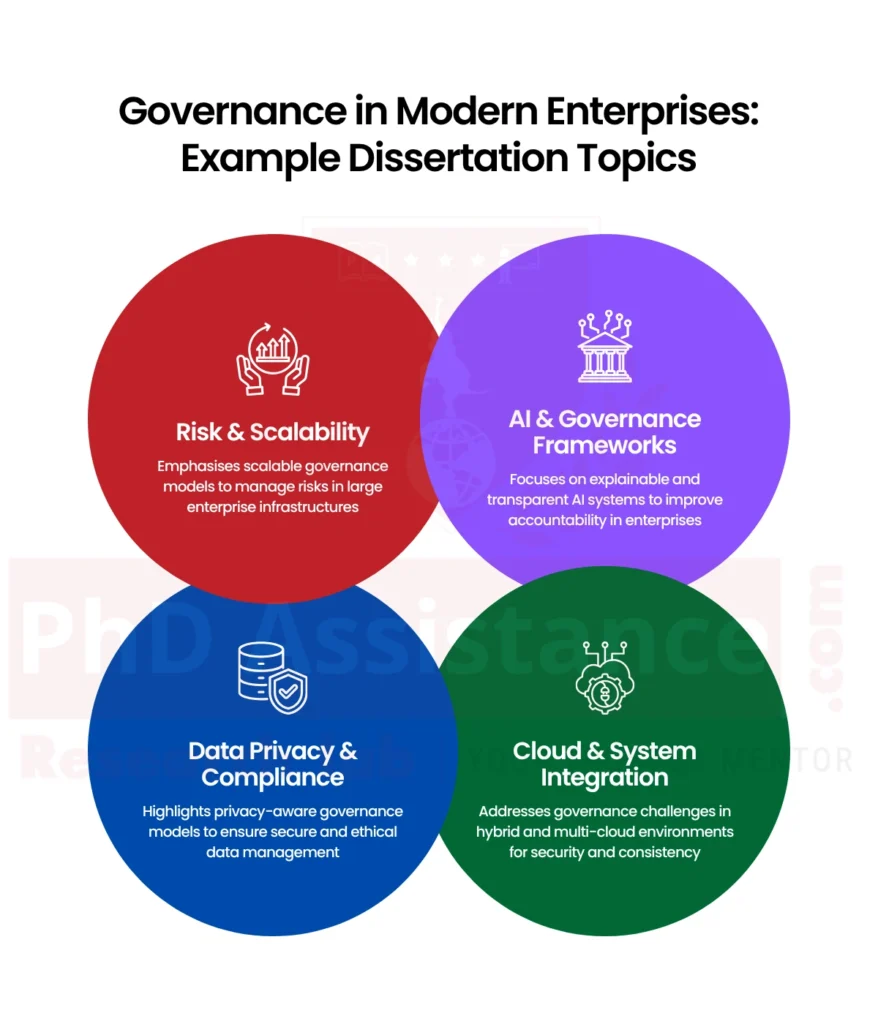
The quick development of digital technologies, which include artificial intelligence and cloud computing, has changed how modern businesses operate because organisations now require effective systems to achieve accountability and transparency and maintain legal compliance. Organisations need to establish adaptive governance frameworks to address their challenges with data privacy and security issues and system integration needs. The current issues connect with risk management procedures for businesses and their IT governance systems, and their new environmental, social and governance requirements. This study presents example topics on governance in modern enterprises, addressing key gaps and supporting the development of effective governance strategies.
Governance in Modern Enterprises Dissertation Topics I phdassistance.com
Proposed PhD Topic 1: Developing Explainable AI Governance Frameworks for Transparent and Accountable Decision-Making in Enterprise Cloud Security Systems
Background Context:
Modern businesses adopt AI-powered cloud security solutions to handle their sophisticated cyber threats according to the changing patterns of organisational governance. The systems enable automated processes while enabling constant system checks and flexible operational choices. The absence of explainability in AI systems, which people refer to as “black-box” systems, creates difficulties for organisations that need to establish effective governance. The limitation impacts three essential aspects of Corporate governance research topics, which include accountability and auditability, and regulatory compliance. Arora (2018) explained in his article for the International Journal of Current Engineering and Scientific Research (IJCESR) that AI systems without explainability make it difficult for users to trust them, which creates governance challenges for business organisations
PhD-Level Verification:
The current research on explainable AI fails to connect with broader IT governance frameworks used by enterprises and their corporate governance systems. The research gap exists because there is no study that connects AI transparency with existing governance policies, compliance frameworks and organisational accountability systems.
Research Questions:
PhD-Level Contributions:
Suggested Readings:
Arora, A. (2018). The significance and role of AI in improving cloud security posture for modern enterprises. International Journal of Current Engineering and Scientific Research (IJCESR), 5(5), 116–128. https://papers.ssrn.com/sol3/papers.cfm?abstract_id=5268192
Proposed PhD Topic 2: Designing Privacy-Aware AI Governance Models for Secure and Compliant Data Management in Enterprise Cloud Environments
Background Context:
The implementation of AI-powered systems requires enterprises to establish data governance systems as their fundamental requirement. Organisations need to protect sensitive information during data processing operations while they conduct their risk management and governance activities. The operation of AI systems depends on massive datasets, which create difficulties for organisations to protect privacy and maintain ethical standards and follow regulatory requirements. Enterprises experience legal challenges and diminished trust in their systems because of poor data governance, according to Arora’s research from 2018.
PhD-Level Verification:
The absence of a unified governance model prevents enterprises from using privacy-preserving technologies that currently exist to protect their cloud systems. The gap demonstrates how enterprises struggle with governance because they must protect sensitive data while meeting legal requirements and ethical standards of data protection.
Research Questions:
PhD-Level Contributions:
Suggested Readings:
Arora, A. (2018). The significance and role of AI in improving cloud security posture for modern enterprises. International Journal of Current Engineering and Scientific Research (IJCESR), 5(5), 116–128. https://papers.ssrn.com/sol3/papers.cfm?abstract_id=5268192
Proposed Dissertation topic 3: Establishing Integrated Governance Frameworks for AI-Driven Security Management in Hybrid and Multi-Cloud Enterprise Architectures
Background Context:
Hybrid and multi-cloud environments enable businesses to operate their systems while creating new challenges for governance. IT governance in enterprises faces its most difficult challenge through the need to maintain security and compliance together with established policies across all distributed systems. Organisations with fragmented infrastructure systems experience both visibility problems and difficulties in enforcing their security protocols. The integrated governance frameworks that modern enterprise systems require are essential, according to Arora 2018 because they address existing challenges.
PhD Level Verification:
The existing research on corporate governance insufficiently addresses two fundamental challenges that need solutions to achieve interoperability between systems and to protect policy consistency across distributed cloud environments.
Research Questions:
PhD-Level Contributions:
Suggested Readings:
Arora, A. (2018). The significance and role of AI in improving cloud security posture for modern enterprises. International Journal of Current Engineering and Scientific Research (IJCESR), 5(5), 116–128. https://papers.ssrn.com/sol3/papers.cfm?abstract_id=5268192
Proposed Dissertation Topic 4: Developing Scalable AI Governance Models for Risk Management and Security Optimisation in Large-Scale Enterprise Cloud Infrastructures
Background Context:
As companies expand their cloud operations, their ability to control governance and risk and assess performance will face growing challenges. The operational efficiency of AI systems improves performance for businesses, but they need proper governance systems to achieve both scalability and operational dependability. Organisations need to structure their AI systems to match their established risk management protocols and business guidelines within their risk management practices. Arora (2018) demonstrates that AI-based security systems experience effectiveness problems because of their scalability restrictions and resource availability issues.
PhD-Level Verification:
Research into AI systems that integrate scalable systems with governance control mechanisms remains in an early stage. Existing studies focus on technical performance but ignore the Governance challenges in enterprises that need to be addressed.
Research Questions:
Contributions at the PhD-Level:
Suggested Readings:
Arora, A. (2018). The significance and role of AI in improving cloud security posture for modern enterprises. International Journal of Current Engineering and Scientific Research (IJCESR), 5(5), 116–128. https://papers.ssrn.com/sol3/papers.cfm?abstract_id=5268192
Proposed Dissertation Topic 5: Designing Interoperability and Policy Governance Frameworks for Integrating AI with Legacy and Modern Enterprise Cloud Security Systems
Background Context:
Companies face difficulties because they need to combine their old systems with their new AI technologies. The IT governance systems of businesses face a primary challenge that demands two requirements to be fulfilled. Organisations experience operational problems because their systems do not work together, and their security measures become more vulnerable. Arora (2018) emphasises that AI-driven cloud security solutions face their biggest challenge with interoperability issues that remain unsolved.
PhD-Level Verification:
There exists an absence of a complete governance framework that would permit AI systems to work together with existing legacy systems. The gap in research studies demonstrates the need for standardisation and policy alignment investigation, which serves as a primary element of corporate governance research.
Research Questions:
PhD-Level Contributions:
Suggested Readings:
Arora, A. (2018). The significance and role of AI in improving cloud security posture for modern enterprises. International Journal of Current Engineering and Scientific Research (IJCESR), 5(5), 116–128. https://papers.ssrn.com/sol3/papers.cfm?abstract_id=5268192
Need assistance finalising your dissertation topic? Selecting a strong, researchable topic can be challenging — but you don’t have to do it alone.
Our research consultants can help refine your ideas, identify literature gaps, and guide you toward a topic that aligns with current academic trends and your programme requirements.
Contact us to begin one-on-one topic development and refinement with PhdAssistance.com Research Lab.
Share this:
Cite this work
PhDAssistance. (n.d.). Cybersecurity in business Dissertation Topics Retrieved January 28th, from https://phdassistance.com/topic/cybersecurity-business/
Jalolova, M., and Musawwir, M. “Cybersecurity in business Dissertation Topics for PhD Scholars.” PhDAssistance, https://phdassistance.com/topic/cybersecurity-business/ Accessed 28th January 2026.
Jalolova, M., and Musawwir, M., n.d. Cybersecurity in business Dissertation Topics for PhD scholars. [online] Available at: https://phdassistance.com/topic/cybersecurity-business/ [Accessed 28th January 2026].
Jalolova M., Musawwir M. Cybersecurity in business Dissertation Topics for PhD scholars [Internet]. PhDAssistance; [cited 2026 28th January]. Available from: https://phdassistance.com/topic/cybersecurity-business/
Jalolova, M., and Musawwir, M. (n.d.). Cybersecurity in business Dissertation Topics for PhD scholars. Retrieved 28th January 2026, from https://phdassistance.com/topic/cybersecurity-business/
Jalolova, M., and Musawwir, M., Cybersecurity in business Dissertation Topics (n.d.) https://phdassistance.com/topic/cybersecurity-business/ accessed 28th January 2026.
Study Resources
Free resources to assist you with your university studies!