
- / Title
Consequences of Service Robots Dissertation Titles | phdassistance.com
Info: 1557 words(1 pages) Financial Inclusion Dissertation Titles
Published: 10th February 2026 in Financial Inclusion Dissertation Titles
Share this:
Related Services
Introduction
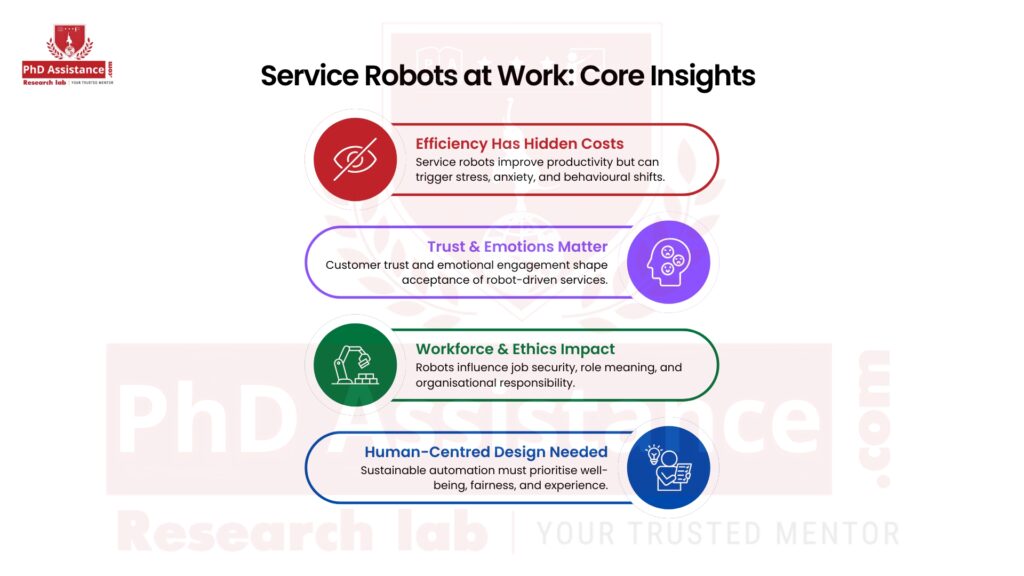
Service robots have become more common across different sectors because of progress in artificial intelligence and robotics, which has been applied to hospitality and retail, healthcare and banking industries. Service robots provide operational efficiency and economic benefits and maintain service quality, but recent research shows they produce hidden effects that impact mental health and social behaviour, moral standards and employment conditions. The period brought changes that affected customer trust and decision processes, staff health and responsibility perceptions and emotional involvement. Existing research often addresses these effects in isolation and focuses on short-term outcomes, creating a need for theory-driven studies that examine the broader and long-term consequences of service robots for sustainable and human-centred service delivery.
Consequences of Service Robots Dissertation Titles
Proposed PhD Title 1: Beyond Efficiency: Investigating the Unintended Psychological and Behavioural Consequences of Service Robot Adoption in Service Encounters
Service robots are increasingly being implemented in hospitality and retail, healthcare, and banking sectors because these robots have the ability to enhance operational efficiency while maintaining service quality and decreasing expenses. The current research on service robotics focuses almost entirely on measuring performance outcomes, which include speed, accuracy and customer satisfaction. The latest research shows that robot-assisted service encounters create unexpected psychological effects, which lead to customer anxiety and discomfort, decreased feelings of personal control and changes in their decision-making behaviour. The current outcomes disprove the belief that technological efficiency directly results in better service experiences; therefore, further research is needed to understand how robotic systems affect human behaviour during service delivery..
Problem Statement:
Even though numerous policies and technological measures have been implemented to achieve wider access to financial services, a large number of people remain either partially or completely unbanked. The situation of keeping accounts inactive, performing a few transactions, and using informal financial means continues to be the case, which ultimately lowers the developmental impact of financial inclusion programs. Neither the government nor the private sector have a good grasp of the different factors, behavioural, structural, and contextual, that inhibit access from turning into continuous financial usage.
Research Gap:
Most of the existing literature defines financial inclusion mainly through the use of access-related indicators like owning a bank account or being near a financial institution. A very small amount of empirical research has addressed the usage, continuity, and, lastly, the long-term integration of financial services in people’s economic lives after access is granted.
Research Question:
What are the mechanisms through which the provision of formal financial services leads to the continuous use of such services and the active participation in the financial system among the poor and marginalised groups?
Outcome:
The research will propose a multipronged model that separates the financial inclusion process into the three stages of access, usage, and impact, thus presenting evidence-based recommendations for policymakers and financial service providers about how to make the inclusion more effective.
Reference:
Broadbent, E., et al. (2009). Acceptance of healthcare robots for the older population. International Journal of Social. https://doi.org/10.1007/s12369-009-0030-6
Proposed PhD Title 2. When Automation Backfires: Examining Trust Erosion, Emotional Disengagement, and Customer Resistance Toward Service Robots
The service industries have started to implement service robots because they believe the robots will provide better operational performance and increased operational efficiency. Van Doorn et al. (2017) introduced automated social presence as a new concept through their research published in the Journal of Service Research, which showed how front-line technology changes the way customers interact with companies. According to Wirtz et al. (2018) in their Journal of Service Management study, service robots succeed at performing their operational duties, but they fail to create emotional connections with customers. The research conducted in the Journal of Service Research and Electronic Markets shows that robot-based services unintentionally damage customer trust while decreasing their emotional connection to services and creating obstacles to service adoption. The main automation narratives currently overlook these negative effects, which need further investigation.
Problem Statement:
Service robots improve operational efficiency and consistency for businesses yet lead to customer trust decline, emotional detachment and active resistance to robot-operated services. The unintentional customer responses to service robots will damage relationship quality, decrease service loyalty and hinder the permanent success of automation projects. Organisations currently lack a clear understanding of the mechanisms through which service robots trigger such negative customer responses.
Research gap:
The existing research studies trust as a positive result of automation because they provide minimal evidence that service robots cause people to lose trust and experience emotional detachment, and show resistance. The existing body of research lacks comprehensive frameworks that demonstrate the way emotional and relational aspects interact with automated service delivery.
Research Question:
How do service robots influence customer trust, emotional engagement, and resistance behaviours in automated service environments?
Outcome:
The research will create a complete model that demonstrates how trust relationships between customers and robot-operated services develop negative trust dynamics. The findings will provide actionable recommendations for service designers and managers to reduce resistance and foster emotionally sustainable automation strategies.
Reference:
Broadbent, E., et al. (2009). Acceptance of healthcare robots for the older population. International Journal of Social. https://doi.org/10.1007/s12369-009-0030-6
Proposed PhD Title 3. The Dark Side of Service Robotics: A Multilevel Analysis of Ethical, Social, and Workforce-Related Unintended Consequences
Service robots have increased research studies since their introduction because researchers now study service robots to evaluate their effect on service operations and their ethical and social impacts. Huang and Rust (2021), in their Journal of Service Research article, showed that AI-driven services create three main problems, which include accountability issues, transparency challenges and workforce displacement concerns. Studies in Human Relations and Organisation Studies demonstrate that employees experience higher job insecurity and reduced work meaningfulness and ethical conflicts. The International Journal of Social Robotics shows through its reviews that service robots create social and organisational disadvantages for certain groups of people. Research studies continue to lack integration because they focus on single aspects of study while remaining disconnected from other research fields.
Problem Statement:
The service robots provide operational advantages and productivity gains, yet their ethical and social impacts, together with their effects on the workforce, remain unaddressed. The employees will experience three challenges because of their job insecurity, together with their role uncertainty and their decreased ability to find meaning in their work. Organisations need to deal with three ethical issues that involve their obligation to maintain operational transparency and accountability, and their duty to handle problems. The unintentional results of these effects will damage both organisational sustainability and social legitimacy.
Research Gap:
The current research base operates through two separate research methodologies, which either study customer behaviour or employee behaviour while lacking a comprehensive examination of ethical, social and organisational factors. The available studies that investigate these impacts at different organisational levels remain limited.
Research Question:
What ethical, social, and workforce-related unintended consequences arise from service robot implementation across different levels of organisations?
Outcome:
The research will propose a multilevel conceptual framework that combines ethical outcomes with employee outcomes and organisational outcomes. The findings will support policymakers and organisations in developing responsible and inclusive service robot implementation strategies.
Reference:
Broadbent, E., et al. (2009). Acceptance of healthcare robots for the older population. International Journal of Social. https://doi.org/10.1007/s12369-009-0030-6
Proposed PhD Title 4. Human–Robot Interaction Under Strain: Exploring Stress, Dehumanisation, and Decision Avoidance Triggered by Service Robots
Service robots have increased research studies since their introduction because researchers now study service robots to evaluate their effect on service operations and their ethical and social impacts. Huang and Rust (2021), in their Journal of Service Research article, showed that AI-driven services create three main problems, which include accountability issues, transparency challenges and workforce displacement concerns. Studies in Human Relations and Organisation Studies demonstrate that employees experience higher job insecurity and reduced work meaningfulness and ethical conflicts. The International Journal of Social Robotics shows through its reviews that service robots create social and organisational disadvantages for certain groups of people. Research studies continue to lack integration because they focus on single aspects of study while remaining disconnected from other research fields.
Problem Statement:
The service robots create unintentional customer stress and dehumanising experiences, which increase cognitive load during their service interactions. The psychological strain that results from this situation will decrease decision-making quality and customer satisfaction while it creates service usage problems in high-involvement service contexts.
Research gap:
The Existing literature examines acceptance and usability and performance outcomes of service robots, but researchers have not studied stress and dehumanisation and decision avoidance as human-robot interaction outcomes.
Research Question:
The research investigates how service robots affect three different factors, which include stress levels, dehumanisation perceptions, and decision-making avoidance during service encounters.
Outcome:
The study will identify essential psychological stress factors that emerge during robot-mediated services and create design and management guidelines that will decrease dehumanisation while enhancing customer decision-making assistance.
Reference:
Broadbent, E., et al. (2009). Acceptance of healthcare robots for the older population. International Journal of Social. https://doi.org/10.1007/s12369-009-0030-6
Proposed PhD Title 5. From Novelty to Normalisation: Long-Term Unintended Consequences of Service Robots on Customer Experience and Employee Well-Being
Early service robot research focused on how customers reacted to new technologies. Belanche et al. (2020) in Electronic Markets warned that people would stop showing positive reactions once robots became everyday objects. Wirtz et al. (2018) in the Journal of Service Management explained that continuous robot operation would create new service standards and change employee job functions. The Journal of Service Research discusses how employees who experience ongoing contact with services will develop lower service warmth and greater emotional distress. The existing empirical research studies remain cross-sectional, which restricts researchers from studying their long-term effects.
Problem Statement:
The assessment of service robot performance by organisations focuses on two factors, which include short-term efficiency improvements and customer reactions to new service robots. Continuous deployment of service robots results in two negative outcomes for businesses, which include decreased customer service quality, increased employee burnout and changes in customer service standards.
Research gap:
The existing research studies depend on cross-sectional research methods, which fail to observe how service robots become normalised over time and generate hidden effects that impact both customers and employees.
Research Question:
What long-term unintended consequences do service robots have on customer experience and employee well-being as they become normalised in service environments?
Outcome:
The study will deliver long-term research findings about the permanent effects of service robots, which will help organisations create effective service automation systems.
Reference:
Broadbent, E., et al. (2009). Acceptance of healthcare robots for the older population. International Journal of Social. https://doi.org/10.1007/s12369-009-0030-6
Need assistance finalising your dissertation topic? Selecting a strong, researchable topic can be challenging — but you don’t have to do it alone.
Our research consultants can help refine your ideas, identify literature gaps, and guide you toward a topic that aligns with current academic trends and your programme requirements.
Contact us to begin one-on-one topic development and refinement with PhdAssistance.com Research Lab.
Share this:
Cite this work
PhDAssistance. (n.d.). Virtual Influencers Dissertation Titles Retrieved 30th January 2026, from https://phdassistance.com/title/virtual-influencers/
“Virtual Influencers Dissertation Titles, https://phdassistance.com/title/virtual-influencers/
“Virtual Influencers Dissertation Titles” PhDAssistance, PhDAssistance, Tuesday, January 30th,2026.
PhDAssistance, n.d. Virtual Influencers Dissertation Titles[Online]. Available at: https://phdassistance.com/title/virtual-influencers/ [Accessed January 30th, 2026].
PhDAssistance. Virtual Influencers Dissertation Titles[Internet]. PhDAssistance; [cited 2026 January 30th]. Available from: https://phdassistance.com/title/virtual-influencers/
PhDAssistance (n.d.).
Virtual Influencers Dissertation Titles. Retrieved January 30th, 2026, from https://phdassistance.com/title/virtual-influencers/
PhDAssistance, Virtual Influencers Dissertation Titles(PhDAssistance, n.d. January 30th accessed 2026.
Study Resources
Free resources to assist you with your university studies!