
- / Title
Graph Data Analysis and Network Intelligence Titles | phdassistance.com
Info: Graph Data Analysis and Network Intelligence Titles | phdassistance.com
Published: 23th May 2026 in Graph Data Analysis and Network Intelligence Titles | phdassistance.com
Share this:
Related Services
Introduction
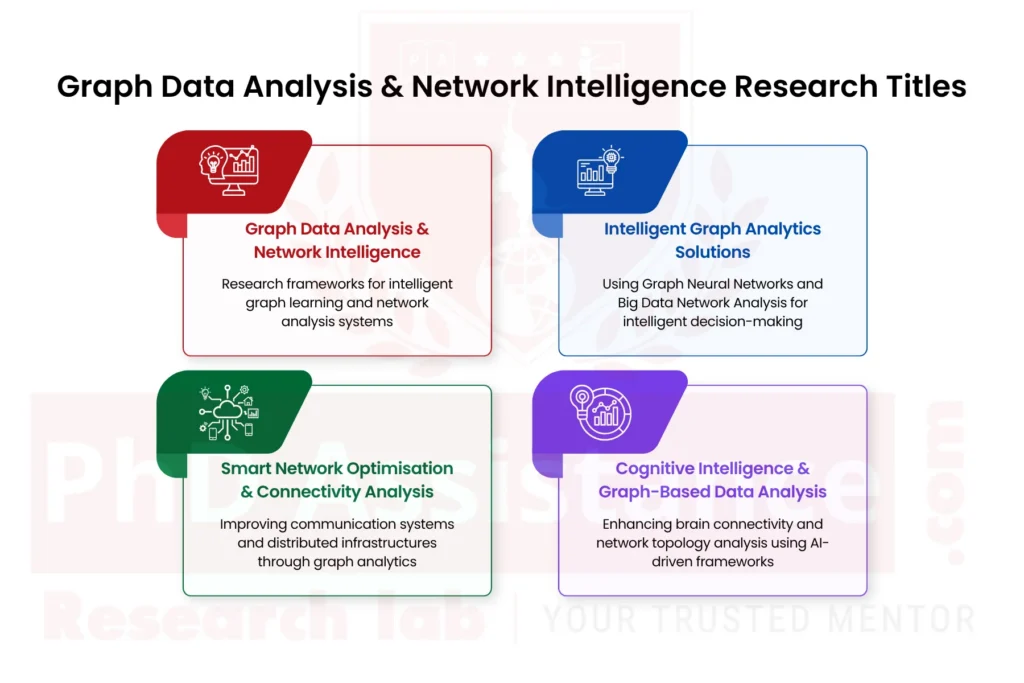
The rapid growth of artificial intelligence and big data technologies has increased the importance of analysing complex network structures across multiple research domains. Advanced Graph Analytical Techniques, Graph-Based Analysis, and Big Data Analysis are widely used to improve communication systems, transportation management, cognitive intelligence analysis, and distributed computing environments. The integration of Graph Data Analysis and Network Intelligence with Neural Networks, reinforcement learning, and AI-driven Network Solutions helps researchers develop intelligent graph learning models for real-world applications. In addition, Social Network Analysis support the understanding of complex connectivity patterns in modern intelligent systems. The PhD Assistance helps in developing creative and publishable topics that involve network and neural intelligence.
Proposed PhD Title 1: AI-Driven Graph Neural Network Frameworks for Intelligent Transportation Systems and Smart Traffic Prediction
In Intelligent Transportation Systems, scholars are exploring how Graph Neural Networks (GNNs) can be used to improve traffic forecasting, intelligent mobility, and transportation safety via state-of-the-art graph analytics and deep learning techniques. The rapid expansion of cities and growth of transportation systems have brought many difficulties, such as traffic congestion, ineffective route optimisation, transportation safety problems, and low accuracy of traffic prediction. The use of transportation analytics through AI technology, coupled with Graph Neural Networks, can help improve the efficiency in traffic management and prediction, as well as decision-making for the ITS (intelligent transport systems). As mentioned by Rahmani et al. (2023), Graph Neural Networks have high proficiency in many transportation-related activities.
Problem Statement:
The existing transportation networks fail to deal with issues related to dynamic traffic interactions, spatial dependencies, and mobility data in real-time. The traditional approach to traffic management does not have adaptive prediction and intelligent optimisation capabilities, leading to traffic congestion and poor urban transportation planning. Therefore, there is a need for advanced graph analytics techniques for intelligent transportation Systems.
Research Gap:
Currently, few studies have only explored the combination of Graph Neural Network with Artificial Intelligence that utilises Big Data Network Analysis and smart transportation systems.
Research Question:
How will the integration of Graph Neural Networks in intelligent transportation systems make improvements to traffic predictions, transportation efficiency, and traffic safety?
Outcome:
The study aims to create an artificial intelligence transportation analytics system through graph-based analysis methods.
Reference:
Rahmani, S., et al. (2023). Graph Neural Networks for Intelligent Transportation Systems: A Survey.
Proposed PhD Title 2. Deep Learning-Based Graph Convolutional Network Models for Intelligent Communication Networks and Big Data Analytics
Researchers from Neuroinformatics and Brain Intelligence Analytics are now trying to discover how Graph Neural Networks can represent functional brain connectivity and cognitive intelligence prediction through resting-state fMRI imaging and graph learning methods. Contemporary studies in neuroscience face growing difficulties when it comes to analysing the intricate processes of interactions within brain networks, cognitive variability, and intelligence prediction. The use of AI-driven graph learning algorithms together with Graph-Based Analysis and intelligent connectivity approaches would help interpret the results much more efficiently. Thapaliya et al. (2025) studied the ability of Graph Neural Networks to predict different types of cognitive intelligence.
Problem Statement:
The shortcomings associated with the traditional network intelligence techniques include ineffective handling of large amounts of graph data and communication relationships. The current methodologies are inadequate with respect to Graph-Based Analysis and network optimisation. Poor resource allocation, inefficient connectivity control and poor intelligent decision-making are the consequences of such a problem.
Research Gap:
Very few papers have developed comprehensive intelligent frameworks for GCN-based graph analytics, big data networking analysis, communications optimisation, and artificial intelligence-based network intelligence solutions.
Research Question:
How can Graph Convolutional Network-based intelligent framework enhance the optimisation of communication networks, efficiency in graph analytics, and intelligent analysis of graph-based data sets?
Outcome:
The proposed research paper aims to develop an enhanced AI-based Graph Convolutional Network framework for intelligent optimisation of communication networks, efficient graph data analysis, and efficient graph-based analysis.
Reference:
Bhatti, U. A., et al. (2023). Deep Learning with Graph Convolutional Networks: An Overview and Latest Applications in Computational Intelligence.
Proposed PhD Title 3. Graph Neural Network-Based Brain Connectivity Frameworks for Cognitive Intelligence Prediction Using Resting-State fMRI Analytics
Neuroinformatics and Brain Intelligence Analytics researchers are studying how to employ Graph Neural Networks to learn about brain functional connectivity patterns and their relationship to cognitive intelligence from resting-state fMRI data with the help of graph-based learning. Current neuroscience studies are facing growing difficulties in comprehending the complexities associated with brain network interactions, variability of cognition, and intelligence prediction. The use of graph-based learning techniques alongside AI models for interpreting neural connectivity and related brain activity is likely to enhance current findings tremendously. Thapaliya et al. (2025) showed that Graph Neural Networks are highly efficient at predicting fluid, crystallised, and overall intelligence from functional connectivity matrices.
Problem Statement:
Brain intelligence prediction frameworks face problems with accurately deciphering complicated connectivity patterns of neurons and cognitive variation. The existing neuroscience models cannot effectively evaluate the functioning of the brain network interaction process. Such a limitation hampers the effectiveness of the intelligence prediction framework. Graph analytics and AI-powered brain connectivity models can enhance the neurological evaluation of intelligence levels.
Research Gap:
Current research lacks papers that explored the combination of sophisticated Graph Neural Network architecture with techniques from the field of resting state functional connectivity analysis and Social Network Analysis methods for cognitive intelligence prediction.
Research Question:
What are the benefits of using Graph Neural Network-based brain connectivity models for the improvement of cognitive intelligence prediction?
Outcome:
In this study, we will devise a new intelligent brain connectivity analysis technique that incorporates Graph Neural Network architecture along with functional connectivity analysis.
Reference:
Thapaliya, B., et al. (2025). Brain Networks and Intelligence: A Graph Neural Network Based Approach to Resting State fMRI Data.
Proposed PhD Title 4. Adaptive Graph Neural Network and Reinforcement Learning Frameworks for Intelligent Distributed Task Scheduling Systems
The study of Distributed Computing and Intelligent Network Systems aims to explore the potential of Graph Neural Networks and Reinforcement Learning in enhancing task scheduling, resource management, and fault tolerance in heterogeneous distributed computing environments. Contemporary distributed computing systems face many problems, such as changes in workload, faulty nodes, resource imbalance, and poor scheduling policies. The AI-powered distributed computing system models based on graph learning can provide better computation and adaptability. GART, an adaptive distributed computing scheduling model based on Graph Neural Networks, was proposed by Yang et al. (2025).
Problem Statement:
The current systems for scheduling tasks in distributed environments are static and heuristic-based approaches, which don’t change the requirements themselves. Conventional approaches to scheduling face issues of resource imbalance, higher latency, and less fault tolerance when used in heterogeneous environments. There is a need for an Intelligent Network Intelligence Solution based on Graph Neural Networks.
Research Gap:
Very limited research has explored the combination of sophisticated Graph Neural Network architecture with techniques from resting state functional connectivity analysis and Social Network Analysis for cognitive intelligence prediction.
Research Question:
What are the benefits of using Graph Neural Network-based brain connectivity models for the improvement of cognitive intelligence prediction?
Outcome:
In this study, we will devise a new intelligent brain connectivity analysis technique that incorporates Graph Neural Network architecture along with functional connectivity analysis.
Reference:
Yang, S., et al. (2025). GART: Graph Neural Network-Based Adaptive and Robust Task Scheduler for Heterogeneous Distributed Computing.
Proposed PhD Title 5. Functional Gradient and Graph Analytics Frameworks for Cognitive Intelligence and Brain Network Topology Analysis
Cognitive Neuroscience and Graph Analytics researchers are investigating the potential benefits of using dimensionality reduction, functional gradients, and graph analysis methods for the enhancement of neural connectivity. The structure and functions of the human brain are extremely complex, which makes traditional neuroscience theories inadequate for explaining cognitive actions and differences in intelligence among individuals. Using AI-powered functional connectivity analytics, combined with Social Network Analysis, could offer valuable insight into the neural structure, cognition, and brain network topology. According to Alberti et al. (2025), functional gradients and graph topologies were key to comprehending the neural correlates of intelligence.
Problem Statement:
In the current context, the challenges encountered by neuroscientists and cognitive analysis tools are associated with variations in the functioning of the brain and neural arrangements related to intelligence. The existing brain connectivity models do not incorporate Graph-Based Data Analytics and dimensional reductions. Consequently, it is difficult to interpret the relationship between cognitive variations and the brain topology.
Research Gap:
There is limited literature that combines functional gradient analysis, Graph Analytical Techniques, modelling of graph topology, and intelligence prediction models for advanced cognitive neuroscience and functional brain connectivity analysis.
Research Question:
How will graph-based analysis models for functional connectivity and dimensional reduction be used to advance the analysis of intelligence-related brain network connectivity and cognitive diversity?
Outcome:
The proposed study will generate an advanced framework for graph analysis models that incorporate functional gradients, graph-based data analysis, and topology analysis for cognitive intelligence and brain connectivity analysis.
Reference:
Alberti, F., et al. (2025). Understanding the Link Between Functional Profiles and Intelligence Through Dimensionality Reduction and Graph Analysis.
Need assistance finalising your dissertation topic? Selecting a strong, researchable topic can be challenging — but you don’t have to do it alone.
Our research consultants can help refine your ideas, identify literature gaps, and guide you toward a topic that aligns with current academic trends and your programme requirements.
Contact us to begin one-on-one topic development and refinement with PhdAssistance.com Research Lab.
Share this:
Cite this work
PhDAssistance. (n.d.). Virtual Influencers Dissertation Titles Retrieved 30th January 2026, from https://phdassistance.com/title/virtual-influencers/
“Virtual Influencers Dissertation Titles, https://phdassistance.com/title/virtual-influencers/
“Virtual Influencers Dissertation Titles” PhDAssistance, PhDAssistance, Tuesday, January 30th,2026.
PhDAssistance, n.d. Virtual Influencers Dissertation Titles[Online]. Available at: https://phdassistance.com/title/virtual-influencers/ [Accessed January 30th, 2026].
PhDAssistance. Virtual Influencers Dissertation Titles[Internet]. PhDAssistance; [cited 2026 January 30th]. Available from: https://phdassistance.com/title/virtual-influencers/
PhDAssistance (n.d.).
Virtual Influencers Dissertation Titles. Retrieved January 30th, 2026, from https://phdassistance.com/title/virtual-influencers/
PhDAssistance, Virtual Influencers Dissertation Titles(PhDAssistance, n.d. January 30th accessed 2026.
Study Resources
Free resources to assist you with your university studies!