
- / Title
Generative Design Dissertation Titles | phdassistance.com
Info: 1557 words(1 pages) Generative Design Dissertation Titles
Published: 28th February 2026 in Generative Design Dissertation Titles
Share this:
Related Services
Introduction
The design field experiences transformation through AI-Generated Content (AIGC) because AIGC enables automated design ideation and creation, and design output optimisation. AIGC tools have found their way into creative processes according to Zhang et al. (2024) because these tools enhance work efficiency and drive innovative outcomes, yet their implementation brings about problems which affect system openness, user confidence, ethical standards and the interaction between humans and artificial intelligence. The current research only evaluates technical abilities and single design activities because it lacks complete systems that unite AIGC with design thinking, design methods, and human-centred design principles. The research requires the establishment of the design requirements that create AIGC systems that maintain transparency and reliability and follow scientific methods for creative work.
Proposed PhD Title 1: Designing Human-Centred Explainable AIGC Systems for Creative Industries: Integrating Transparency, Trust and Ethical Governance in AI-Driven Design
AIGC technologies, which enable automated design processes through their capacity to create and improve designs, currently drive rapid changes in creative industries. AIGC tools, which Zhang et al. (2024) studied, differentially impact productivity and innovation, whereas designers view these tools as non-transparent systems that function like “black boxes.” Designers and organisations maintain a lack of trust in AIGC systems because of ongoing concerns about algorithmic bias, copyright violations, ethical misuse and limited system explainability. AIGC design environments need to implement Human-Centred AI (HAI) and Explainable AI (XAI) frameworks because both systems enhance user trust through their ability to provide transparent information. Organisations need to develop complete frameworks which fulfill human-centered design principles while providing system explanations and ethical controls to establish reliable AIGC practices in creative design work.
Problem Statement:
AIGC systems require transparent and explainable systems that perform ethical operations to establish user confidence, yet these systems block their usage in professional design spaces. Designers face difficulties because they need to comprehend how AI systems make decisions, while they must find algorithmic bias and take responsibility for all the results produced, which creates problems for them to use the technology. A human-centred design approach needs to explainable systems, yet organisations must establish responsible AIGC design usage which builds trust and sustainable operations.
Research Gap:
AIGC tool research mainly investigates the technological capabilities and generative output, while researchers study human-centred design, systems explainability and ethical governance through AI system design research. A complete framework does not exist that links AGC-driven design environments with transparency, trust and ethical aspects.
Research Question:
How can human-centred and explainable AI principles be integrated into AIGC-driven design systems to enhance transparency, trust and ethical governance in creative industries?
Outcome:
The research will develop a comprehensive human-centred explainable AIGC framework that integrates transparency mechanisms, trust-building strategies and ethical governance principles. The findings will provide practical guidance for designers, developers and organisations to ensure responsible and trustworthy implementation of AI-driven design systems.
Reference:
Zhang, X., et al. (2024). Integration of AI-Generated Content in design: Trends, challenges and future directions. https://www.tandfonline.com/doi/full/10.1080/09544828.2024.2362587
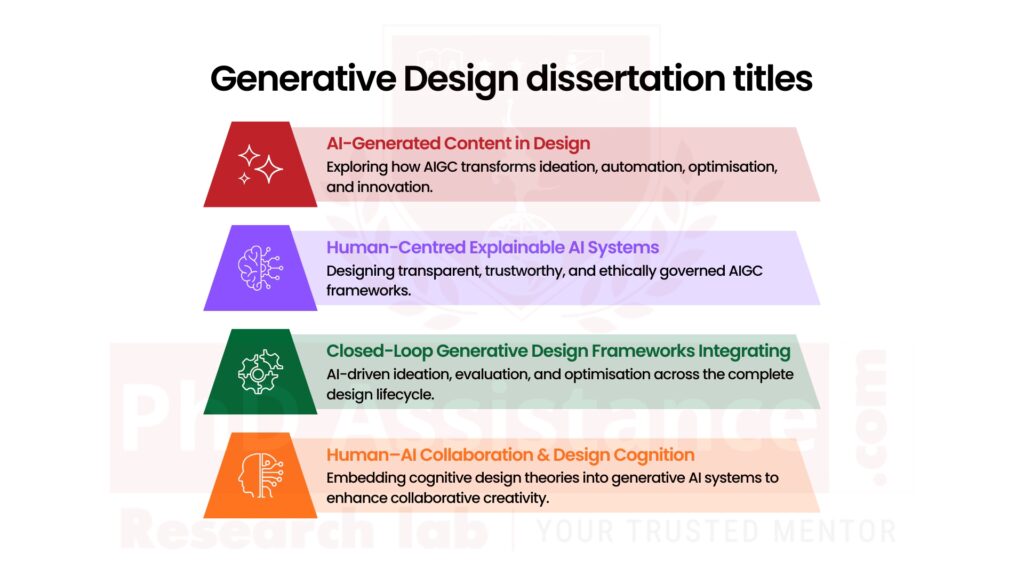
Proposed PhD Title 2. Developing Closed-Loop Generative Design Systems: Integrating AIGC Across Ideation, Evaluation and Optimisation in the Design Lifecycle
Since its first appearance, AIGC has become the design sector’s new standard for creating artistic work through automated processes that provide designers with increased design efficiency. According to Zhang et al. (2024), most current AIGC applications in design remain limited to isolated generation tasks such as image creation, layout development and interface design. Designers will repeat their work process through multiple design stages until they create their final product, which includes idea development, prototype testing, product assessment and design improvements. Designers currently lack access to AIGC tools, which enable them to execute design work throughout its complete duration using a unified system. Designers need complete closed-loop systems that use AIGC throughout their entire design process to develop effective design systems that operate smoothly.
Problem Statement:
The design generation efficiency of AIGC tools receives improvement through their deployment in various tasks, which currently limits their capacity to support entire design workflows. The absence of unified systems that link designers’ creative work with their assessment and design improvement activities creates design process delays and results in unpredictable design results.
Research gap:
The existing literature concentrates on task-based generative applications while failing to provide complete closed-loop frameworks that would link AIGC technology across all design process stages.
Research Question:
How can closed-loop AIGC design systems be developed to support seamless integration across all stages of the design lifecycle?
Outcome:
The research will propose a multistage closed-loop AIGC design framework that integrates generation, evaluation and optimisation, which will improve AI-assisted design processes through better spatial and temporal coherence.
Reference:
Zhang, X., et al. (2024). Integration of AI-Generated Content in design: Trends, challenges and future directions. https://www.tandfonline.com/doi/full/10.1080/09544828.2024.2362587
Proposed PhD Title 3. Integrating Design Cognition and Generative AI: A Framework for Enhancing Human–AI Collaboration in Creative Design Processes
AIGC technologies have developed from their initial state to present capabilities that enable design tools to function as collaborative design assistants. The early generative tools, which Zhang et al. (2024) studied, required users to define parameters because the tools did not support design cognition, theoretical knowledge or creative reasoning. The study produced outputs that lacked understanding of the context, together with design understanding. AIGC tools become advanced intelligent assistants through the combination of design thinking and cognitive theories with computational intelligence, which helps users in their creative research and decision-making activities. Researchers need to conduct additional research and development work to create frameworks that link design cognition with generative AI systems.
Problem Statement:
AIGC tools currently available in the market work for content generation and automation tasks and require design cognition and theoretical frameworks for their complete functionality. The system cannot handle complex creative processes because it does not support human-AI partnerships required for design work.
Research Gap:
The existing studies have not examined how design cognition theories can be applied to generative AI systems for improving collaborative creativity and decision-making during design work.
Research Question:
The study investigates design cognition principles that can enhance AIGC systems to improve human-AI design decision-making processes.
Outcome:
How can design cognition principles be integrated into AIGC systems to enhance human–AI collaboration and creative decision-making in design?
Reference:
Zhang, X., et al. (2024). Integration of AI-Generated Content in design: Trends, challenges and future directions. https://www.tandfonline.com/doi/full/10.1080/09544828.2024.2362587
Proposed PhD Title 4. Mapping Design Theories to AIGC Applications: A Pluralistic Methodology Framework for Theory-Driven Generative Design Innovation
The field of design has gained fresh opportunities for innovative, creative work through the combined development of generative AI technology and design techniques. Zhang et al. (2024) report that current research investigations concentrate mainly on developing technical model training methods and automated systems, but do not incorporate established design principles and methods. Design functions as a multidisciplinary field because it draws on design thinking, analogical design and user-centred design as its theoretical foundations. The current situation needs systematic connections between their theoretical foundations and AIGC applications because these links will enhance the development of theory-based generative design tools.
Problem Statement:
AIGC tools provide better automation and productivity benefits, but their current design needs theoretical connections to established design methods, which prevent them from handling advanced creative and strategic design activities.
Research gap:
The research findings demonstrate that design theories and methodologies cannot be transferred to AIGC applications because there exists no theory-based framework that supports generative design development.
Research Question:
How can diverse design methodologies be systematically integrated with AIGC applications to support theory-driven innovation in design?
Outcome:
The research will develop a pluralistic methodology framework that connects design theories with generative AI applications to create a method for structured design innovation based on established theoretical concepts.
Reference:
Zhang, X., et al. (2024). Integration of AI-Generated Content in design: Trends, challenges and future directions. https://www.tandfonline.com/doi/full/10.1080/09544828.2024.2362587
Proposed PhD Title 5. Exploring Ethical, Bias and Copyright Risks in AIGC-Driven Design: Developing Governance Models for Responsible AI Creativity
The use of AIGC in design work has created major ethical and legal problems because it produces biased results, violates copyright laws and enables people to improperly use generated materials. Zhang et al. (2024) explain that generative AI systems depend on existing datasets, which contain both biased information and copyrighted material. The system generates outputs that contain both discriminatory elements and plagiarism issues, and it creates conflicts about intellectual property rights. The design profession faces two major challenges that decrease trust levels while making it harder for users to adopt their solutions. Although organisations have developed ethical AI principles and governance models for AIGC-driven design systems, their actual implementation remains insufficient and inconsistent.
Problem Statement:
The design field faces ethical issues, together with bias problems and copyright violations, because of increasing AIGC usage, which jeopardises trust and legal compliance and responsible innovation. Organisations do not have effective risk management systems because they lack established governance frameworks to address these particular risks.
Research gap:
Current research lacks complete frameworks that handle ethical governance, bias reduction and copyright protection in AIGC design environments.
Research Question:
How can governance frameworks be developed to address ethical, bias and copyright risks in AIGC-driven design systems?
Outcome:
The research will create a responsible AI governance framework for AIGC design that needs to practice ethical standards while maintaining transparency and supporting sustainable, innovative development.
Reference:
Zhang, X., et al. (2024). Integration of AI-Generated Content in design: Trends, challenges and future directions. https://www.tandfonline.com/doi/full/10.1080/09544828.2024.2362587
Need assistance finalising your dissertation topic? Selecting a strong, researchable topic can be challenging — but you don’t have to do it alone.
Our research consultants can help refine your ideas, identify literature gaps, and guide you toward a topic that aligns with current academic trends and your programme requirements.
Contact us to begin one-on-one topic development and refinement with PhdAssistance.com Research Lab.
Share this:
Cite this work
PhDAssistance. (n.d.). Virtual Influencers Dissertation Titles Retrieved 30th January 2026, from https://phdassistance.com/title/virtual-influencers/
“Virtual Influencers Dissertation Titles, https://phdassistance.com/title/virtual-influencers/
“Virtual Influencers Dissertation Titles” PhDAssistance, PhDAssistance, Tuesday, January 30th,2026.
PhDAssistance, n.d. Virtual Influencers Dissertation Titles[Online]. Available at: https://phdassistance.com/title/virtual-influencers/ [Accessed January 30th, 2026].
PhDAssistance. Virtual Influencers Dissertation Titles[Internet]. PhDAssistance; [cited 2026 January 30th]. Available from: https://phdassistance.com/title/virtual-influencers/
PhDAssistance (n.d.).
Virtual Influencers Dissertation Titles. Retrieved January 30th, 2026, from https://phdassistance.com/title/virtual-influencers/
PhDAssistance, Virtual Influencers Dissertation Titles(PhDAssistance, n.d. January 30th accessed 2026.
Study Resources
Free resources to assist you with your university studies!