
- / Title
Crypto Auditing Dissertation Titles | phdassistance.com
Info: 1557 words(1 pages) Crypto Auditing Dissertation Titles
Published: 27th February 2026 in Crypto Auditing Dissertation Titles
Share this:
Related Services
Introduction
The auditing landscape experiences rapid changes because organisations increasingly adopt crypto assets and blockchain-based financial systems. Auditors face challenges because digital assets are now used in mainstream finance, which leads to decentralisation and valuation volatility, regulatory uncertainty and technological complexity. Blockchain technology provides better transparency and traceability functions, yet it brings new hazards for organisations to use in fraud detection and compliance, and internal control mechanisms. Existing research highlights these issues but often examines them separately, creating a need for integrated auditing approaches that ensure reliability, transparency and trust in crypto-asset financial reporting.
Proposed PhD Title 1: Developing a Comprehensive Audit Risk Framework for Crypto Assets: Integrating Blockchain Complexity, Valuation Uncertainty and Fraud Detection
The rapid expansion of crypto assets and blockchain-based financial systems has transformed global financial markets and introduced new complexities for auditors and accounting professionals. The decentralised nature of crypto assets, combined with their extreme price fluctuations and advanced technological features, creates a situation where traditional auditing methods fail to establish transparent operations and trustworthy outcomes. Existing research highlights key audit risks, which include inherent risks that arise from both volatility and decentralised operations, and control risks that stem from insufficient internal control systems and valuation risks that exist because consistent pricing standards do not exist. The pseudonymous design of transactions, together with the lack of clear regulations, makes it difficult to conduct verification tasks and ensure compliance with established standards.
Problem Statement:
Auditors face increasing difficulty in maintaining audit quality and financial reporting reliability in crypto-asset environments. The absence of structured frameworks for assessing valuation uncertainty, fraud risk and technological complexity creates inconsistencies in audit practices. Auditors need integrated risk management models because they help auditors detect misstatements while ensuring compliance and building stakeholder trust. The current situation demands an immediate solution through the development of an all-encompassing audit risk framework, which must be designed specifically for cryptocurrency asset assessment.
Research Gap:
The research field currently lacks studies that develop an integrated audit risk framework that handles three main challenges of technological threats, valuation problems and fraud detection issues, although previous research has identified specific audit risks for each crypto-asset.
Research Question:
How can a comprehensive audit risk framework be developed to effectively manage inherent, control and valuation risks in crypto-asset auditing?
Outcome:
The research will present an integrated audit risk framework which specifically applies to crypto assets, providing auditors and regulators with strategic and operational guidelines to enhance transparency and reliability and trustworthiness.
Reference:
Lazea (Trifa), G.-I., Bunget, O.-C., Bălan, A.-D., Solovăstru, M. Ş. (2025), Navigating Auditing Risks in the Crypto Asset Landscape, Audit Financiar, vol. XXIII, no. 1(177)/2025, pp. 197-209, DOI: 10.20869/AUDITF/2025/177/006
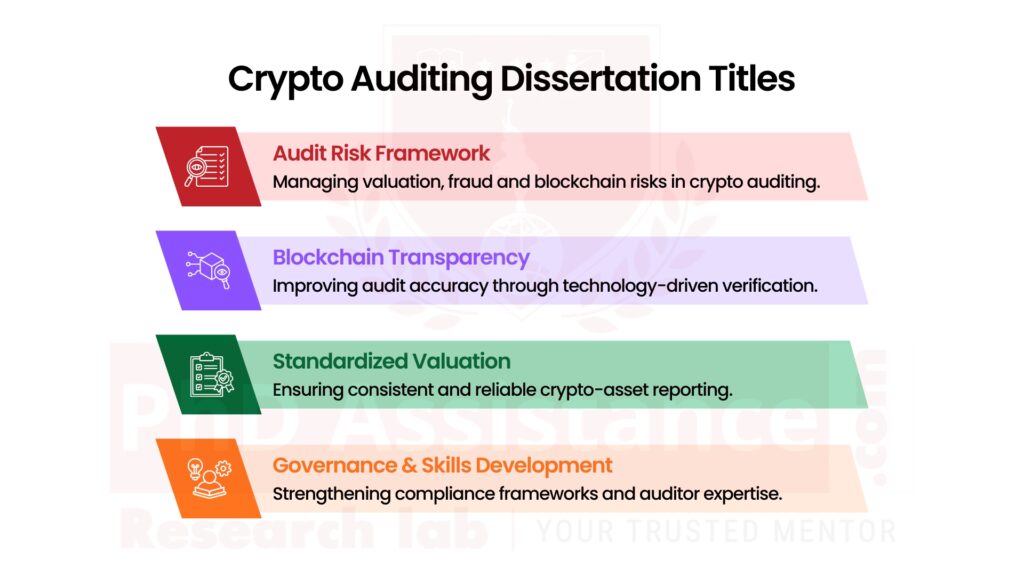
Proposed PhD Title 2. Blockchain-Enabled Auditing and Financial Transparency: Designing Technological Solutions to Mitigate Crypto Asset Audit Risks
The financial reporting and auditing processes receive significant benefits from blockchain technology because it delivers results that are completely transparent and traceable, and fully reliable. Financial institutions can conduct ongoing audits through the system, which uses a decentralised ledger system to monitor transactions instantaneously, while its unchangeable system design protects all financial information. Auditors need to change their approaches because crypto assets have become part of regular financial practices, which require them to use blockchain tools for transaction verification and fraud investigation. The process of implementing blockchain technology into auditing systems faces challenges because organisations lack both established implementation methods and the necessary technological expertise, and insufficient supervisory controls.
Problem Statement:
Blockchain technology has the potential to transform auditing practices; however, auditors face difficulties because they do not possess established guidelines or technological solutions that would enable them to use blockchain auditing tools with their current auditing methods. The gap in this technology prevents organisations from using blockchain technology to improve their audit processes through enhanced transparency and accuracy, and better fraud detection systems. Organisations and auditors cannot use blockchain technology to improve audit quality, which results in better financial reporting trustworthiness.
Research gap:
Current research discusses blockchain’s potential benefits but lacks empirical and conceptual models that demonstrate how blockchain-enabled auditing reduces audit risks while improving reporting reliability.
Research Question:
How can blockchain technology be used in auditing processes to improve transparency and accuracy while detecting fraud in crypto-asset transactions?
Outcome:
The research will establish a blockchain-based auditing system that enables ongoing auditing processes, authenticates audit results and builds trust among stakeholders in digital financial statements.
Reference:
Lazea (Trifa), G.-I., Bunget, O.-C., Bălan, A.-D., Solovăstru, M. Ş. (2025), Navigating Auditing Risks in the Crypto Asset Landscape, Audit Financiar, vol. XXIII, no. 1(177)/2025, pp. 197-209, DOI: 10.20869/AUDITF/2025/177/006
Proposed PhD Title 3. Valuation Challenges in Crypto Asset Accounting: Developing Standardised Models for Reliable Financial Reporting and Auditing
The process of determining crypto asset worth presents the greatest difficulty that modern accounting and auditing professionals must tackle. Crypto assets exhibit three main characteristics that create difficulties for organisations and auditors to assess their true value, establish ownership, and complete their financial documentation process. The practice of valuing assets through different methods creates a risk that financial statements will show incorrect information, which will decrease trust from investors.
Problem Statement:
Auditors and organisations face significant challenges when they attempt to find trustworthy methods that produce consistent results for assessing crypto asset value. The absence of unified assessment methods together with incomplete accounting standards creates a dual problem, which results in financial reporting errors while decreasing audit accuracy and making financial assessment more complex. The absence of organised assessment systems will make it impossible for organisations to achieve consistent and clear financial documentation of their crypto asset holdings
Research Gap:
The existing literature contains valuation problems that require additional research because it requires complete models that combine accounting principles with market information and technological resources to achieve accurate crypto-asset valuation.
Research Question:
Which valuation models, together with which auditing methods, will establish consistent financial reporting that maintains transparency and reliability for crypto assets?
Outcome:
The research will establish a standardised framework for crypto-asset valuation together with auditing guidelines, which will improve reporting accuracy while reducing financial error risks and increasing investor confidence.
Reference:
Lazea (Trifa), G.-I., Bunget, O.-C., Bălan, A.-D., Solovăstru, M. Ş. (2025), Navigating Auditing Risks in the Crypto Asset Landscape, Audit Financiar, vol. XXIII, no. 1(177)/2025, pp. 197-209, DOI: 10.20869/AUDITF/2025/177/006
Proposed PhD Title 4. Regulatory and Compliance Challenges in Crypto Asset Auditing: Towards a Global Governance and Assurance Framework
The worldwide decentralised system of cryptocurrency assets creates major difficulties for organisations’ auditors and government authorities who require effective regulatory compliance methods. The regulations that control cryptocurrency transactions differ between countries, and their rules continue to change because of ongoing technological developments. The existing regulations create difficulties for compliance verification processes because they establish legal uncertainties that make it difficult for organisations to meet their regulatory requirements. Auditors must navigate these complex regulatory environments while ensuring accurate financial reporting and adherence to standards.
Problem Statement:
Auditors face substantial challenges in ensuring regulatory compliance and financial transparency in crypto-asset transactions due to fragmented global regulations and rapidly changing legal frameworks. The absence of unified governance and assurance mechanisms increases the risk of non-compliance, fraud and financial misreporting. The current situation establishes an immediate requirement for organised regulatory systems and auditing standards that specifically address cryptocurrency assets.
Research gap:
The existing research on integrated governance and assurance frameworks that connect crypto-asset auditing practices to developing international regulatory requirements remains limited.
Research Question:
What steps are necessary to create a complete governance and compliance system that enables reliable auditing of cryptocurrency assets throughout different regions?
Outcome:
The research will develop an international governance and assurance framework that enables better regulatory compliance, enhances compliance monitoring and establishes credibility for crypto-asset financial statements.
Reference:
Lazea (Trifa), G.-I., Bunget, O.-C., Bălan, A.-D., Solovăstru, M. Ş. (2025), Navigating Auditing Risks in the Crypto Asset Landscape, Audit Financiar, vol. XXIII, no. 1(177)/2025, pp. 197-209, DOI: 10.20869/AUDITF/2025/177/006
Proposed PhD Title 5. Enhancing Auditor Competence and Technological Readiness in the Era of Crypto Assets: A Capability Development Framework
The introduction of cryptocurrency and blockchain systems into financial markets has fundamentally changed how auditors perform their duties. Auditors must now understand complex technological systems, which include blockchain architecture and cybersecurity mechanisms, and digital asset valuation processes. Audit professionals do not have enough technical skills and training to handle the new challenges that arise from emerging technologies. The skills deficiency that they have results in their difficulty in recognising risks and assessing internal controls while offering dependable assurance in environments that use crypto assets.
Problem Statement:
Auditors face considerable challenges because cryptocurrency assets have become more popular, and this leads to insufficient skills, which prevent them from handling technological needs, valuation work and compliance responsibilities. The audit standards of auditors need structured training programs and capability development frameworks to help them operate effectively with emerging digital financial systems. The existing gap shows that organisations need to create comprehensive competency development frameworks that specifically address the requirements of crypto-asset auditing.
Research gap:
Current studies demonstrate the necessity of auditor training, yet current studies do not provide the specific competency frameworks that research needs to develop the auditing expertise needed for crypto-asset auditing.
Research Question:
What competencies and training frameworks are essential for improving auditors’ capacity to use technology in their work?
Outcome:
The research will develop a competency-based capability framework that enables auditors to advance their skills in blockchain technology, digital risk assessment and advanced auditing practices.
Reference:
Lazea (Trifa), G.-I., Bunget, O.-C., Bălan, A.-D., Solovăstru, M. Ş. (2025), Navigating Auditing Risks in the Crypto Asset Landscape, Audit Financiar, vol. XXIII, no. 1(177)/2025, pp. 197-209, DOI: 10.20869/AUDITF/2025/177/006
Need assistance finalising your dissertation topic? Selecting a strong, researchable topic can be challenging — but you don’t have to do it alone.
Our research consultants can help refine your ideas, identify literature gaps, and guide you toward a topic that aligns with current academic trends and your programme requirements.
Contact us to begin one-on-one topic development and refinement with PhdAssistance.com Research Lab.
Share this:
Cite this work
PhDAssistance. (n.d.). Virtual Influencers Dissertation Titles Retrieved 30th January 2026, from https://phdassistance.com/title/virtual-influencers/
“Virtual Influencers Dissertation Titles, https://phdassistance.com/title/virtual-influencers/
“Virtual Influencers Dissertation Titles” PhDAssistance, PhDAssistance, Tuesday, January 30th,2026.
PhDAssistance, n.d. Virtual Influencers Dissertation Titles[Online]. Available at: https://phdassistance.com/title/virtual-influencers/ [Accessed January 30th, 2026].
PhDAssistance. Virtual Influencers Dissertation Titles[Internet]. PhDAssistance; [cited 2026 January 30th]. Available from: https://phdassistance.com/title/virtual-influencers/
PhDAssistance (n.d.).
Virtual Influencers Dissertation Titles. Retrieved January 30th, 2026, from https://phdassistance.com/title/virtual-influencers/
PhDAssistance, Virtual Influencers Dissertation Titles(PhDAssistance, n.d. January 30th accessed 2026.
Study Resources
Free resources to assist you with your university studies!