Call for Papers: The War on Children
Introduction
Children who experience armed conflict face multiple dangers because these situations subject them to violent attacks, force their displacement, cause them psychological damage and result in their loss of basic services. The presence of war and political instability in various regions leads to increasing dangers that threaten the safety, development, and long-term health of children. The rise of international conflicts has created a greater demand for research that uses evidence-based methods and for practical solutions that improve protection systems while maintaining the human rights standards of Children in armed conflict.
Children who live in areas affected by war suffer from severe human rights violations, which include their forced movement from home, their recruitment into military forces, their loss of educational opportunities and their exposure to violent situations. The impact of war on children remains one of the most critical yet under-explored areas that affects their emotional health, social development and future stability. The armed conflict, together with humanitarian emergencies, creates forced displacement of children, which results in family disintegration, educational interruptions, and access to healthcare.
The War on Children special issue requests interdisciplinary research together with practical evidence-based studies that examine methods to safeguard children from armed conflicts throughout the world. The organisation intends to demonstrate innovative methods together with policy frameworks and on-the-ground solutions, which will enhance child protection systems and help children develop resilience and achieve permanent recovery. The issue aligns with global policy dialogues, including the United Nations Security Council agenda on Children and Armed Conflict, to enhance policy relevance and international impact.
Scope
This special issue seeks original research, policy analyses, programme evaluations, and interdisciplinary studies that examine how children experience armed conflict protection in different parts of the world. The submission should present research methods that demonstrate both high scientific standards and real-world applicability to establish better protection systems for children and humanitarian emergency response systems.
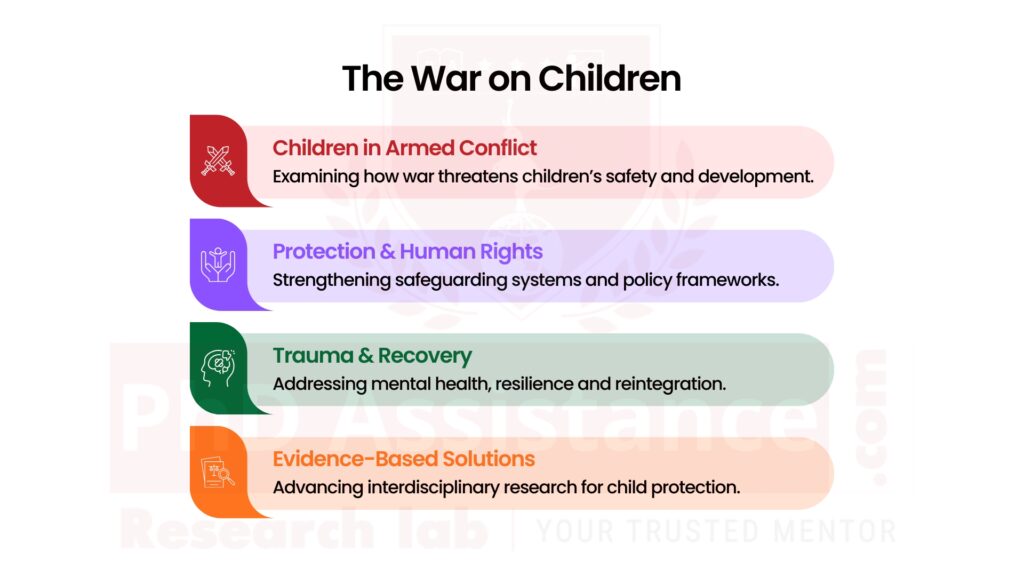
Researchers should study how conflict, displacement and education disruption and psychosocial trauma interact with each other. The research will create a positive impact through two main areas, which include studies of education in conflict zones and studies of essential service access, which help communities build resilience through recovery-based programs.
The problem requires solutions that need to address three areas of research. The solution employs an interdisciplinary method that combines four different fields of study.
Know More About This Issue
The experiences of children in the army need immediate global action, together with research partnerships between different fields. Ongoing conflicts increasingly affect civilian populations, which creates greater dangers for children because of risks to their safety, their ability to learn and their mental well-being.
The research about child protection policies, together with community-based solutions, needs to be studied because it helps improve both local and international safeguarding systems. The research about education in conflict during emergencies provides essential information about how to maintain stability and create educational opportunities for children who are affected.
The special issue seeks to enhance understanding about how war affects children through its three research areas, which study trauma and resilience and their impacts on long-term development. The issue aims to develop complete protection and recovery solutions through its research on child forced displacement and existing frameworks that protect the human rights of children.
The special issue will use research evidence and practical insights to shape international policy discussions while enhancing global efforts to protect children who experience armed conflict.
Key Themes
Researchers are invited to submit manuscripts addressing, but not limited to, the following themes:
How We Support Your Submission
Publishing in a high-impact international special issue requires strong conceptual frameworks, methodological rigour, and clear academic writing. The PhD Assistance Research Lab provides comprehensive support to researchers who write manuscripts about children affected by armed conflict and related subjects.
Our services include:
Journal Guidelines:
Important Dates
Submission Deadline: 15 April 2026
To ensure successful and timely submission to the special issue “The War on Children,” researchers are encouraged to leverage the expert services of the PhD Assistance Research Lab, which offers comprehensive support from conceptualisation to final manuscript submission by the specified deadline.
Free Guide: How to Write the Journal Manuscript
Book a free consultation to get guidance from PhD assistance research lab for writing a credible research manuscript and submitting it in the high-quality journal.
Reference
Roy, D., Jiménez López, M. D., & García Álvarez, M. E. (2025). Hires-PhD: A transversal skills framework for diversifying PhD employability. Humanities and Social Sciences Communications, 12, 18. https://doi.org/10.1057/s41599-024-04257-x