
Call for Papers: Fusion-based and Solid State Surface Engineering for Enhancing Functional Properties
Introduction
Rapid advancements in advanced manufacturing technologies, together with the development of high-performance material systems, have created increased demand for Fusion-based and solid state surface engineering solutions, which provide better durability and wear resistance, together with multiple operational capabilities. Modern engineering components operating in aerospace, automotive, biomedical, marine, and energy environments require surfaces that can withstand extreme mechanical, thermal, and corrosive conditions while maintaining structural integrity.
The process of surface degradation through frictional wear, oxidation, fatigue and microstructural instability forces components to experience reduced operational efficiency and shorter lifespans. Engineers now use advanced surface techniques, which enable them to create desired surface microstructure, surface chemical composition and surface mechanical properties while maintaining the original material properties.
This Special Issue invites high-quality original research and review articles that advance scientific understanding and technological innovation in fusion-based and solid-state surface processing methods for surface enhancement. The issue aims to connect experimental development with modelling and simulation and performance assessment for the purpose of developing next-generation engineered surfaces.
Scope
This Special Issue presents original research about Fusion-based and solid-state surface engineering, which creates new functional properties through better processing techniques and design methods focused on performance.
The submission process accepts work from all fields, which includes research about creating wear-resistant surface coatings that improve tribological performance, corrosion resistance and fatigue life extension in extreme operational conditions. Researchers should submit their work on modern surface modification methods, which include thermal spray processes, cold spray, diffusion treatments and ion implantation.
The research focuses on surface engineering methods, which create microstructural changes, surface alloying, cladding and texturing. The research team recommends that scientists study friction stir processing as a solid-state method to improve surface quality, grain size, and material properties.
Know More About This Issue
Engineering systems today require surfaces that support multiple functions while still performing reliably during extreme operational conditions. The use of fusion-based and solid-state surface engineering technologies permits precision control over three processes, which include heat input, material deposition and microstructural evolution to achieve specific property enhancements.
Fusion-based methods, such as surface engineering, create localised thermal treatment areas that enable precise control of alloying processes to produce better hardness, Wear resistant surface coatings and corrosion protection. Solid-state processes such as friction processing enable microstructural refinement through their ability to maintain material integrity without melting, while they improve mechanical performance through thermal distortion reduction.
The current state of functional surface enhancement research enables scientists to use experimental methods together with computational modelling techniques for studying how processing variables affect surface patterns, internal stress distribution and frictional performance. The combination of modelling and experimental testing enables industrial production of engineered surface technologies to be scaled up effectively.
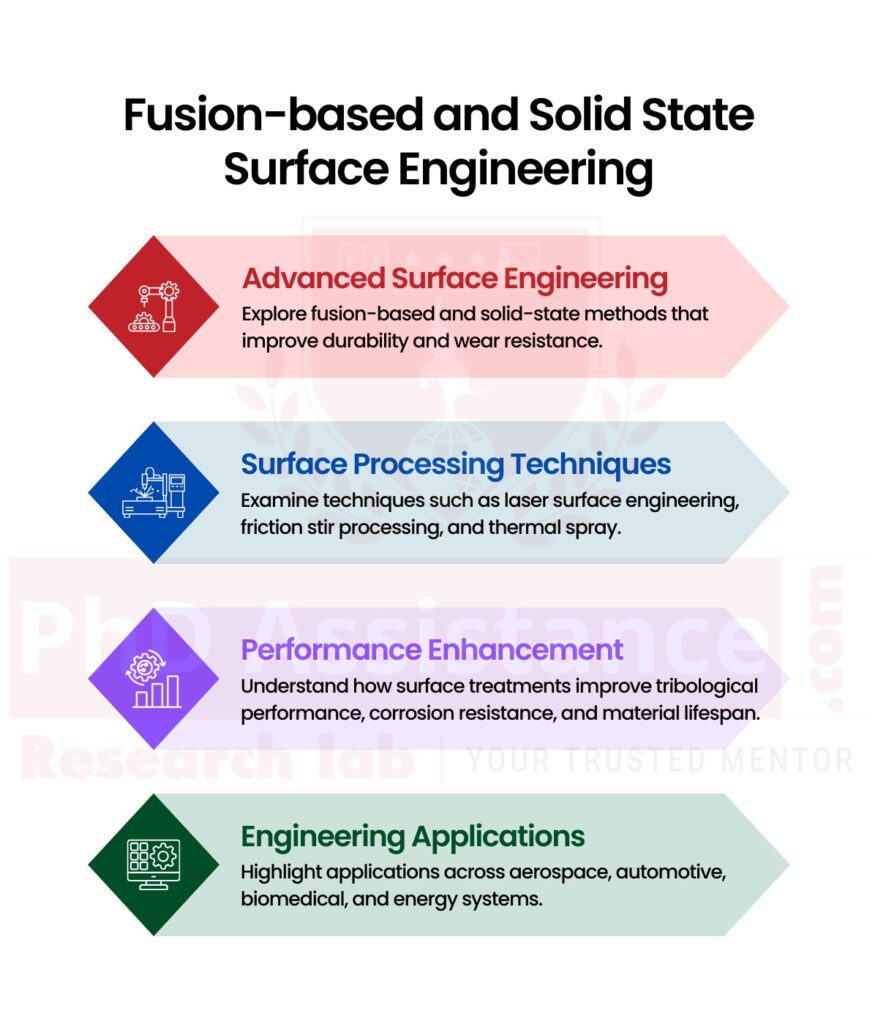
Key Themes
Researchers are invited to submit manuscripts addressing, but not limited to, the following themes:
How We Support Your Submission
Publishing in a high-impact Special Issue requires rigorous experimental validation, methodological clarity, and precise adherence to journal standards. Our research support services assist authors in preparing publication-ready manuscripts that align with the technical expectations of surface engineering journals.
Our editing services assist academic and technical writers to improve their document clarity, coherence, and scientific accuracy for Fusion-based and solid-state surface engineering research. Our team supports researchers in structuring their methodology sections, refining process descriptions, integrating modelling results, and presenting tribological data effectively.
We help with creating graphical abstracts and aligning journal formatting, standardising references, and responding to peer-review feedback. Your work on surface enhancement, surface modification techniques and performance modelling will receive better presentation results through our efforts.
Journal Guidelines:
Important Dates
Submission Deadline: 30 July 2026
To ensure successful and timely submission to the special issue “Fusion-based Surface Engineering for Enhancing Functional Properties,” researchers are encouraged to seek expert publication support from conceptualisation to final submission.
Free Guide: How to Write the Journal Manuscript
Book a free consultation to get guidance from the PhD assistance research lab for writing a credible research manuscript and submitting it in the high-quality journal.
Reference
Fusion-based and solid-state surface engineering for enhancing functional properties. (2026). ScienceDirect – Special Issue. Elsevier. https://www.sciencedirect.com/special-issue/330914/fusion-based-and-solid-state-surface-engineering-for-enhancing-functional-properties