
phdassistance

H1-Call for Papers: Hydrological Change and Water Extremes under Climate and Human Pressures at Regional Scales

Introduction

The current state of global hydrological systems experiences rapid changes, which result from climate variability and human activities. The call for papers invites researchers to study how current dynamic pressures impact water resource management at both regional and basin-level water systems.

Climate change enables water extremes, which include floods, droughts and water-quality degradation through its effects on precipitation patterns, rising temperatures and extreme weather events. Human activities, which include urbanisation, building reservoirs and expanding agriculture and extracting groundwater, have created new pressures that change natural hydrological systems’ flow patterns and storage capacities.

This call for paper on hydrological change research highlights the need for combining hydrological science with ecological, social, and policy perspectives. This special issue presents advanced research that develops scientific knowledge while offering real-world solutions to existing problems.

Scope

This special issue invites researchers from different fields to study Climate impact on regional water systems and how environmental factors and human activities interconnect with each other.

Researchers are encouraged to submit studies that:

  • Investigate the hydrological patterns and changes which occur in rivers and groundwater and reservoirs
  • Examine how climate factors and human activities affect hydrological systems which control water sources
  • Conduct research on hydrological extremes which includes floods droughts and simultaneous flood and drought events
  • Investigate how land-use changes and urbanisation and infrastructure development affect water runoff and storage capacities
  • The study investigates how water quality responds to changing hydrological patterns while assessing environmental risks
  • The team creates new modeling methods which combine data analysis and scenario development techniques
  • The team creates adaptable water management solutions which protect water resources at the regional level.
  • Know More About This Issue

    The growing complexity of hydrological processes necessitates a transition from traditional methods, which use static systems, to operational systems that function in real-time.

    Researchers should investigate the relationship between climate impacts on Regional hydrological change and the associated socio-economic factors, governance systems and technological developments. The organisation values contributions that generate practical solutions that support decision-making and help achieve sustainable outcomes.
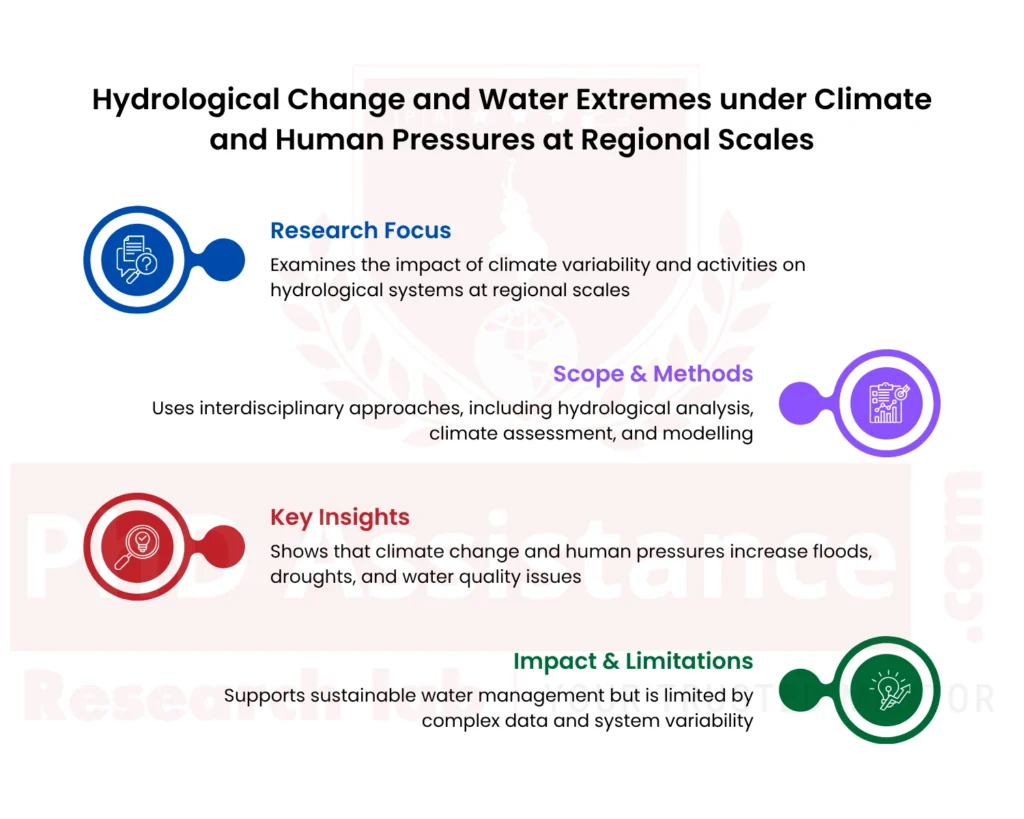
    Climate impact on regional water systems

    Key Themes

    The submission process requires candidates to submit their work, which may address the following research areas.

  • The investigation focuses on both the factors that lead to hydrological changes and their resulting patterns in specific geographic areas.
  • The investigation examines how climate change affects water extremes, which include floods, Human pressures on hydrology, and their combined risks.
  • Human activities, which include urbanisation, irrigation and infrastructure development, create negative effects on hydrological systems.
  • The research investigates how climate change affects regional water systems and their future water supply.
  • The field of Hydrological extremes research has developed through advancements in research methods, modelling techniques, and predictive analytics.
  • The research field studies socio-hydrological systems to assess resilience and risk and develop adaptive management strategies.
  • The research focuses on developing sustainable water resource management through effective policy-making, governance and planning methods.
  • How We Support Your Submission

    The special issue needs academic research that demonstrates exceptional quality and scientific methods that fulfil established publishing standards. Our support services help researchers enhance their work by:

  • Improving manuscript clarity, structure, and academic tone
  • Assisting in research design, methodology selection, and data analysis
  • Strengthening interpretation of hydrological results and findings
  • Ensuring compliance with journal formatting, referencing, and submission standards
  • Providing end-to-end guidance, including revisions based on peer-review feedback
  • Journal Guidelines:

  • The authors must submit original research articles and comprehensive review papers that remain unpublished and not under consideration by other publications.
  • The manuscript must demonstrate essential research results that advance hydrological change knowledge through defined research goals and expected results.
  • The authors must adhere to the journal’s official Guide for Authors, which specifies requirements for formatting and structural organisation, citation methods and figure and table presentation.
  • The organisation upholds strict academic integrity principles, which require scholars to avoid plagiarism while properly attributing all sources they use in their work.
  • The authors must confirm that all manuscript authors have completed their review of the final manuscript and provided their approval.
  • The authors must reveal all potential conflicts of interest along with funding sources and ethical considerations.
  • The authors must submit their manuscripts through the Editorial Manager system and choose the correct special issue category at the time of submission.
  • The authors must successfully upload all necessary documents, which include the manuscript, figures, supplementary data and cover letter.
  • The authors must complete manuscript revisions after receiving reviewer and editor comments according to the established deadline.
  • The evaluation process for all submissions involves a double-blind peer-review method, which assesses the work’s originality and research quality and its scientific value.
  • Important Dates

    Submission Deadline: 01 October 2026

    To ensure successful and timely submission to the special issue “Water extremes under climate change and Human Pressures at Regional Scales,” researchers are encouraged to seek expert publication support from conceptualisation to final submission.

    Free Guide: How to Write the Journal Manuscript

    Book a free consultation to get guidance from the PhD assistance research lab for writing a credible research manuscript and submitting it to a high-quality journal.

    Reference

    Journal of Hydrology: Regional Studies. (2026, March 16). Call for papers: Hydrological change and water extremes under climate and human pressures at regional scales. Elsevier. https://www.sciencedirect.com/journal

    Call For paper
    Generative AI on Educational Divide
    Call For paper
    Manuscript Call on TinyML advancements in Intelligent Systems
    Call For paper
    Abstract Submission Call on Big Data at IEEE international conference 2024
    Call For paper
    IEEE Annual Congress on Artificial Intelligence of Things (AIoT)
    We offer our Greatness in Various Parts of Research, and we help you with any phase of your Process. Make a Smart Decision and get your Paper Published.