
phdassistance

Call for Papers: CRISPR Screens in Illuminating Cancer Mechanisms and Drug Discovery

Introduction

The special issue investigates how large-scale CRISPR-based screening methods show cancer mechanisms and speed up drug development. Advances in gene-editing technology have revolutionised cancer research, allowing scientists to use genome-wide CRISPR screening to study the molecular processes that lead to tumour formation and to assess treatment outcomes.

The CRISPR/Cas systems allow scientists to edit multiple genes at the same time because they can conduct pooled screens, which test genetic material through both activation and deactivation methods. Cancer genomics approaches help scientists discover both oncogenic drivers and tumour suppressors, as well as specific weaknesses that researchers study in particular contexts. Researchers investigate both loss-of-function and gain-of-function disturbances to discover drug resistance pathways while establishing treatment response factors that lead to new treatment methods.

This special issue seeks to advance research in precision oncology through experimental studies that use CRISPR screening to identify cancer targets and develop new drugs and repurpose existing therapies.

Scope

We invite submissions of original research articles and experimental studies that investigate genome-wide CRISPR together with its applications in cancer biology and therapeutic discovery. The contributions must show both methodological accuracy and practical value, which will help develop functional cancer and precision medicine approaches.

  • Target identification through loss-of-function or gain-of-function CRISPR screens
  • The study investigates mechanisms of drug resistance together with the factors that determine drug responsiveness.
  • The study discovered synthetic lethality in cancer and discovered genetic vulnerabilities that occur in particular contexts through validation testing.
  • The research establishes methods to discover specific treatment requirements that differ among cancer subtypes and individual patients in oncology.
  • The research uses CRISPR technology to discover new anticancer treatments.
  • The research uses genome-scale screening methods to find new uses for existing approved therapies.
  • The issue encourages interdisciplinary research, which connects molecular biology with genomics and bioinformatics, and translational oncology and therapeutic development.

    Know More About This Issue

    Genome-wide CRISPR has rapidly become a standard approach in drug discovery and cancer research. CRISPR screens enable researchers to test all genes in the genome, which helps them study how genes work and how biological systems function. The technologies enable researchers to discover vital genes that tumours need to survive, to identify the connections that drive drug resistance mechanisms, and to find specific weaknesses that can be exploited.

    Researchers can use CRISPR screening together with omics technologies to study cancer genomics, which helps them understand how tumours differ from each other and how patients respond to treatment. The research studies that investigate lethality in cancer demonstrate strong potential to discover targeted treatment methods that reduce harmful side effects while achieving maximum treatment success.

    The special issue uses innovative experimental designs and translational applications to accelerate precision research, which creates targeted therapies based on genetic and molecular tumour characteristics.
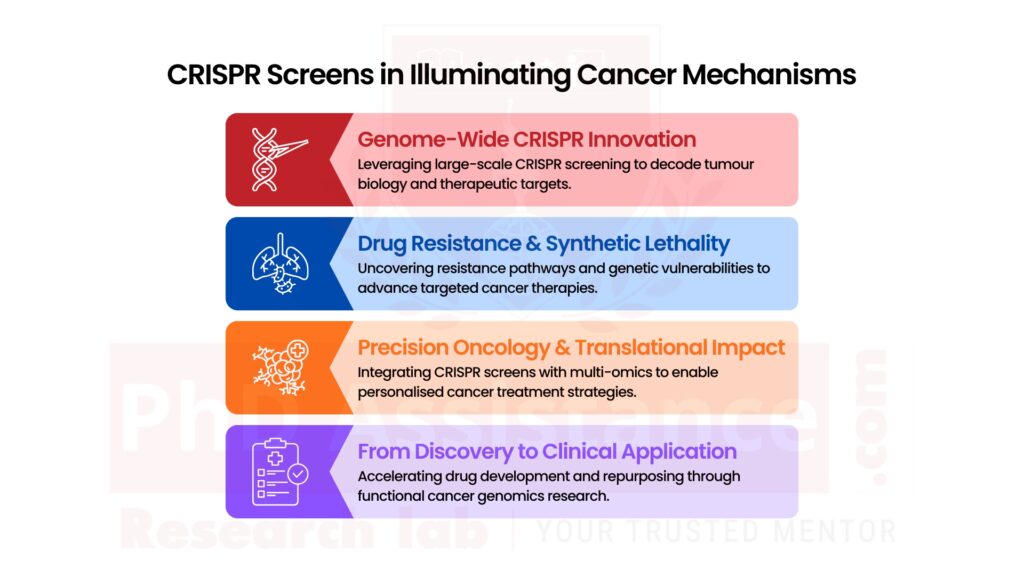
    CRISPR Screening in Cancer Mechanisms

    Key Themes

    Researchers are invited to submit manuscripts addressing, but not limited to, the following themes:

  • The use of genome-wide screening methods in cancer research demonstrates its various applications.
  • The field of cancer research has made progress through the development of new methods for discovering and confirming cancer treatment targets.
  • Researchers use CRISPR technologies to investigate the process that leads to drug resistance in their mechanistic studies.
  • The process of synthetic lethality discovery helps researchers develop targeted therapies for cancer treatment.
  • The combination of CRISPR screening and multi-omics research methods enables scientists to study cancer genomics at the functional level.
  • The research aims to establish practical methods that will enable doctors to deliver personalised cancer treatment.
  • Scientists use CRISPR technology to discover new cancer treatment drugs, which they then transform into usable medications.
  • How We Support Your Submission

    Publishing in a high-impact biomedical journal requires strong experimental design, clear data interpretation, and precise scientific writing. The PhD Assistance Research Lab provides comprehensive publication support for researchers working on CRISPR screening, cancer genomics, and translational oncology studies.

    Our services include:

  • Academic editing and manuscript refinement for clarity, coherence, and scientific accuracy
  • The service provides researchers with assistance to develop their experimental design for cancer target identification studies, which use CRISPR technology
  • The service assists researchers who need to show their large-scale screening results, bioinformatics data, and statistical results
  • The service helps researchers explain their discoveries about how cancer cells develop drug resistance and synthetic lethality
  • The service provides structural enhancements that help authors prepare their manuscripts to meet the journal’s scope and formatting requirements
  • The service assists authors who need help writing cover letters and making their submission materials meet requirements
  • The service helps researchers handle peer-review feedback while they work on their final manuscript revisions for acceptance.
  • Journal Guidelines:

  • The manuscript should contain original research that has not been published or submitted to other platforms. The authors must ensure that they maintain scientific integrity while they validate all data.
  • The final manuscript needs approval from all authors, who must also reveal their funding sources and any potential conflicts of interest.
  • The submission must adhere to the journal’s official Guide for Authors, which outlines requirements for formatting and referencing and ethical standards.
  • The authors need to choose “VSI: CRISPR” as the article type during their submission process, while they must indicate the manuscript category through their cover letter.
  • The peer review process for all manuscripts will include independent experts who will evaluate the work for originality and quality and its connection to CRISPR screening and functional cancer genomics research.
  • Research that uses human or animal samples needs to obtain proper ethical approvals, while authors must complete the review process by responding to comments and submitting their revised work within the specified time frame.
  • Important Dates

    Submission Deadline: 30 August 2026

    To ensure successful and timely submission to the special issue “CRISPR Screens in Illuminating Cancer Mechanisms and Drug Discovery,” researchers are encouraged to leverage the expert services of the PhD Assistance Research Lab, which offers comprehensive support from conceptualisation to final manuscript submission by the specified deadline.

    Free Guide: How to Write the Journal Manuscript

    Book a free consultation to get guidance from the PhD assistance research lab for writing a credible research manuscript and submitting it in the high-quality journal.

    Reference

    Gene Journal. (2026, February 19). Call for papers: CRISPR screens in illuminating cancer mechanisms and drug discovery (Special issue). Elsevier. Gene | ScienceDirect.com by Elsevier – Gene | ScienceDirect.com by Elsevier

    Call For paper
    Generative AI on Educational Divide
    Call For paper
    Manuscript Call on TinyML advancements in Intelligent Systems
    Call For paper
    Abstract Submission Call on Big Data at IEEE international conference 2024
    Call For paper
    IEEE Annual Congress on Artificial Intelligence of Things (AIoT)
    We offer our Greatness in Various Parts of Research, and we help you with any phase of your Process. Make a Smart Decision and get your Paper Published.