
Call for Papers: Biophysical Models in Clinical Radiation Oncology
Introduction
Biophysical Models in Clinical Oncology establish essential scientific foundations for contemporary radiotherapy by creating numerical connections between radiation dose and biological response. Through advances in radiobiological modelling in radiotherapy, researchers and clinicians can now better understand tumour control and normal tissue toxicity and treatment outcomes, which occur across multiple biological scales.
The latest advancements in modelling methods, which include tumour control probability models, tissue complication probability models and the linear quadratic model for radiotherapy, have delivered better treatment optimisation results and more accurate outcome predictions. The systems enable better assessment of radiation effects, which helps develop customised radiotherapy plans that match specific patient needs.
The special issue of Zeitschrift für Medizinische Physik titled “Biophysical Models in Clinical Radiation Oncology” invites high-quality original research reviews and perspectives that advance biologically informed radiotherapy while strengthening the translation of modelling innovations into clinical practice.
Scope
The special issue examines models in clinical radiation oncology, which are developed through research and practical implementation. The submission should demonstrate new progress in Radiobiological modeling in radiotherapy that provides better treatment planning and risk assessment, and therapeutic decision-making in radiotherapy.
We welcome studies addressing predictive modelling approaches such as tumour control probability models and tissue complication probability models, as well as investigations into the refinement and application of the linear quadratic model in radiotherapy. The research team particularly welcome studies that use imaging and genomics together with computational data to improve personalised radiotherapy planning.
The issue also seeks contributions that examine model validation and uncertainty quantification together with the clinical implementation of modelling frameworks that support biologically guided and patient-specific radiotherapy strategies.
Know More About This Issue
The development of Biophysical Models in Radiation Oncology has created new methods for designing and assessing radiation therapy treatments. Clinicians use the combination of radiobiological knowledge and computational modelling to forecast how tumours will respond to treatment, evaluate potential side effects and develop better treatment plans.
The development of new radiobiological models for radiotherapy treatment now enables scientists to investigate how radiation interacts with molecular targets and cellular structures. Clinicians use advanced tumor control probability models together with tissue complication probability models to make predictions about patient outcomes. The linear quadratic model, together with its associated frameworks in radiotherapy, continues to evolve, which leads to improved patient treatment planning through precise and flexible methods.
Personalized radiotherapy planning relies on these advancements to achieve maximum treatment benefits while reducing patient side effects. The special issue presents research that establishes better precision in radiation oncology through advanced modelling techniques.
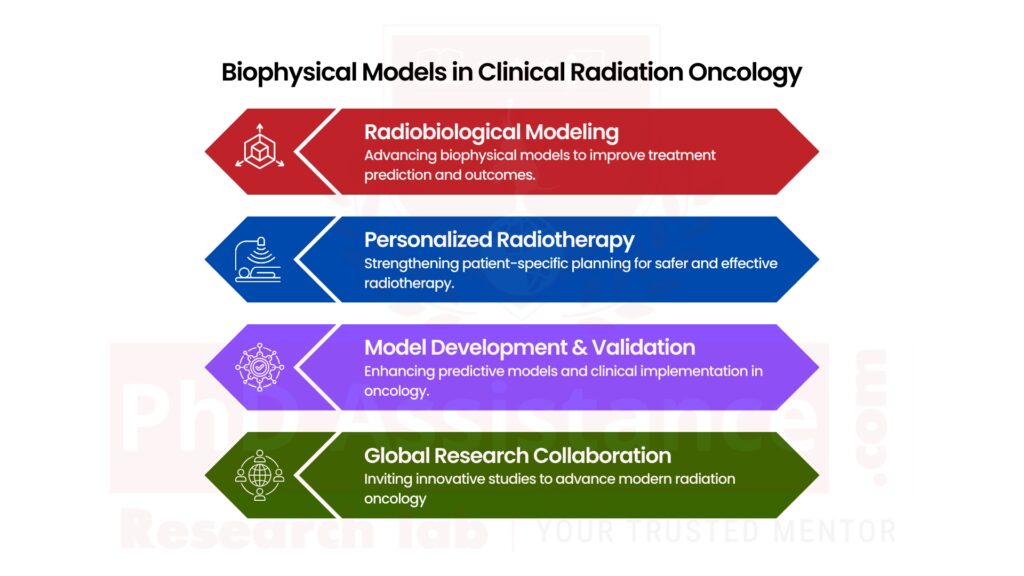
Key Themes
Researchers are invited to submit manuscripts addressing, but not limited to, the following themes:
How We Support Your Submission
Research articles submitted to medical physics journals with high impact must demonstrate exceptional conceptual understanding, thorough research methods and clinical application value. The PhD Assistance Research Lab provides complete manuscript development services for researchers studying Biophysical Models in Radiation Oncology and their associated fields.
Journal Guidelines:
Important Dates
Submission Deadline: 01 October 2026
To ensure successful and timely submission to the special issue “Biophysical Models in Clinical Radiation Oncology,” researchers are encouraged to leverage the expert services of the PhD Assistance Research Lab, offering comprehensive support from conceptualisation to final manuscript submission within the specified deadline.
Free Guide: How to Write the Journal Manuscript
Book a free consultation to get guidance from PhD assistance research lab for writing a credible research manuscript and submitting it in the high-quality journal.
Reference
Schneider, U., & Unterkirhers, S. (Guest Eds.). (2026). Call for papers: Biophysical models in clinical radiation oncology. Zeitschrift für Medizinische Physik. Elsevier. https://www.elsevier.com/journals/zeitschrift-fur-medizinische-physik/0939-3889