

Anomaly Detection in SCADA Systems for Power Grid Cyberattack Prevention
August 5, 2026
How to Fix a Weak PhD Research Methodology in Oxford Digital Humanities: Addressing Corpus Design and Text-Mining Frameworks
August 7, 2026Why UAE PhD Nursing Researchers Struggle to Build a Strong Theoretical Framework
- August 6, 2026
- Literature Reviews
Introduction
Developing a strong theoretical framework is one of the most difficult things during a PhD in nursing. Although many nursing doctorate students in the UAE have great clinical experience, they still find it hard to link nursing theories with the research questions, methodology, and results of their studies. The lack of a solid theoretical framework may influence the whole quality of the dissertation as well.
Since nursing research deals with complicated issues within health care and adds to evidence-based practice, it is necessary to find an adequate theory, critically appraise the current literature, and justify how the chosen theory is going to help throughout the research. Unfortunately, insufficient knowledge of nursing theories, poor methodology, and inability to critically review the literature can become barriers to creating a framework for doctoral research.
Understanding these problems will enable nursing researchers to improve the quality and effectiveness of their research proposals and dissertations. This blog post examines the major reasons that lead to difficulties in creating a strong theoretical framework by UAE PhD nursing researchers and gives tips on how to overcome the obstacles. PhD assistance research lab offers structured PhD Theoretical Framework Help in UAE to enhance the quality of nursing research.
What you will learn from this blog?
- Why a theoretical framework is essential in PhD nursing research.
- The common challenges faced by UAE nursing researchers.
- Practical strategies for developing a strong theoretical framework.
- How expert research support can improve doctoral research quality.
Why Does a Nursing Framework Help in UAE matters?
Theoretical frameworks are always used to set the basis of doctoral research. They explain what assumptions and relationships underlie the research process and why the research objectives and methodology were chosen. In nursing research, theoretical frameworks help formulate evidence-based practice based on the findings obtained through research.
A well-developed theoretical framework helps researchers:
- Define key concepts and variables.
- Develop focused research questions.
- Select appropriate research methods.
- Interpret findings within an established theoretical perspective.
- Demonstrate the originality and significance of the study.
In the absence of a sound theoretical basis, research loses its coherence, thus making it hard for supervisors and examiners to understand the academic contributions of the study. Researchers can build a strong framework with a customised Nursing Framework Help in UAE.
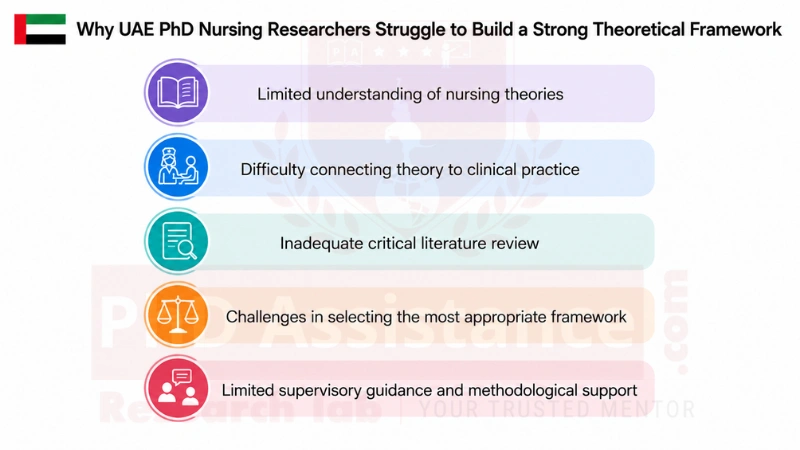
Why Do UAE PhD Nursing Researchers Struggle to Develop a Strong Theoretical Framework?
1. Limited Understanding of Nursing Theories
Most nurse-researchers who embark on their doctoral studies have abundant clinical experience but very little exposure to nursing theories. Although such researchers know everything about patient care and practice, it might be hard for them to choose an adequate theoretical framework.
It might be challenging for them to differentiate between grand theories, middle-range theories, and conceptual models or to use the selected theories in relation to their research topic. This is why many research proposals incorporate theories loosely related to the research purpose.
What research shows:
An exploratory study conducted by Dickinson, Quay, and Dolen in 2023 analysing 747 dissertations for doctoral nursing found that even though most of the doctoral studies had a theory framework included, only 31.7% applied a theory specific to nursing. It shows that most of the nursing researchers do not use theories specific to their field of research or are unable to find them.
Tips:
- Study major nursing theories before selecting a framework.
- Compare theories based on your research objectives.
- Review recent nursing dissertations for examples.
- Discuss theory selection with your supervisor.
2. Connecting Theory to Clinical Practice with PhD Theoretical Framework Service in UAE
The nature of research conducted by nurses is very practical. The topics chosen by PhD candidates for research are often determined by practical issues that occur in hospitals or healthcare organisations. Nevertheless, transforming practical issues of healthcare into a theoretical issue of research is not easy.
Clinicians can formulate problems well, but have difficulty explaining why the selected nursing theory is used to justify their research. They often get support from a structured PhD Theoretical Framework Service in UAE to address these challenges.
What research shows:
According to the systematic review conducted by Singh et al. (2024), one of the primary challenges for nursing education and research is the existence of the persistent gap between theory and practice. In particular, the inability of nurses to integrate theoretical concepts into their work is related to the insufficient connection between theoretical knowledge and clinical settings.
Tips:
- Choose theories that align with your clinical problem.
- Link theoretical concepts to each research objective.
- Explain how the framework guides data collection.
- Review studies that successfully apply similar theories.
3. Inadequate Critical Literature Review
A critical literature review is an essential part of Public Health Master’s research because it helps to build a theoretical base for the research. However, numerous students have difficulties progressing from summarizing other studies and do not conduct a critical evaluation of the evidence, point out research gaps and explain the necessity of conducting their own research.
Instead of combining findings from several scientific sources, they prepare descriptive literature reviews that do not include any analysis of the strengths and weaknesses of existing literature.
What research shows:
Lacerda et al. (2024) suggest that it is essential for nurses conducting research to critically analyse and justify the theoretical basis through a review of all available literature instead of simply reporting what was previously done. This is because theoretical analysis enhances the scientific base of research work and makes its results more applicable.
Tips:
- Critically analyse rather than summarise previous studies.
- Compare different theoretical perspectives.
- Identify strengths, weaknesses, and research gaps.
- Use recent peer-reviewed nursing literature.
4. Challenges in Selecting the Most Appropriate Framework
There are various theoretical/conceptual models in nursing, and hence doctoral researchers often find it difficult to select an appropriate framework. Most theories have similar concepts, hence making students choose popular frameworks rather than the ones that best fit their research questions.
Some researchers also try to merge different theories without giving a clear indication of how these theories can complement each other. Such a move may result in inconsistency among the research questions, methodologies and results interpretation. The choice of the best framework should depend on a proper evaluation of the research question.
What research shows:
It is evident from Bethel et al. (2022) that choosing a suitable theoretical framework involves a critical assessment of alternative theories based on the research aims, environment, and methods used. It is evident that through effective theory criticism, nurses can select more suitable theoretical frameworks that offer better theoretical congruence in their research.
Tips:
- Select a framework that aligns with your objectives.
- Clearly justify your theory selection.
- Maintain consistency between theory and methodology.
- Review similar doctoral studies for guidance.
Explore the guidance from PhD Assistance Research Lab to develop a high-quality theoretical framework for PhD Nursing.
5. Career Uncertainty During Clinical Academic Training
The guidance provided by the supervisor is very significant in assisting doctoral researchers to craft a sound theoretical framework. This, however, differs from one institution to another depending on the supervisor’s style. The students are usually required to come up with a suitable theory on their own and defend their decisions, a task that is difficult without having enough methodological knowledge.
This means that the researcher will need to revise a theoretical framework several times before the proposal is approved. Lack of feedback could also delay the research work.
Example: The qualitative study conducted by Jackson et al. (2021) indicates that successful supervision of doctoral candidates relies on having an adequate level of methodological knowledge, effective communication skills, and academic mentorship. The authors claim that mismatched expectations, poor advice, and lack of supervisory help may harm doctoral students’ self-confidence and research process, especially when theoretical frameworks need to be developed.
Tips:
- Discuss the framework during supervision meetings.
- Seek regular feedback on theoretical development.
- Attend research methodology workshops.
- Consult experts when additional guidance is needed.
Which Challenge Sounds Most Like You?
Take a moment to identify where you’re getting stuck:
- If you’re struggling to choose a nursing theory: Select a few related theories and pick the one that will best serve your research aims and methods.
- If you’re finding it difficult to link theory with practice: Begin with your clinical issue and then write about how your theory would help solve it during your research.
- If your literature review is mostly descriptive: Compare previous research, state the gap, and clarify your contribution to nursing research.
Quick Self-Check
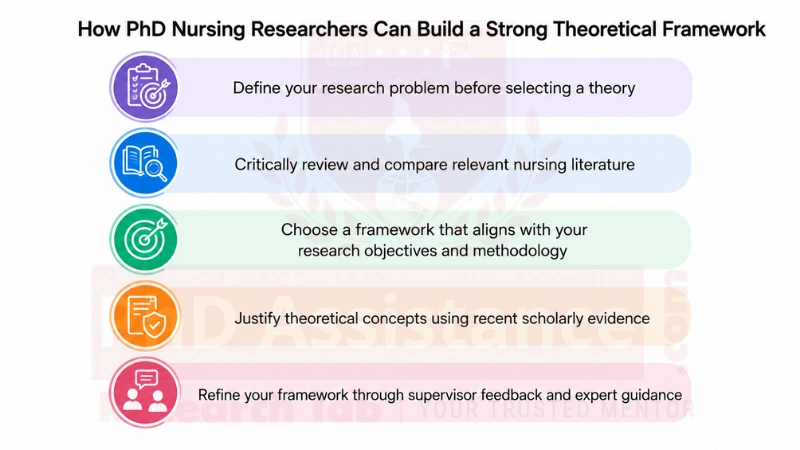
- Have I selected a theory that aligns with my research objectives?
- Have I critically reviewed the relevant nursing literature?
- Have I clearly linked my theoretical framework to my methodology?
- Have I justified my framework using recent scholarly evidence?
Conclusion
It is vital to have a robust theoretical foundation for conducting quality nursing research aimed at developing evidence-based practice in healthcare. Nonetheless, many UAE PhD nursing scholars encounter issues due to a lack of theoretical knowledge, difficulty in linking theory to practice, and a lack of critical review of the literature.
By addressing these problems and developing a strategy to select theories and analyse literature, doctoral candidates can build better research proposals and dissertations. Proper planning and consistent feedback from supervisors and personal academic development play a major role in creating a better theoretical framework.
If you are struggling to build a strong theoretical framework for your nursing PhD research, get professional research guidance from PhD assistance research lab to strengthen your proposal, improve theoretical alignment, and enhance the overall quality of your doctoral study.
Book a Free Expert Consultation and receive Customised PhD Nursing Framework Support in UAE for nursing students.
References
- Dickinson, J. K., Quay, C., & Dolen, E. (2023). Use of Nursing Theory to Guide Doctoral Research: An Exploratory Study. Nursing science quarterly, 36(4), 381–386. https://doi.org/10.1177/08943184231187868
- Singh, Kalpana, Alomari, Albara Mohammad Ali, Sayed, Hashim Mohamed Al, Mannethodi, Kamaruddeen, Kunjavara, Jibin, Joy, George V., Hassan, Nesiya, Martinez, Ederlie, Lenjawi, Badriya Al, Barriers and Solutions to the Gap between Theory and Practice in Nursing Services: A Systematic Review of Qualitative Evidence, Nursing Forum, 2024, 7522900, 10 pages, 2024. https://doi.org/10.1155/2024/7522900
- Lacerda, M. R., Silva, R. S. D., Gomes, N. P., & Souza, S. R. R. K. (2024). Reflections on theoretical framework use in nursing research. Revista brasileira de enfermagem, 77(3), e20230486. https://doi.org/10.1590/0034-7167-2024-0486
- Bethel, C., Reed, P. G., Brewer, B. B., & Rainbow, J. G. (2022). Selecting a theoretical framework to guide research on the COVID-19 pandemic impacts on nursing care delivery and the critical care work system (using Reed’s Intermodern approach to theory critique). Applied Nursing Research, 63, 151513. https://doi.org/10.1016/j.apnr.2021.151513
- Jackson, D., Power, T., & Usher, K. (2021). Understanding doctoral supervision in nursing: “It’s a complex fusion of skills.” Nurse Education Today, 99, 104810. https://doi.org/10.1016/j.nedt.2021.104810
FAQs:
1. Why is a theoretical framework important in nursing research?
A theoretical framework provides the foundation for the study by guiding research questions, methodology, data analysis, and interpretation of findings.
2. How do I choose the right nursing theory for my PhD research?
Choose a theory that closely aligns with your research objectives, study variables, and healthcare problem while ensuring sufficient scholarly evidence supports its application.
3. What is the difference between a theoretical and conceptual framework?
A theoretical framework is based on established theories, whereas a conceptual framework is developed by the researcher to explain relationships between concepts within the study.
4. Can I use more than one theory in my nursing research?
Yes, multiple theories may be used if they complement each other and are clearly justified. However, the framework should remain coherent and aligned with the research objectives.
4. How can professional research support help with theoretical framework development?
Professional guidance can help researchers identify appropriate theories, strengthen literature reviews, justify theoretical choices, improve academic writing, and ensure the framework aligns with the overall research design.
