
How to Fix a Weak PhD Research Methodology in Oxford Digital Humanities: Addressing Corpus Design and Text-Mining Frameworks
Sustainable Practices in Environmental Science
- Diagnose Weaknesses in Your Current Research Methodology
- Rebuild Corpus Design Around Sampling, Balance, and Representativeness
- Select and Justify a Text-Mining Framework
- Anchor the Methodology in Theory and Reproducibility
- Validate, Document, and Defend Your Research Methodology
- Which Challenge Applies to You?
- Conclusion

Recent Post
Introduction
The process of writing the methodology chapter is among the most challenging aspects of a PhD in Digital Humanities. Students are supposed to combine their skills in literary or historical interpretation with computational approaches while maintaining methodological rigour. This is especially true for PhD candidates at the University of Oxford.
In contrast to many conventional areas of the humanities, in Digital Humanities, the researcher needs to provide an explanation for each and every methodological choice made during research, including the choice of texts to analyse and the computational techniques to apply. More and more examiners expect from a methodology chapter not only an explanation of the methods applied, but also their justification and reproducibility.
The problems with methodology chapters arise during the analysis stage, when the rationale for certain methodological choices is missing. In particular, researchers might simply use data that they have at hand, apply well-known techniques of text mining without any justification why this tool is appropriate or lack documentation for the analysis process. This article aims to describe ways to enhance the quality of the corpus design and text mining approaches. Structured PhD Methodology Writing Support in UK can significantly increase the quality of research conducted in corpus design.
What you will learn?
Step 1: Diagnose Weaknesses in Your Current Research Methodology
Before revising the methodology chapter, it is crucial for researchers to critically analyse and discover the methodological weaknesses in the research design. In the case of corpus-based Digital Humanities studies, some of the most common problems involve the creation of a corpus on a convenience basis, the choice of text-mining approaches without relating them to research goals, and inadequate documentation of analysis.
This is crucial because transparency and reproducibility play vital roles in determining the quality of research in Digital Humanities. Examiners will always require the researcher to explain why he has adopted certain methodologies in his research process. This can include such aspects as the choice of corpus, its preprocessing, parameter setting and analysis techniques.
What Research shows:
Research conducted by Joyeux-Prunel (2024) claims that Digital Humanities is moving into a new era where computational approaches must satisfy the same criteria of transparency and rigour as humanities scholarship. In other words, one is expected not to consider computational techniques as neutral, but rather to justify the choice of a corpus, the model used and the analysis itself.
In the case of doctoral students, this underscores the importance of the following rule: the Digital Humanities Research Methodology section should not only include sophisticated computing techniques, but should justify why these methods are relevant to answer the research question.
Tips
Step 2: Rebuild Corpus Design Around Sampling, Balance, and Representativeness
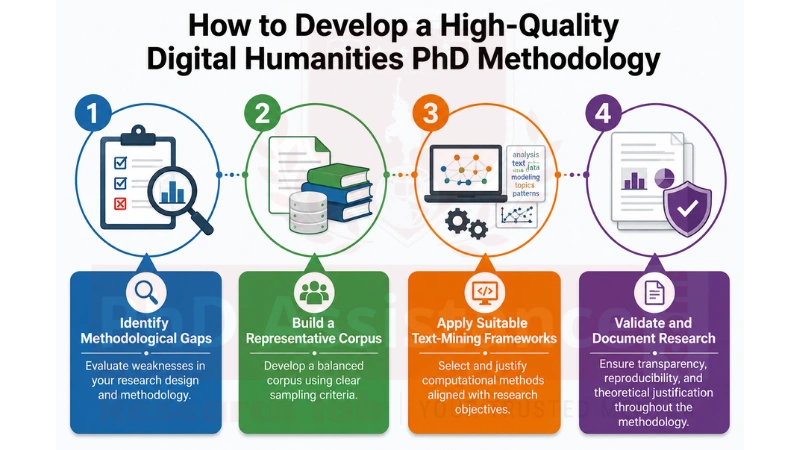
A well-structured corpus is the basis of trustworthy Digital Humanities studies. First, before conducting any computations, it is important to make sure that the corpus adequately represents the group being studied. To have an Effectively Designed Corpus for PhD Research, a clear sampling strategy should be established and the necessary balance between such factors as genre, period, authorship, or source should be achieved.
Many PhD students often undervalue the importance of corpus design and concentrate only on computerised analysis. Nonetheless, the decisions related to the sample affect the validity of the results produced by the research. Should the corpus fail to cover the targeted audience, even the most advanced computerised analysis can yield false results.
What Research shows:
Egbert, Biber, and Grey (2022) offer a realistic way to measure the representativeness of a corpus by comparing various forms of sampling. This work shows that well-justified sampling methods make corpus-based analysis more valid. In digital humanities studies, these ideas can be used as a basis for justifying the choice of texts, writers, or time periods included in the corpus.
Tips
Step 3: Select and Justify a Text-Mining Framework
Once a representative corpus has been established, researchers should select computational methods that directly address their research objectives. A suitable Text Mining Framework for Digital Humanities should be chosen based on the nature of the research questions rather than the popularity or familiarity of particular software tools.
Common approaches include topic modelling, stylometric analysis, authorship attribution, named entity recognition, collocation analysis, and machine-learning techniques. However, the choice of method should always be supported by a clear methodological rationale. Researchers should also explain how the selected approach is validated and why it is appropriate for analysing the characteristics of their corpus.
What Research shows:
Joo et al. (2022) have conducted a study on research trends in the field of Digital Humanities through text mining using topic modelling and computational text analysis. Likewise, in their research on methodology in the journal Digital Humanities Quarterly, Aladağ and Aydın (2026) used topic modelling and co-occurrence analysis. Such studies prove the importance of well-grounded computational processes in facilitating results interpretation.
Tips
Example modal:
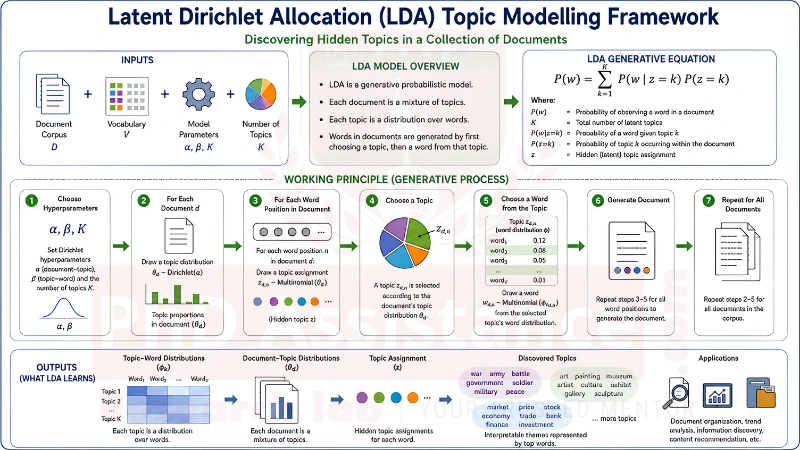
Latent Dirichlet Allocation (LDA) Topic Modelling Framework
Latent Dirichlet Allocation (LDA) was proposed by Blei, Ng, & Jordan (2003) as a statistical topic modelling method that can reveal underlying topic structures of large document corpora. As an application of LDA in the field of digital humanities, the method is commonly used to analyse historical documents, literary works, newspapers, and other text corpora by detecting clusters of words that tend to co-occur together.
P(w)=k=1∑KP(w∣z=k)P(z=k)
Where:
P(w) = Probability of observing a word in a document
K = Total number of latent topics
P(w∣z=k) = Probability of a word given topic k
P(z=k) = Probability of topic k occurring within the document
z = Hidden (latent) topic assignment
Step 4: Anchor the Methodology in Theory and Reproducibility
An effective methodology section has to prove not only the competence of researchers in terms of their technical skills but also their theoretical knowledge. Researchers must clarify how their Corpus Design for PhD Research approaches correlate with the theories of Digital Humanities, corpus linguistics, etc.
While many doctoral researchers may be able to explain how their methods work, they often struggle to explain why they chose that method, from a theoretical perspective. It is always useful to relate the methodology chosen to scholarly theories to lend credibility to the research.
What Research shows:
Ries, van Dalen-Oskam, & Offert (2023) present the special issue in the International Journal of Digital Humanities concerning reproducibility and explainability, emphasising the importance of transparency and documentation in digital humanities research. The authors stress the importance of making clear how the corpus was constructed, what the workflow of analysis is, and what methods were used.
Tips:
Step 5: Validate, Document, and Defend Your Research Methodology
The final step of building a robust methodology is making sure that all research choices are explicit and defensible. Researchers need to validate the methods of analysis, outline all steps taken in preparing and analysing the data, and admit any shortcomings of the research process. This shows that the methodology was rigorous enough to be understood or repeated by others.
The viva preparation is just as crucial as well. Scholars need to be prepared to explain the reason behind choosing a particular sampling approach, computational technique or theoretical framework. This makes the methodology section stronger and boosts one’s confidence in the viva.
Stating the contributions in a clear manner ensures that the originality of the dissertation and relevance to Agricultural Engineering Research are achieved.
What Research shows:
According to Joyeux-Prunel (2024), reproducibility involves making a clear documentation of the research process, including decisions made, workflow, and underlying assumptions. It increases the validity of the research process and enables assessment and reproduction by others.
Tips
Which Challenge Applies to You?
Identify the area where you need the most improvement:
Quick Self-Check
Conclusion
A poor methodology section is not always an indication of a poorly-conducted research project. In most cases, the difficulty lies in the lack of adequate reasoning behind the development of the corpus, computing and analysis methods. By analysing the research design, creating a representative corpus and being methodologically transparent, a doctoral researcher will greatly improve the quality of the dissertation.
A sound methodology relies on well-justified corpus design, text mining, theoretical foundation, and good documentation. When combined, these components will increase the validity, reproducibility, and scholarly value of the research in Digital Humanities.
Looking to strengthen your Digital Humanities methodology? Connect with the Experts at the PhD Assistance Research Lab to build research methodology in corpus construction, computational text analysis, and methodological validation to support high-quality doctoral research.
Get a free consultation with PhD Assistance Research Lab and receive expert PhD Methodology Writing Services in UK.
References
- Egbert, J., Biber, D., & Gray, B. (2022). Corpus design and representativeness in practice. In J. Egbert, D. Biber, & B. Gray (Eds.), Designing and evaluating language corpora: A practical framework for corpus representativeness (pp. 177–219). Cambridge University Press. https://doi.org/10.1017/9781316584880.007
- Joo, S., Hootman, J., & Katsurai, M. (2022). Exploring the digital humanities research agenda: A text mining approach. Journal of Documentation, 78(4), 853–870. https://www.emerald.com/sign-in?returnUrl=%2Fjd%2Farticle%2F78%2F4%2F853%2F200104%2FExploring-the-digital-humanities-research-agenda-a
- Joyeux-Prunel, B. (2024). Digital humanities in the era of digital reproducibility: Towards a fairest and post-computational framework. International Journal of Digital Humanities, 6(1), 23–43. https://link.springer.com/article/10.1007/s42803-023-00079-6
- Ries, T., van Dalen-Oskam, K. H., & Offert, F. (2023). Reproducibility and explainability in digital humanities: Introduction. International Journal of Digital Humanities, 5(2–3), 247–251. https://pure.knaw.nl/ws/portalfiles/portal/1653408865/Reproducibility_and_explainability
References
1. How can I improve a weak Digital Humanities PhD research methodology?
Start by identifying methodological weaknesses, defining a representative corpus, selecting appropriate text-mining methods, and ensuring every methodological decision is clearly justified and reproducible.
2. Why is corpus design important in Digital Humanities research?
A well-designed corpus ensures representativeness, improves research validity, and provides a reliable foundation for computational text analysis and meaningful interpretation.
3. What text-mining methods are commonly used in Digital Humanities?
Researchers commonly use topic modelling, stylometry, authorship attribution, named entity recognition, collocation analysis, and machine learning, depending on their research objectives.
4. How can I ensure my Digital Humanities methodology is reproducible?
Document every stage of corpus construction, preprocessing, analysis, and validation. Clearly explain your workflow and justify all methodological choices to support transparency and reproducibility.
5. How can I strengthen my Digital Humanities PhD dissertation methodology?
Develop a representative corpus, choose suitable computational methods, align your methodology with relevant theories, validate your findings, and prepare to justify your methodological decisions during your viva.