

Critical Review of Jamshed et al.’s non-terrestrial networks for 6G: Integrated, intelligent, and ubiquitous connectivity
September 23, 2026
Five PhD Research Directions in Real-Time Genomic Surveillance for Antimicrobial Resistance Prediction
September 25, 2026Chasing a Saudi PhD Scholarship in Medicine? Why Medical Research Proposals Get Rejected at the Funding Stage
- September 24, 2026
- PhD Research proposal
A good healthcare PhD research proposal should include more than just a description of a research problem in healthcare. If the research is to secure funds, the proposal must explain the significance of the issue, the knowledge gap the research will address, the research methodology that will be applied, and the expected outcome of the research.
This becomes more important when applying for a PhD scholarship in Saudi Arabia because there are different requirements for different universities, programs, and scholarships. For example, the Saudi Ministry of Education’s Study in Saudi platform states that scholarship applications are submitted through the chosen educational institution, while universities determine acceptance and scholarship processing.
At the university level, research can also be an explicit part of doctoral progression. King Saud University’s PhD framework for health and medical sciences includes a research proposal as a component of the doctoral programme, while its PhD in Optometry & Vision Science specifically requires applicants to submit a research proposal demonstrating their research interests and intended direction.
This is where PhD Research Proposal Help in Saudi Arabia from PhD Assistance Research Lab can support researchers through research-gap development, methodology alignment, proposal structuring, academic editing, and final proposal review.
What Will You Learn from This Blog?
- Why a medical PhD research proposal may be unsuccessful at the funding or selection stage.
- How to establish a research gap that is relevant to the proposed study.
- How to strengthen feasibility, expected outcomes and research impact.
- What to check before submitting a PhD scholarship or funding proposal in Saudi Arabia.
Why Is a Strong Research Proposal Important for PhD Funding in Saudi Arabia?
The research proposal facilitates evaluators with an organised presentation of the research that the applicant intends to undertake. The research proposal provides an integrated research argument connecting the research problem, knowledge gap, research objectives, methodology, expected results, and contribution.
Requirements vary among Saudi universities. For instance, at Umm Al-Qura University, postgraduate requirements involve having a statement of purpose and a CV that includes research accomplishments, but the research support program involves elements like an introduction, literature review, methodology, expected outcome, research benefit for Saudi Arabia, and references (Umm Al-Qura University, n.d.).
This means applicants should not assume that one generic proposal format will satisfy every university or funding route.
For a medical research proposal, the reviewer may need to understand:
- What clinical, public-health or biomedical problem is being investigated?
- What is already known?
- What remains uncertain?
- Why does the gap matter?
- What population or setting will be studied?
- Why is the proposed methodology appropriate?
- Is the study feasible within the doctoral timeframe?
- What could the findings contribute to healthcare, research or policy?
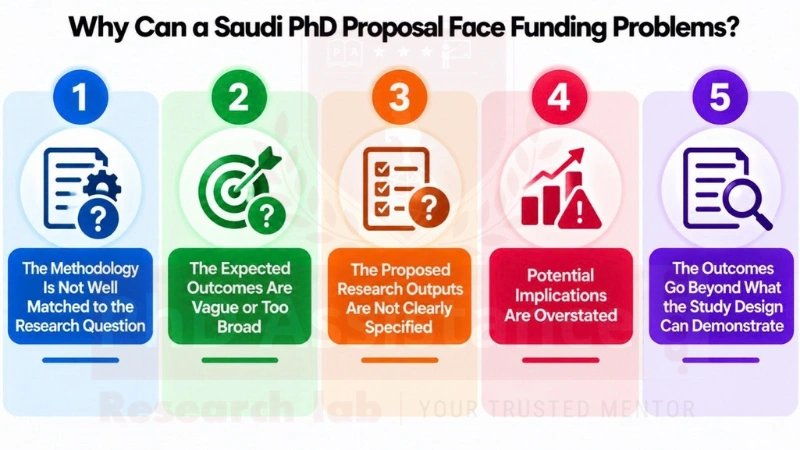
PhD Proposal Rejection in Saudi Arabia: Why Medical Research Proposals May Not Receive Funding
1. The Research Problem Is Too Broad
A common weakness in a Research Proposal for PhD Funding is attempting to address an entire disease, healthcare system or clinical problem within a single doctoral project.
For example:
Too broad:
“Improving Diabetes Management in Saudi Arabia”
More focused:
“Evaluating the Association Between Medication Adherence and Glycaemic Control Among Adults With Type 2 Diabetes in Primary Healthcare Settings in Riyadh”
The second topic identifies a clearer:
- Population
- Clinical context
- Research relationship
- Measurable outcome
- Geographical setting
A doctoral proposal does not necessarily become stronger by covering more variables. Its strength depends on whether the proposed research question is sufficiently focused and investigable. Maintaining this focus is important for students preparing proposals for doctoral programmes in Saudi Arabia, as an overly broad or poorly defined research scope can make a proposal more difficult to evaluate and may weaken its funding case.
Research Example:
The Prince Naif bin Abdulaziz Health Research Centre’s Small Research Project initiative from King Saud University (KSU) requires postgraduate research proposals to fall within health research and innovation, and proposals are evaluated for merit, innovation and relevance to the centre’s research mission. The initiative also asks applicants to explain the direct contribution of the research outcomes to health practice.
This illustrates why a broad topic such as “Improving Diabetes Management in Saudi Arabia” would need to be narrowed into a researchable problem. A proposal should identify the specific population, healthcare setting, variables or phenomenon being investigated, and the outcome that will be examined.
2. The Research Gap is Unclear
A PhD research proposal may face difficulties when the proposal describes a health problem but does not demonstrate what remains unknown.
Statements such as:
“Diabetes is a major health problem and more research is needed.”
do not, by themselves, establish a doctoral research gap.
A stronger proposal should show what existing studies have already established and where uncertainty remains.
The gap may involve:
- Contradictory findings
- Limited evidence in a particular population
- Methodological limitations
- An under-researched clinical setting
- Limited longitudinal evidence
- Inconsistent findings between studies
- An unexplored mechanism or association
- Lack of evidence from a particular geographical or healthcare context
The logic should become:
Existing Evidence → Limitation → Specific Gap → Research Question → Proposed Contribution
Example
Suppose previous studies have examined medication adherence among patients with diabetes, but evidence is limited regarding how adherence relates to glycaemic control in a defined Saudi primary-care population.
The proposal should not simply state that the topic is “important.”
It should demonstrate:
What is known → What is uncertain → Why the uncertainty matters → How the proposed study will investigate it.
This makes the research gap part of the research argument rather than a separate paragraph.
3. The Proposal Does Not Demonstrate Feasibility
A research proposal could be scientifically fascinating, yet it could remain tough to fund if the proposal fails to show its feasibility.
Reviewers should understand whether the applicant has considered:
- Access to participants or datasets
- Recruitment requirements
- Research sites
- Laboratory facilities
- Equipment
- Data availability
- Required expertise
- Ethical approval
- Study duration
- Sample size requirements
For medical research, feasibility can become especially important when a proposal involves clinical participants, biological samples, diagnostic procedures, longitudinal follow-up or specialised laboratory facilities.
A useful proposal therefore connects:
Research Objective → Required Data → Data Source → Method → Resources → Timeline
This gives reviewers a clearer picture of whether the proposed study is realistically executable.
Research example:
The Prince Naif bin Abdulaziz Health Research Center at King Saud University provides a particularly relevant Saudi funding example.
Its research-support requirements ask applicants to provide a detailed work plan/research calendar, itemised budget, research methodology, expected-result utilisation and relevant research approvals. For projects involving human or animal subjects or clinical work, ethical clearance is required before approval of the research-support application. The initiative also limits supported projects generally to a maximum period of one year, with exceptions specified in the programme guidance.
Explore PhD Research Proposal Support at PhD Assistance Research Lab for guidance on research gaps, methodology and proposal quality
4. The Methodology and Expected Outcomes Are Not Clearly Defined
The methodology should demonstrate how the proposed design will answer each research question. Sampling, data collection and analysis should therefore be justified in relation to the study objectives. A methodology that does not explain how the study will generate evidence for the research questions can be difficult to evaluate.
Rather, one should separate research outcomes from any possible implications of the research.
Instead, distinguish between research outputs and potential longer-term implications.
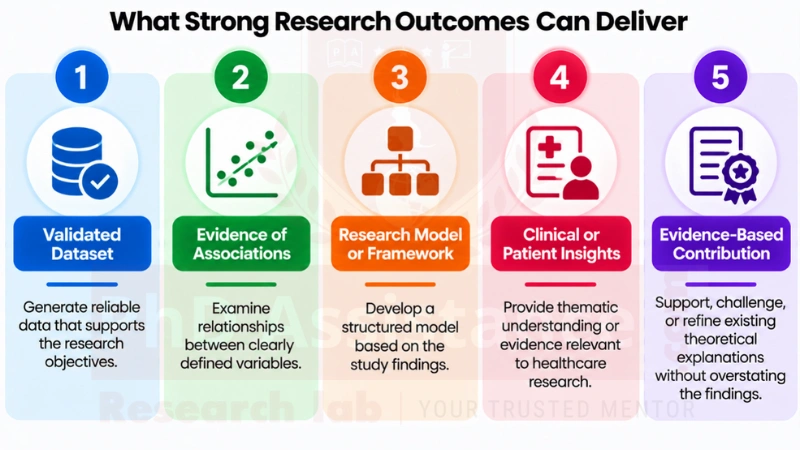
- Possible research outputs
- A validated dataset
- Evidence of an association between defined variables
- A model or framework
- A thematic understanding of patient experiences
- A diagnostic or analytical method
- A systematic evidence synthesis
- Evidence supporting or challenging an existing theoretical explanation
- Potential implications
Depending on the study, findings could potentially inform:
- Clinical practice
- Healthcare management
- Public-health interventions
- Future research
- Health policy
- Resource allocation
The proposal should avoid promising outcomes that the research design cannot establish.
Saudi Medical Research Example: King Saud University’s Prince Naif Health Research Centre explicitly states that the methodology should properly match the research question. Its funding guidance considers quantitative, qualitative and mixed-methods approaches, provided the selected methodology can produce the data required to achieve the project’s aims and is sufficiently explained in the proposal.
5. Research Proposal for PhD Funding Does Not Meet University Requirements
One of the most practical causes of avoidable problems is treating proposal requirements as universal. But they are not universal.
For example, Umm Al-Qura University publishes postgraduate admission requirements that include a statement of purpose and CV, while its research-support application specifies research-proposal components.
At King Saud University, the PhD in Optometry & Vision Science requires a research proposal demonstrating research interests and intended direction, along with other programme-specific requirements.
Therefore, before submission, applicants should check:
- University-specific admission requirements
- Programme-specific requirements
- Scholarship requirements
- Proposal word/page limits
- Required sections
- Referencing requirements
- Language requirements
- Supporting documents
- Supervisor requirements
- Submission platform
- Application deadline
A proposal can be academically strong but still require revision if it does not follow the specified application format.
6. The Research Questions and Objectives Do Not Match
A proposal can contain an interesting research problem but still become difficult to evaluate when the research questions and objectives are disconnected.
For example:
Research Question:
What is the association between medication adherence and glycaemic control among adults with type 2 diabetes?
Objective:
To develop a nationwide policy framework for diabetes prevention.
The objective extends far beyond what the stated research question investigates.
A stronger alignment would be:
Research Question:
What is the association between medication adherence and glycaemic control among adults with type 2 diabetes receiving primary care?
Objective:
To investigate the relationship between medication adherence and glycaemic control in adults with type 2 diabetes attending primary care clinics.
Saudi PhD Example: Linking Literature, Hypothesis and Aims
KSU’s PhD in Optometry & Vision Science offers a useful example of this alignment. Its dissertation proposal preparation course requires students to conduct a literature review related to their PhD topic, then formulate a hypothesis and aims before developing a complete scientific research proposal.
This demonstrates the importance of moving logically from the identified knowledge gap to what the proposed research will investigate.
PhD Research Proposal Quality Check
| Proposal Element | Key Question |
|---|---|
| Research Problem | Is the problem clearly defined? |
| Research Gap | Is the gap supported by literature? |
| Research Questions & Objectives | Are they clear and aligned? |
| Literature Review | Is existing evidence critically evaluated? |
| Methodology | Is the design appropriate and justified? |
| Data & Analysis | Are the data and analytical methods appropriate? |
| Feasibility | Can the study realistically be completed? |
| Expected Outcomes | Are the outcomes specific and realistic? |
| Contribution | Is the potential contribution clearly defined? |
| Saudi/University Requirements | Does the proposal meet the relevant requirements? |
What Does a Strong Saudi PhD Scholarship Proposal Look Like?
A strong proposal is not necessarily the longest proposal.
Instead, it should allow a reviewer to understand five things quickly:
- What is the problem?
A clearly defined medical or healthcare research problem. - What is missing from current knowledge?
A defensible research gap supported by relevant literature. - What will the researcher investigate?
Clear research questions and objectives. - How will the study investigate it?
A justified and feasible methodology. - What could the research contribute?
Clearly defined expected outcomes and potential contribution without overstating impact.
This creates a coherent research argument rather than a collection of disconnected sections.
Conclusion
The reasons a medical PhD research proposal may be unsuccessful can differ across universities, programmes and scholarship routes. Common proposal weaknesses include an unclear research gap, overly broad research questions, insufficient methodological explanation, and weak feasibility planning.
Before submission, researchers should verify the current requirements of their intended Saudi university and scholarship route, because application and proposal requirements can differ across institutions. The Saudi Ministry of Education’s Study in Saudi platform states that scholarship applications are processed through the chosen educational institution, reinforcing the importance of checking institution-specific requirements.
Are Gaps in Your Medical PhD Proposal Affecting Your Scholarship Application?
A research proposal needs more than a compelling medical topic. It needs a defensible research gap, aligned research questions, an appropriate methodology, realistic outcomes and a clear academic contribution.
Connect with PhD Assistance Research Lab for expert guidance on research planning, methodology alignment, proposal development and academic review.
Book a Free Expert Consultation to get dedicated support for a PhD Scholarship Proposal in Saudi Arabia.
FAQs:
1. Why are medical PhD research proposals rejected for funding?
A proposal may face difficulties when the research problem or gap is unclear, the methodology does not adequately address the research questions, the study is not sufficiently feasible, expected outcomes are vague, or the proposal does not meet the requirements of the relevant university or funding route.
2. What should a PhD research proposal for funding include?
The exact requirements vary, but a proposal commonly needs a research problem, literature review, research gap, research questions or objectives, methodology, expected outcomes, contribution and references. Some Saudi research applications specify additional elements, such as research benefits for the Kingdom and research phases.
3. How can I strengthen my Medical PhD Research Proposal?
Start by establishing a specific research gap and then ensure that the research questions, objectives, methodology, data, analysis and expected contribution are logically connected. Finally, check the proposal against the requirements of the target university or scholarship.
4. What is the difference between a PhD admission proposal and a funding proposal?
The distinction depends on the institution and funding route. An admission proposal may primarily demonstrate the applicant’s research direction and suitability for doctoral study, while a funding-oriented proposal may require greater detail about significance, feasibility, expected outcomes, resources or potential impact. Applicants should follow the specific instructions provided by the institution or funder.
5. Can PhD research proposal support help with methodology?
Yes. Academic research support can include reviewing the research questions, assessing methodological alignment, examining sampling and data-collection plans, reviewing proposed analytical methods, and identifying areas that require stronger justification.
References
- King Saud University, College of Applied Medical Sciences. (n.d.). PhD in Optometry & Vision Science. https://cams.ksu.edu.sa/en/node/2285
- King Saud University, College of Pharmacy. (n.d.). Doctorate in Pharmaceutics. https://pharmacy.ksu.edu.sa/en/node/3140
- King Saud University, College of Pharmacy. (n.d.). PhD in Pharmacology and Toxicology. https://pharmacy.ksu.edu.sa/en/node/3506
- King Saud University, College of Pharmacy. (2016). Guidelines for writing research proposals. https://pharmacy.ksu.edu.sa/sites/pharmacy.ksu.edu.sa/files/imce
- King Saud University, College of Pharmacy. (n.d.). Research forms. https://pharmacy.ksu.edu.sa/en/node/3092
- Saudi Ministry of Education. (n.d.). Study in Saudi: Frequently asked questions. https://studyinsaudi.moe.gov.sa/Faq
- Prince Naif Health Research Center, King Saud University. (n.d.). Small Research Project Initiative (SRP). https://pnhrc.ksu.edu.sa/srp
