
Why ethics shapes the whole dissertation
Research ethics is not a form completed once before fieldwork. It covers how participants are treated, how data are handled and how the work is reported, and examiners look for it in the design, the methods chapter and the discussion of limitations. Ethical norms protect participants, but they also protect the credibility of research, because findings obtained through harm, pressure or misrepresentation cannot be trusted (Resnik, n.d.).
The framework has also moved on since many older guides were written. The Declaration of Helsinki was revised in 2024 and now speaks of research "participants" (World Medical Association, 2025); the British Educational Research Association published the fifth edition of its guidelines in 2024 (BERA, 2024); the British Psychological Society issued its current code in 2021 (British Psychological Society, 2021); and data protection laws in many countries now govern personal data used in research. This guide sets out the core principles, the approval process and how to write about ethics in a thesis.
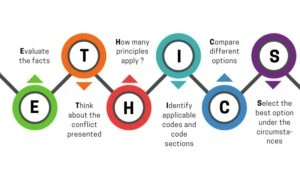
The core principles and what they require
Most codes share a small set of principles, although they word them differently. The table sets out six principles and adds what each requires in practice.
| Principle | What it requires in practice | Where it is set out |
|---|---|---|
| Minimise harm | Identify physical, psychological, social, legal and financial risks; reduce them; plan what to do if distress or a disclosure occurs | (British Psychological Society, 2021; World Medical Association, 2025) |
| Informed consent | Clear information on purpose, procedures, risks, data use and rights; voluntary agreement recorded; consent revisited as the study changes | (BERA, 2024; World Medical Association, 2025) |
| Confidentiality and anonymity | Pseudonyms or codes, secure storage, limited access, care with small or identifiable groups and with quotations | (BERA, 2024; Nii Laryeafio & Ogbewe, 2023) |
| Honesty and no unjustified deception | Deception only where a committee accepts it is necessary, with debriefing; no exaggeration of findings | (British Psychological Society, 2021) |
| Right to withdraw | Withdrawal without penalty, with clear limits (for example, once data are anonymised or analysed) stated in advance | (BERA, 2024) |
| Integrity in writing | Acknowledge others' work, report honestly, avoid undisclosed reuse of your own published text | (Committee on Publication Ethics, 2024) |
Two corrections to common readings are worth stating. First, the right to withdraw comes from ethics codes; its legal footing differs between countries, so the information sheet must say exactly what withdrawal means for data already collected. Second, anonymity and confidentiality are not the same: confidentiality means not disclosing what you learn, while anonymity means that no one, sometimes including the researcher, can link data to a person.
How to obtain ethics approval
Any study involving people, their personal data or animals normally needs approval from a research ethics committee before data collection begins. Requirements are national as well as institutional. In Saudi Arabia, for example, the implementing regulations of the research ethics law require each proposal to be approved by a local committee, with expedited review possible for low-risk surveys and interviews (National Committee of Bioethics, 2025); in India, the ICMR guidelines set the expectations for biomedical and health research (Indian Council of Medical Research, 2017).
- Identify the committee that must review your study, including any committee at a hospital, school or company where you will collect data.
- Classify the risk level using your institution's criteria; sensitive topics, children and other vulnerable groups usually need full review.
- Prepare the documents: protocol, information sheet, consent form, recruitment material, data management plan and interview or survey instruments.
- Check the data protection basis for processing personal data under the law that applies where you collect it, and how data will be stored, shared and deleted.
- Wait for written approval before recruiting anyone, and keep the approval letter and reference number.
- Submit an amendment before changing the sample, instruments or data use, and report adverse events.
National rules for several countries are explained in the Academy Insights: the European Code of Conduct for Research Integrity, Australia's 2025 National Statement, Saudi Arabia's research ethics law, Abu Dhabi's standard on human subject research and UGC good academic research practices.
Consent, confidentiality and data in practice
Consent as a process
Consent is not only a signature. Participants should understand the study, have time to decide and feel free to refuse, which is harder when the researcher has power over them, for example as their teacher or manager (BERA, 2024). Reviews of interview research show recurring dilemmas over how much to disclose about aims, how to protect identities in small communities and how to handle distress during interviews (Nii Laryeafio & Ogbewe, 2023).
Ethics during fieldwork
Approval cannot anticipate everything. Guillemin and Gillam (2004) distinguish procedural ethics, the approval process, from "ethics in practice", the everyday decisions in the field, and recommend reflexivity to handle the ethically important moments that arise. Researchers on sensitive topics also need protection: Williamson et al. (2020) describe the risk of secondary trauma and the support that should be planned for it.
Online and secondary data
Publicly visible posts are not automatically free to use; expectations of privacy, platform terms and the risk of re-identification through quoted text all need assessment (franzke et al., 2020). Personal data are increasingly regulated: Saudi Arabia's Personal Data Protection Law, for example, sets rules on sensitive data, minimisation and retention (Saudi Data & AI Authority, 2023). Plans to share data should follow agreed principles such as consent for reuse, de-identification and controlled access (Kalkman et al., 2019).
Vulnerable groups and special cases
Some participants need additional protection because their ability to consent freely, or to resist pressure, is limited. Children, people who lack capacity, prisoners, patients recruited by their own clinicians and employees recruited through their managers are common examples. Codes typically ask for consent from a parent or legal representative together with the assent of the person concerned, for recruitment that does not pass through a person with power over the participant, and for a clear justification of why the research needs these participants at all (World Medical Association, 2025; British Psychological Society, 2021).
Three other situations often surprise doctoral researchers. Insider research, where you study your own workplace or community, raises questions of power, role conflict and confidentiality among colleagues (BERA, 2024). Covert observation or deception requires an explicit justification and usually a debriefing plan (British Psychological Society, 2021). Research across borders may need approval in each country and must respect the strictest applicable data protection rules, so plan the time this takes into your schedule.
Worked example: an ethics plan for an interview study
Illustrative example. A doctoral candidate plans 20 interviews with nurses about workplace stress in two hospitals where she once worked. Table 2 shows how each principle becomes a concrete measure.
| Issue | Measure in the plan |
|---|---|
| Approval | University committee plus each hospital's research office; no recruitment before both approve |
| Power and voluntariness | Recruitment by a ward administrator, not the researcher; no former close colleagues |
| Harm | Topic guide avoids probing personal trauma; a distress protocol and list of support services |
| Confidentiality | Pseudonyms; hospital names withheld; quotations checked for identifying details |
| Withdrawal | Possible until two weeks after the interview, before transcripts are anonymised and analysed |
| Data | Encrypted university storage; recordings deleted after transcription; retention period stated |
| Researcher wellbeing | Debriefs with the supervisor after difficult interviews |
Writing about ethics in the thesis
| What to report | Example wording or detail |
|---|---|
| Approving committee and reference | Name of the committee, approval number and date; any site approvals |
| Recruitment and consent | Who approached participants, what they were told, how consent was recorded |
| Risks and safeguards | Main risks identified and the measures taken, including a distress protocol |
| Confidentiality and data | Pseudonymisation, storage, access, retention and any sharing or deposit |
| Withdrawal | The point after which data could no longer be withdrawn, and why |
| Issues that arose | Unexpected disclosures, amendments and how they were handled |
The methods chapter should report the committee, the approval reference and date, how consent was obtained, how confidentiality was protected, how data were stored and any ethical problems that arose and how they were handled. Integrity also applies to the writing itself: cite every source, report findings without exaggeration and do not reuse your own published text without disclosure (Committee on Publication Ethics, 2024). Having someone else write any part of a thesis that is submitted as your own is a breach of academic integrity, whatever it is called.
Common mistakes
- Starting recruitment or a pilot before written approval is received.
- Promising complete anonymity in a small, identifiable group.
- Offering an unlimited right to withdraw data that will be anonymised and merged.
- Treating public social media posts as free of ethical obligations.
- Changing instruments or sample without submitting an amendment.
- Writing a one-line ethics statement instead of describing what was actually done.
See also ethics and data collection in clinical PhD research, using social media data in health research and the UAE Personal Data Protection Law.
Key takeaways
- Obtain written ethics approval before any recruitment or data collection (National Committee of Bioethics, 2025; Indian Council of Medical Research, 2017).
- Treat consent as a process and protect voluntariness where you hold power over participants (BERA, 2024).
- State the limits of withdrawal and anonymity honestly in the information sheet (British Psychological Society, 2021).
- Plan for ethically important moments in the field and for your own wellbeing (Guillemin & Gillam, 2004; Williamson et al., 2020).
- Report ethics in detail and keep integrity in the writing itself (Committee on Publication Ethics, 2024).