
- / Title
Five PhD Research Directions in Real-Time Genomic Surveillance for Antimicrobial Resistance Prediction
Info: Five PhD Research Directions in Real-Time Genomic Surveillance for Antimicrobial Resistance Prediction | phdassistance.com
Published: 25th September 2026 inFive PhD Research Directions in Real-Time Genomic Surveillance for Antimicrobial Resistance Prediction | phdassistance.com
Share this:
Related Services
Introduction
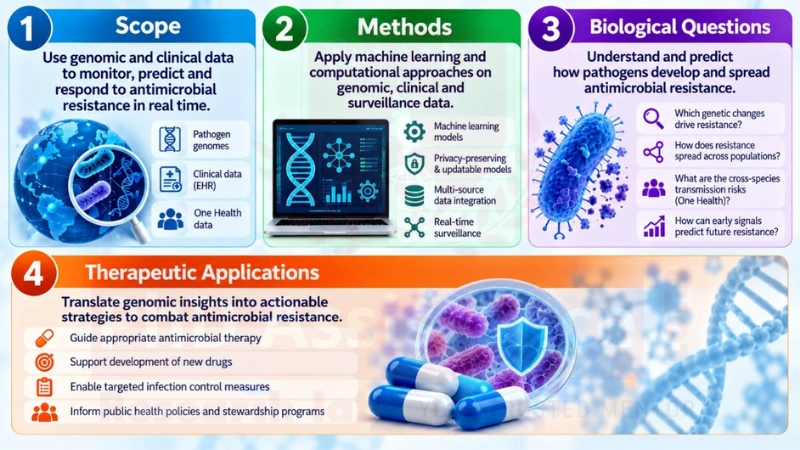
The growth of antimicrobial resistance (AMR) is outpacing the rate at which traditional monitoring and laboratory-based methods can assess it, leading to a need for machine learning techniques that could help in predicting, monitoring, and acting on AMR in real time. Modern technologies such as genome sequencing, electronic health records, and One Health monitoring systems now offer the kinds of data needed to construct such predictive, privacy-preserving, and interpretable AMR models, yet the vast majority of current tools are limited in scope, are pathogen-specific, and hard to update after deployment. The Antimicrobial Resistance Dissertation Titles collection outlines five unique PhD research agendas, each built upon a specific foundational work and developed into a novel and doable PhD project in areas including machine unlearning, multimodal clinical-genomic predictions, real-time genomic surveillance, interpretable biomarker modelling, and rapid genotypic susceptibility testing.
Proposed PhD Title 1: Privacy-Preserving and Continuously Updatable Machine Learning for Real-Time Genomic Antimicrobial Resistance Surveillance
Training of machine learning models based on clinical and genomic data related to AMR should consider the continuous updates of the input data together with meeting the requirements regarding privacy issues like the GDPR right to erasure. In their paper analysing the machine learning approaches to AMR prediction, Saniya and Khan compare Sharded, Isolated, Sliced and Aggregated (SISA) retraining, full retraining, label-flip retraining, influence reweighting, and selective tree pruning on a large clinical EHR data set and the BV-BRC/PATRIC genomic surveillance data set. The SISA approach showed a nine-fold speedup compared to full retraining on both data sets while maintaining the accuracy penalty below the clinical threshold level, while the label-flip retraining and the influence reweighting provided insignificant speedup, and tree pruning exceeded the threshold on EHR data. Still, the study is limited by the analysis of Random Forest classifiers and controlled data deletions.
Problem Statement:
Real-time genomic surveillance requires AMR prediction models to be continuously updated as new pathogen genomes become available. However, removing specific data contributions from deployed models can require computationally expensive retraining and may create challenges for privacy, regulatory compliance and ongoing model maintenance, particularly once a system is being relied upon for clinical or public-health decisions.
Literature Comparison:
| Tools | Best for |
|---|---|
| SPSS | Easy to use and very user friendly; best suited for analysing survey data as well as descriptive and inferential statistics. |
| STATA | Analyses using commands through four different windows (command window, results window, review window, variables window); very effective in analysing simple and complex statistical models. |
| R | R is free and open-source, highly flexible, and well suited to regression analysis and statistical modelling [2]. |
| Python | Includes both statistical analysis as well as machine learning. |
| Power BI | Data visualization and interactive dashboards from analysis results. |
The additional literature supports the need to consider machine unlearning not only as a computational technique but also as part of the governance and lifecycle management of healthcare AI.
Research Gap:
Existing research demonstrates that machine learning can reduce the computational burden of removing data from AMR prediction models, and that governance frameworks are emerging to guide how such deletions should be verified and audited in clinical settings. However, there is limited research on continuously updated genomic AMR models that combine predictive performance, data deletion, privacy verification and regulatory compliance within a single framework. The transferability of unlearning approaches beyond Random Forest models, and their behaviour under realistic, high-frequency deletion requests, also requires further investigation.
Research Question:
To what extent can privacy-preserving machine-learning approaches support continuous updating and data removal in real-time genomic antimicrobial resistance surveillance?
Proposed Methodology and Feasibility:
- Data access: Public genomic AMR datasets will be obtained from BV-BRC/PATRIC and other open genomic surveillance repositories, supplemented by de-identified clinical microbiology records where available.
- Baseline: A SISA-based Random Forest model will be implemented as the primary baseline, following the configuration used in the Saniya and Khan study.
- Comparative models: XGBoost and selected neural-network architectures will be trained under the same SISA sharding scheme to test whether unlearning efficiency generalises beyond Random Forests.
- Continuous updating: Sequential genomic records will be introduced in batches to simulate real-time surveillance and to measure how model performance drifts as new pathogen data arrives.
- Machine unlearning: SISA and alternative unlearning approaches, including influence reweighting and selective pruning, will be compared against full retraining on accuracy, cost and completeness.
- Performance evaluation: Model quality will be tracked using AUROC, AUPRC, accuracy, calibration and computational time across training and unlearning cycles.
- Robustness: Different deletion sizes, request frequencies and data distributions will be evaluated to test performance under realistic operational conditions.
Outcome:
This research aims to develop a continuously updateable AMR prediction framework capable of incorporating new genomic data while removing designated data contributions without complete model retraining. The framework will evaluate predictive accuracy, unlearning effectiveness, computational efficiency and privacy preservation across multiple model architectures and deletion scenarios.
Reference:
Saniya, & Khan, A. A. (2026). Machine Unlearning for GDPR Right-to-Erasure in Antimicrobial Resistance Prediction Models. medRxiv preprint. https://doi.org/10.64898/2026.03.09.26347960
Porter, A., Kirkpatrick, E., Garg, A., et al. (2026). Machine unlearning as a governance imperative for clinical AI. npj Digital Medicine. https://doi.org/10.1038/s41746-026-03050-1
Sakib, S. K., & Xie, M. (2024). Machine Unlearning in Digital Healthcare: Addressing Technical and Ethical Challenges. Proceedings of the AAAI Symposium Series, 4(1), 319–322. https://doi.org/10.1609/aaaiss.v4i1.31809
Proposed PhD Title 2: Multimodal Clinical–Genomic Machine Learning for Real-Time Antimicrobial Resistance Prediction in Hospital Care
Hardan et al. (2024) developed a real-time AMR prediction framework using multimodal EHR data drawn from the MIMIC-IV database. The study integrates time-invariant patient characteristics, time-series information and free-text clinical notes using multimodal deep-learning fusion techniques to determine resistance based on either an antibiotic or a pathogen. The framework demonstrates the potential of using routinely available EHR information for rapid, affordable AMR prediction without requiring genomic sequencing, but its evaluation is primarily based on ICU data and a selected set of antibiotic and pathogen tasks, leaving open how well the approach generalises to ward-level care and to pathogen resistance mechanisms that are only visible at the genomic level.
Problem Statement:
Existing real-time AMR prediction models based on EHR data can provide early resistance predictions but may not fully capture pathogen-level genomic determinants of resistance. Integrating dynamic clinical information with genomic resistance features could provide a more comprehensive and more clinically actionable basis for real-time AMR prediction.
Literature Comparison:
| Existing method/study | Demonstrated capability | Remaining limitation | Potential doctoral research direction |
|---|---|---|---|
| Hardan et al. (2024) – Multimodal EHR AMR prediction | Combines time-series, time-invariant and clinical-note data for real-time AMR prediction. | Mainly evaluated in ICU settings and lacks genomic integration. | Integrate clinical and genomic features for broader real-time prediction. |
| Nigo et al. (2024) – PyTorch_EHR MRSA prediction | Uses time-series EHR data to predict MRSA culture positivity and demonstrates external validation using MIMIC-IV. | Focuses specifically on MRSA rather than broader AMR phenotypes. | Extend temporal clinical prediction with genomic resistance information. |
| Kanjilal et al. (2020) – UTI decision algorithm | Uses EHR-based ML predictions to support antibiotic selection and antimicrobial stewardship. | Focused on uncomplicated UTI and outpatient prescribing. | Develop broader real-time clinical–genomic AMR decision support. |
The MRSA study provides evidence that time-series EHR models can achieve external validation across hospital systems, while Kanjilal et al. demonstrate how resistance predictions can be translated into concrete antibiotic-selection decisions in practice.
Research Gap:
Current studies demonstrate the value of multimodal EHR data for early AMR prediction and the value of genomic information for identifying resistance mechanisms. However, there is limited research integrating patient-level temporal clinical information with pathogen genomic features in a single, unified real-time prediction framework that has been validated outside the ICU setting.
Research Question:
To what extent can integrating multimodal clinical and genomic information improve real-time antimicrobial resistance prediction across hospital settings, beyond what EHR data alone can achieve?
Proposed Methodology and Feasibility:
Outcome:
This research aims to develop a multimodal clinical–genomic ML framework that combines patient history, laboratory and microbiology data, clinical notes and pathogen genomic features to generate dynamic, continuously updated AMR predictions suitable for both ICU and general ward settings. The proposed framework provides a strong basis for an AMR Dissertation Title focused on integrating clinical and genomic information for real-time antimicrobial resistance prediction.
Reference:
Hardan, S., Shaaban, M. A., Abdalla, J., & Yaqub, M. (2024). Affordable and real-time antimicrobial resistance prediction from multimodal electronic health records. Scientific Reports, 14, 16464. https://doi.org/10.1038/s41598-024-66812-5
Nigo, M., Rasmy, L., Mao, B., Kannadath, B. S., Xie, Z., & Zhi, D. (2024). Deep learning model for personalized prediction of positive MRSA culture using time-series electronic health records. Nature Communications, 15, 2036. https://doi.org/10.1038/s41467-024-46211-0
Kanjilal, S., Oberst, M., Boominathan, S., Zhou, H., Hooper, D. C., & Sontag, D. (2020). A decision algorithm to promote outpatient antimicrobial stewardship for uncomplicated urinary tract infection. Science Translational Medicine, 12(568), eaay5067. https://doi.org/10.1126/scitranslmed.aay5067
Proposed PhD Title 3: Real-Time One Health Genomic Surveillance and Machine Learning for Predicting the Emergence and Transmission of Antimicrobial Resistance
Struelens et al. (2024), representing two ESCMID study groups, highlight the significance of real-time genome-based surveillance involving WGS of pathogens along with diagnostic microbiology, clinical and epidemiologic information. The authors present the idea of interconnected surveillance systems that use a “One Health” approach for monitoring pathogens, their evolution, transmission, and AMR in humans, animals, and the environment. This study is based on the experience gained through large-scale SARS-CoV-2 genomic surveillance during the pandemic caused by the novel coronavirus. The authors state the necessity of interoperability, standardisation, responsible data sharing, and coordinated genomic surveillance networks as prerequisites for transforming genomic data into public health measures. However, they do not introduce a predictive machine-learning system.
Problem Statement:
Current AMR surveillance systems often rely on retrospective laboratory or epidemiological reporting. Although genomic surveillance can identify resistant lineages, transmission pathways and resistance determinants, integrating genomic, clinical, epidemiological and cross-sectoral data into a single real-time predictive surveillance system remains a substantial technical and organisational challenge.
Literature Comparison:
| Existing method/study | Demonstrated capability | Remaining limitation | Potential doctoral research direction |
|---|---|---|---|
| Struelens et al. (2024) – Real-time genomic surveillance | Establishes an integrated WGS, clinical, epidemiological and One Health surveillance framework. | Highlights implementation, interoperability and data-sharing challenges rather than developing a predictive ML system. | Develop ML-based predictive surveillance within an integrated genomic framework. |
| Sherry et al. (2022) – Multi-site WGS surveillance | Demonstrates prospective multi-centre genomic surveillance across eight Australian hospitals and identifies previously unrecognised MDRO transmission. | Primarily focused on surveillance and transmission detection rather than forecasting. | Add predictive modelling for emerging resistance and transmission risk. |
| Kohlenberg et al. (2025) – EURGen-Net | Demonstrates multi-country genomic surveillance and joint analysis of carbapenem-resistant Enterobacterales across the EU/EEA. | Cross-border genomic surveillance still depends on data sharing, harmonisation and coordinated infrastructure. | Develop predictive and interoperable surveillance models using multi-country genomic data. |
Research Gap:
While such technologies as genomic surveillance are becoming more proficient at detecting resistant lineages and transmission pathways, there is still a necessity to shift from descriptive to predictive surveillance with the use of genomic surveillance. Specifically, machine learning algorithms can be utilised to predict emerging AMR trends and select the highest-risk lineages and transmission events based on constantly updating data.
Research Question:
To what extent can real-time genomic and epidemiological data be used with machine learning to predict the emergence and transmission of antimicrobial resistance within a One Health surveillance framework?
Proposed Methodology and Feasibility:
Outcome:
The research aims to develop a real-time predictive surveillance framework identifying high-risk AMR lineages, resistance determinants and potential transmission patterns across healthcare and relevant One Health settings, informed by the interoperability principles set out by Struelens et al.
Reference:
Struelens, M. J., Ludden, C., Werner, G., Sintchenko, V., Jokelainen, P., & Ip, M. (2024). Real-time genomic surveillance for enhanced control of infectious diseases and antimicrobial resistance. Frontiers in Science, 2, 1298248. https://doi.org/10.3389/fsci.2024.1298248
Sherry, N. L., Gorrie, C. L., Kwong, J. C., et al. (2022). Multi-site implementation of whole genome sequencing for hospital infection control: A prospective genomic epidemiological analysis. Lancet Regional Health – Western Pacific, 23, 100446. https://doi.org/10.1016/j.lanwpc.2022.100446
Kohlenberg, A., Linkevicius, M., Alm, E., et al. (2025). From structured surveys to outbreak investigations: advancing genomic surveillance of carbapenem-resistant Enterobacterales within the European Antimicrobial Resistance Genes Surveillance Network. Frontiers in Public Health, 13, 1671769. https://doi.org/10.3389/fpubh.2025.1671769
Proposed PhD Title 4: Interpretable Machine Learning Integrating Phenotypic and Genomic Biomarkers for Real-Time Antimicrobial Resistance Prediction
Adeyemi & Paudel (2026) use the technique of phenotypic antimicrobial resistance testing alongside biomarker genomics and machine learning approaches to predict AMR in E. coli. The study involved over seventeen thousand clinical isolates, where XGBoost gave the most efficient results, while the genomic markers involved gyrA, parC, CTX-M-15, and OXA-1, which were found in CARD and ResFinder databases. The biological interpretability is emphasised, since the feature attribution methods were used to explain the predicted phenotypes, while the limitations include lack of scalability, limited availability of the data, and non-real-time processing, leaving room for improvement.
Literature Comparison:
| Existing method/study | Demonstrated capability | Remaining limitation | Potential doctoral research direction |
|---|---|---|---|
| Adeyemi & Paudel (2026) – E. coli phenotypic/genomic ML | Integrates AST, ML, genomic biomarkers and phylogenetic analysis. | Focused on E. coli and retrospective datasets. | Develops interpretable and temporally validated AMR prediction across pathogens. |
| Nguyen et al. (2019) – Nontyphoidal Salmonella | Uses XGBoost and over five thousand genomes to predict MICs for 15 antibiotics and identifies relevant genomic regions. | Focused on Salmonella and MIC prediction rather than integrated real-time surveillance. | Extend genomic prediction to real-time, multi-pathogen surveillance. |
| Xu et al. (2024) – K. pneumoniae metagenomic prediction | Uses ML and metagenomic sequencing for resistance prediction across six antibiotics, with clinical retrospective case-study evaluation. | Focused on K. pneumoniae and requires further broader validation. | Develop a generalisable real-time framework integrating genomic and phenotypic evidence. |
Nguyen et al. showed that whole-genome ML can predict MICs across multiple antibiotics with high accuracy from relatively small training sets, while Xu et al. demonstrated that metagenomic AMR prediction could plausibly change clinical treatment decisions in a retrospective case series.
Research Gap:
Existing studies demonstrate accurate genomic and phenotypic AMR prediction, but there remains a need for a biologically interpretable, continuously updated and externally validated framework that combines resistance biomarkers with phenotypic outcomes across multiple bacterial pathogens rather than a single species.
Research Question:
To what extent can interpretable machine learning integrating phenotypic AST and genomic biomarkers provide robust real-time antimicrobial resistance predictions across bacterial pathogens?
Proposed Methodology and Feasibility:
Outcome:
This research will develop an interpretable ML framework that links predicted AMR phenotypes with genomic resistance mechanisms and evaluates whether these biomarkers remain predictive across time, pathogens, and independent datasets. The study will extend the single-species approach of Adeyemi and Paudel and provide a strong foundation for an Antimicrobial Resistance Dissertation focused on interpretable, real-time, and generalisable AMR prediction.
Reference:
Adeyemi, S. H., & Paudel, R. (2026). Integrating Phenotypic and Genomic Data with Machine Learning to Predict Antimicrobial Resistance and Identify Genetic Biomarkers in E. coli. International Journal of Environmental Research and Public Health, 23(5), 561. https://doi.org/10.3390/ijerph23050561
Nguyen, M., Long, S. W., McDermott, P. F., et al. (2019). Using Machine Learning To Predict Antimicrobial MICs and Associated Genomic Features for Nontyphoidal Salmonella. Journal of Clinical Microbiology, 57(2), e01260-18 https://pmc.ncbi.nlm.nih.gov/articles/PMC6355527/
Xu, Y., et al. (2024). Rapid inference of antibiotic resistance and susceptibility for Klebsiella pneumoniae by clinical shotgun metagenomic sequencing. International Journal of Antimicrobial Agents, 64, 107252. https://doi.org/10.1016/j.ijantimicag.2024.107252
Proposed PhD Title 5: Real-Time Whole-Genome Machine Learning for Rapid and Generalisable Antimicrobial Susceptibility Prediction Across Bacterial Pathogens
Liu et al. (2025) study WGS and ML in rapidly assessing the antimicrobial susceptibility of Stenotrophomonas maltophilia. This research employs 441 genomes and determines the genomic resistance markers for levofloxacin and trimethoprim-sulfamethoxazole to obtain area-under-the-curve values greater than 90% for the two antibiotics. Liu et al. emphasise the drawbacks of culture-based AST, which may take up to twenty-four hours and state that WGS-assisted ML is faster and genotype-based compared to culture-based AST and that this approach requires further study in other pathogens and antibiotics.
Problem Statement:
Conventional AST can delay targeted antibiotic treatment, while genomic prediction approaches are often developed for a specific pathogen or a limited number of antibiotics. The generalisability of WGS-based ML models across pathogens, antibiotic classes and changing resistance patterns over time remains insufficiently established.
Literature Comparison:
| Existing method/study | Demonstrated capability | Remaining limitation | Potential doctoral research direction |
|---|---|---|---|
| Liu et al. (2025) – S. maltophilia WGS/ML | Identifies genomic resistance markers and predicts LEV/SXT resistance with high accuracy. | Limited to one pathogen and two antibiotics. | Develop cross-pathogen and multi-antibiotic genotypic AST. |
| Xu et al. (2024) – K. pneumoniae mNGS-AST | Predicts resistance across six antibiotics using metagenomic sequencing and ML, with substantially shorter reporting time than culture-based AST. | Focused on K. pneumoniae. | Develop a broader pathogen-independent rapid prediction framework. |
| Hu et al. (2023) – A. baumannii mNGS-AST | Develops and prospectively evaluates mNGS-based ML models for four antibiotics, reducing reporting time by over forty hours compared with culture-based AST. | Pathogen-specific and antibiotic-specific. | Assess cross-pathogen transferability and real-time deployment. |
Xu et al. demonstrated AUCs above 0.9 for several K. pneumoniae antibiotics and reported that predicted results could plausibly have changed treatment in a meaningful share of retrospective cases. Hu et al. similarly demonstrated rapid mNGS-AST prediction in A. baumannii, including prospective clinical evaluation with perfect agreement against phenotypic AST on a held-out sample set.
Research Gap:
Existing WGS and metagenomic studies demonstrate that machine learning can substantially accelerate AMR phenotype prediction relative to culture-based testing. However, most models remain pathogen- and antibiotic-specific. Further research is required to determine whether genomic predictors can be transferred across pathogens and whether models remain robust when applied to temporally and geographically independent datasets.
Research Question:
To what extent can whole-genome machine-learning models provide rapid, accurate and generalisable antimicrobial susceptibility predictions across bacterial pathogens and antibiotic classes?
Proposed Methodology and Feasibility:
Outcome:
The purpose of the study is to build a genotypic AST system that is generalizable to predicting antimicrobial susceptibility using genomic information, and test for the robustness of such a system among different bacteria strains, antibiotic classes, populations, and time periods.
Reference:
Liu, X., Long, S., Chen, F., et al. (2025). Genomic and machine learning approaches to predict antimicrobial resistance in Stenotrophomonas maltophilia. Microbiology Spectrum, 13(8), e02632-24. https://journals.asm.org/doi/10.1128/spectrum.02632-24
Xu, Y., et al. (2024). Rapid inference of antibiotic resistance and susceptibility for Klebsiella pneumoniae by clinical shotgun metagenomic sequencing. International Journal of Antimicrobial Agents, 64, 107252. https://doi.org/10.1016/j.ijantimicag.2024.107252
Hu, X., Zhao, Y., Han, P., et al. (2023). Novel Clinical mNGS-Based Machine Learning Model for Rapid Antimicrobial Susceptibility Testing of Acinetobacter baumannii. Journal of Clinical Microbiology, 61(5), e01805-22. https://doi.org/10.1128/jcm.01805-22
Interested in pursuing PhD research in antimicrobial resistance and genomic surveillance? Explore our PhD research support services for help with research topic selection, proposal development, methodology design, literature review, and dissertation planning.
Our research methodology consultants can help refine your ideas, identify literature gaps, and guide you toward a topic that aligns with current academic trends and your programme requirements.
Contact us to begin one-on-one topic development and refinement with PhD Assistance Research Lab.
FAQs:
1. How can I identify a suitable PhD research topic in real-time genomic surveillance for AMR?
Researchers can focus on gaps in existing genomic surveillance systems, such as retrospective analysis, delayed reporting, limited pathogen coverage, and lack of predictive capabilities. Potential areas include real-time AMR prediction, WGS-based surveillance, genomic epidemiology, machine learning, and transmission monitoring.
2. How do I formulate a research gap in real-time genomic AMR surveillance?
Compare existing studies based on genomic datasets, pathogens, sequencing approaches, ML methods, temporal validation, and surveillance applications. Unresolved limitations can help identify gaps in real-time prediction, cross-pathogen generalisation, emerging resistance detection, and external validation.
3. What methodologies can researchers use for a PhD in genomic AMR surveillance?
Methods may include whole-genome sequencing, antimicrobial susceptibility testing, bioinformatics, genomic feature extraction, phylogenetic analysis, machine learning, temporal modelling, resistance gene detection, and genomic epidemiology.
4.How can I design a feasible methodology for real-time genomic surveillance research?
Start with accessible WGS and AMR datasets and established genomic and ML methods. The methodology can then progress toward temporal validation, continuously updated models, emerging resistance detection, external validation, and real-time surveillance workflows.
5. What challenges should researchers consider when starting a genomic AMR surveillance project?
Key challenges include genomic data quality, sequencing availability, resistance gene annotation, changing resistance patterns, computational requirements, data integration, model interpretability, temporal robustness, and generalisation across pathogens, locations, and time periods.
Share this:
Cite this work
PhD Assistance. (n.d.). Real-Time Genomic Surveillance for Antimicrobial Resistance Prediction. Retrieved September 5, 2026.
PhD Assistance. “Real-Time Genomic Surveillance for Antimicrobial Resistance Prediction.” PhD Assistance, n.d. Web. 5 Sept. 2026.
PhD Assistance. “Real-Time Genomic Surveillance for Antimicrobial Resistance Prediction.” PhD Assistance. Web. 5 Sept. 2026.
PhD Assistance (n.d.) Real-Time Genomic Surveillance for Antimicrobial Resistance Prediction. Available at: https://www.phdassistance.com/title/antimicrobial-resistance-dissertation/ (Accessed: 5 September 2026).
PhD Assistance. Real-Time Genomic Surveillance for Antimicrobial Resistance Prediction [Internet]. [cited 2026 Sep 5]. Available from: https://www.phdassistance.com/title/antimicrobial-resistance-dissertation/
PhD Assistance. “Real-Time Genomic Surveillance for Antimicrobial Resistance Prediction.” PhD Assistance. Retrieved September 5, 2026, from https://www.phdassistance.com/title/antimicrobial-resistance-dissertation/
PhD Assistance, ‘Real-Time Genomic Surveillance for Antimicrobial Resistance Prediction’ (PhD Assistance, n.d.) https://www.phdassistance.com/title/antimicrobial-resistance-dissertation/ accessed 5 September 2026.
Study Resources
Free resources to assist you with your university studies!