

Critical Review of Advancing international business research through artificial intelligence and machine learning applications
July 8, 2026
How to Strengthen a PhD Research Proposal in UK Life Sciences: Addressing Research Gaps in Genomics and Precision Medicine
July 9, 2026Why UAE PhD Manuscripts Get Rejected by Journals Despite Strong Research
- July 09, 2026
- Manuscripts
Introduction
Health research in the UAE experienced an annual growth rate of 25% between 2018 and 2022. The UAE ranks second in the Gulf Cooperation Council in conducting clinical trials (Hazem et al.,2025). Although there have been numerous advancements in health research and innovations in the country, a gap has emerged in research publications. Researchers experience difficulties when publishing their research because of different reasons such as lack of time, formatting of papers, and adherence to the journal guidelines. Scientifically conducted research is not published even with groundbreaking results.
Rejection by a journal is not necessarily a sign of poor-quality research. Rejection may be on account of problems with presentation, poor academic writing skills, incorrect choice of journal, methodological issues, and/or non-conformity to journal requirements. Even seasoned researchers get their manuscripts rejected if the manuscripts do not meet certain criteria.
At PhD Assistance Research Lab, we assist PhD researchers in preparing papers suitable for publication, which follow the requirements of international journals. Our PhD Manuscript Help in UAE support scholars in publishing their years of research in a suitable journal.
What you will learn from this blog?
- Why strong PhD research still gets rejected by journals.
- The most common manuscript mistakes made by UAE researchers.
- Practical strategies to improve journal acceptance rates.
- How professional publication support helps researchers publish successfully.
Understanding Journal Publication Challenges with PhD Manuscript Editing Help in UAE
The process of getting published in a peer-reviewed journal is considered an important achievement for PhD students in the United Arab Emirates. Nevertheless, many scientifically valid studies are refused to be published as it is not only dependent on scientific validity but also on how the results are written. Manuscripts should satisfy the highest criteria in terms of academic writing, methodology, originality, and formatting.
The most common causes of rejection include a lack of research contributions, poor academic writing, insufficient explanation of methodology, incompatibility with the journal scope, and non-compliance with submission instructions. Getting professional PhD Manuscript Editing Help in UAE will make it easier for you to succeed in your publication.
Why UAE PhD Manuscripts Get Rejected Despite Strong Research
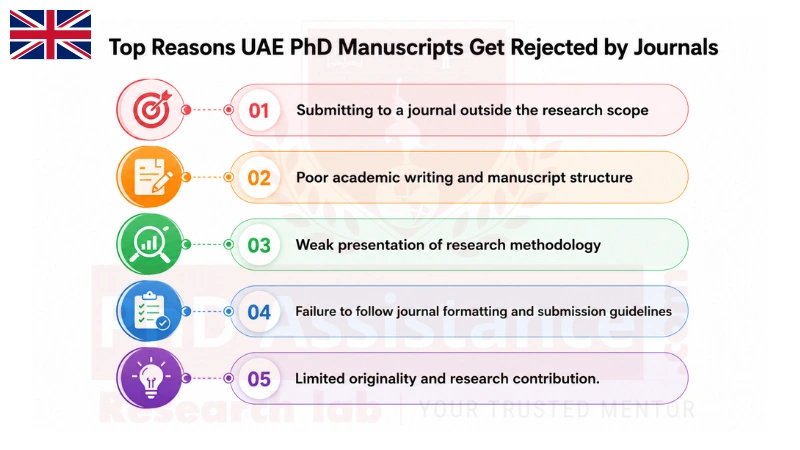
1. Selecting the Wrong Journal for Submission
One frequent reason for receiving a desk rejection or simply having your manuscript thrown out immediately upon submission is sending it to a journal whose aims, subject, or reader base don’t match what you have submitted. This is the case even for perfectly designed studies if they just aren’t the kind of thing the journal typically publishes.
You don’t want to fall into the trap many researchers do, where you select your journal based on impact factor and reputation without checking the actual journal aims, scope and some recent articles. Editors decide if it’s in scope or not, for their readers, before reading whether it is good science.
Conversely, research on educational leadership in universities in the UAE may be rejected from a journal on engineering or applied sciences, no matter how good the work is. Similarly, an interdisciplinary study would be rejected from a journal not usually published with a broad remit.
Example: Desk rejection often happens due to a lack of match between a manuscript and the journal’s aims and scope. This finding comes from an analysis of desk rejects in the Journal of International Business Studies carried out by Beugelsdijk and Bird (2025). They note that an editor will assess if a manuscript would suit a journal’s readers and publication intent before even looking at its academic merit.
Tips
- Study the journal’s author guidelines before submitting your paper.
- Stick to all the formatting and referencing guidelines consistently.
- Make sure that all ethical statements/declarations are made.
- Provide a comprehensive answer to the reviewer’s feedback.
2. Addressing Weak Academic Writing with PhD Healthcare Manuscript Help in UAE
Even a good study can seem like poor research when it’s explained in a disorganised and confusing way. If you have a study with the best results on the market, confusing explanations can cause a reviewer to never see the impact. These will have grammatical errors, inconsistency in the usage of language, repetitions, and lengthy paragraphs.
It is expected of the authors to present their results in such a way that it would impress even the most rigorous reviewer. Your research paper should consist of all research objectives, methodology, results and conclusions. Scholars are primary researchers rather than writers. So, getting support from professional PhD Healthcare Manuscript Help in UAE would improve their writing skills and their manuscripts.
Example: “As stated by Day and Gastel (2022) in How to Write and Publish a Scientific Paper, clear writing and logical structuring of the manuscript are important in the process of decision-making by the editors and reviewers. They note that disorganised and unclear manuscripts hinder the assessment of the importance of the study by the reviewer, hence increasing the chances of being rejected regardless of the quality of the study.
Tips:
- Be concise while writing the manuscript.
- Use the manuscript format recommended by the journal.
- Avoid redundancy and use simple sentences.
- Be consistent with the use of terminology and format.
3. Insufficient Literature Review and Weak Research Gap
Numerous manuscripts are rejected due to not defining the significance of the study. The Literature review is not only about summarising studies carried out so far; it’s about the critical review of prior studies and highlighting issues that still stand unresolved to demonstrate a clear rationale for your own work.
However, some authors review older papers or simply reiterate previous work without justifying how their research will fill a research gap. This could be perceived by the reviewers as unoriginal work or a work whose findings contribute nothing new.
Identifying a particular gap in the literature helps you justify the importance of your study rationally.
What research shows:
According to Hart (2018), a good literature review is one that provides a critical evaluation of previous works, identifies gaps in the previous literature, and shows the novelty of the current work. Manuscripts lacking a clear gap in their research will fail to convince the editors and reviewers.
Tips:
- Use the latest and high-quality scholarly sources.
- Define the research gap clearly.
- Discuss the contribution of the study to theory or practice.
- Analyse the earlier research critically instead of just describing it.
4. Poor Presentation of Methodology and Results
Reviewers and editors scrutinise whether the methods are well-described, relevant and replicable. Good methods are evidence that the researchers have studied the question systematically and can thus support the conclusions.
Researchers often present few details of their study’s sample characteristics, study design, approval from research ethics committees, data-collection techniques or statistical analysis. Still others give a summary of their results without relating them to their research questions or describing the potential practical value of their work. These deficiencies complicate the task of the peer reviewers.
Using clear presentation for methods and results enhances research credibility, aiding reviewers in understanding and assessing its contribution to the science community.
What research shows:
It is indicated by Creswell & Creswell (2023) that proper documentation of methodology will improve the reliability and replicability of the study. It is highlighted by the researchers that research design, sampling, data collection, and analysis procedures should be considered because this will assist in evaluating the validity and reliability of the study.
Tips:
- Clearly describe research design and methodology.
- Give detailed information about sampling and data collection processes.
- Show results using logical reasoning and proper use of tables and graphs.
- Connect findings with the research aims directly.
Get the pricing details for the PhD manuscript service at PhD Assistance Research Lab, designed to assist researchers in writing a clear manuscript.
5. Ignoring Journal Guidelines and Reviewer Expectations
Every journal follows specific guidelines in terms of formatting, referencing, length of manuscripts, position of figures, reporting guidelines, and author declarations. It is quite typical for scientists to receive rejections for their manuscript as well as encounter delays in the process because they fail to follow the journal’s guidelines.
Some journals also have Editors who screen for formatting before submitting the work to reviewers, while others do the “formatting checks” only after you get that positive reviewer response.
Researchers who receive reviews must address all reviewer comments thoroughly, without just tweaking the document, making revisions only to specific sentences and words, and by making sure to address all the reviewers’ comments. Failing to adhere to journal instructions only weakens your manuscript’s chances of publication.
Example: Based on the findings of the study done by Bavdekar in 2015 in the Journal of the Association of Physicians of India, non-compliance to the guidelines provided, non-adherence to the formatting policies, and inability to respond to the queries from the reviewers are some of the major causes of rejection of manuscripts.
Tips:
- Read the guidelines for authors of the journal carefully before submission.
- Be consistent with the format and references required.
- Include all the ethical statements and declarations.
- Write a comprehensive reply to the reviewer’s feedback.
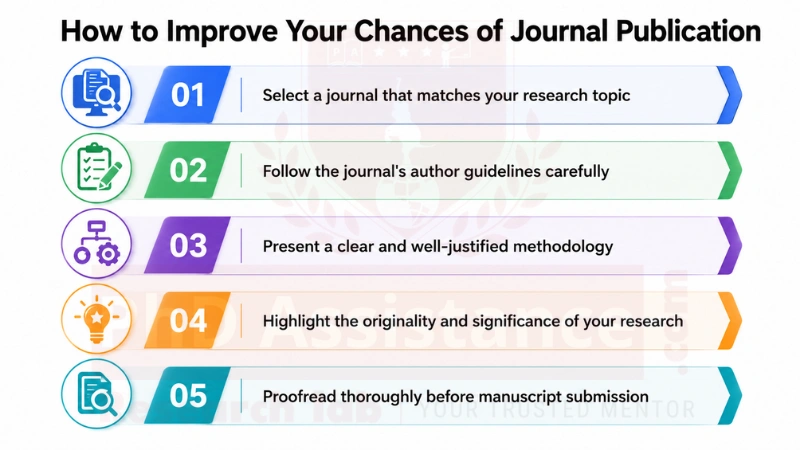
How UAE PhD Researchers Can Improve Journal Acceptance
- Choose publications that align closely to your topic.
- Write precise, concise and well-written manuscripts.
- Show that there is an evident research gap and uniqueness.
- Be transparent about the methodology and the findings.
- Adhere to all the journal submission instructions.
- Consider getting professional Journal Manuscript Writing Help in UAE.
- Treat all reviewer comments respectfully.
Conclusion
Journal rejection is usual in the academic publication process and is not an indication of unqualified research. Most PhD dissertations from the United Arab Emirates are rejected due to avoidable reasons, including selecting the wrong journal, inadequate academic writing, lack of literature review, lack of methodology reporting, and non-compliance with journal requirements.
The researchers would greatly enhance their prospects of getting published through proper preparation of their manuscripts and making sure that they conform to international publishing standards. Proper manuscript preparation will save much time during the review process.
Experts at PhD Assistance Research Lab provide customised PhD Manuscript Writing Services in UAE that help students increase publication success and avoid manuscript rejection.
Book a Free Expert Consultation to get clarity on how to build your manuscript aligned with academic structure.
References
- AbuEl-Enien H, Al Harbi M, Koornneef E, Naeem A, Jadallah S, Srinivasan K, Kumar M N. Health and Medical Sciences Productivity in the United Arab Emirates: A Bibliometric Analysis Based on 27 Years of Data From 1998 to Mid-2024. Cureus. 2025 Aug 20;17(8):e90629. doi: 10.7759/cureus.90629.
- Beugelsdijk, S., & Bird, A. (2025). How to avoid a desk reject: Do’s and don’ts. Journal of International Business Studies, 56, 301–310.
- Day, R. A., & Gastel, B. (2022). How to Write and Publish a Scientific Paper (9th ed.). Greenwood.
- Hart, C. (2018). Doing a Literature Review: Releasing the Research Imagination (2nd ed.). Sage Publications.
- Creswell, J. W., & Creswell, J. D. (2023). Research Design: Qualitative, Quantitative, and Mixed Methods Approaches (6th ed.). Sage Publications.
- Bavdekar, S. B. (2015). Writing, submitting and publishing a paper: Tips for authors. Journal of the Association of Physicians of India, 63(8), 56–60.
