
Critical Review of Advancing international business research through artificial intelligence and machine
learning applications
Introduction
The development of digital technologies is transforming research practices in the fields of management and international business studies. In their paper “Advancing Business Research through Artificial Intelligence and Machine Learning methods”, Gaur et al. (2026) investigate the application of artificial intelligence (AI) and machine learning (ML) techniques for analysing complex and unstructured data sets that cannot be analysed using statistical approaches. The emergence of Artificial Intelligence in International Business is one of these developments, which has proved itself as an effective tool for making decisions based on data and conducting analytical research.
The authors believe that AI and ML should be used as complements to traditional methodologies through increased precision of forecasting, identification of patterns, and theoretical development. The paper highlights the main types of AI, such as supervised learning, unsupervised learning, generative AI, and multimodal learning and shows how they can be applied to internationalisation, corporate governance, legitimacy, and deglobalization among other topics. Through the combination of innovative methodologies with existing IB theories, the paper offers a good foundation for future research in international business.
Summary of the article
The main purpose of Gaur et al. (2026) is to create a well-structured framework that helps scholars integrate AI and ML approaches into international business research. The study is not aimed at producing new empirical results; rather, it works as a perspective piece that provides an overview of existing methodological advances and shows how these approaches can be applied to current challenges in IB.
The study starts with a review of papers published in top international business journals in the period between 2000 and 2025. During the analysis, the authors noted that even though there were many complex datasets available, relatively few papers made use of machine learning methods. Prior literature mostly employed supervised and unsupervised learning when dealing with textual and numeric data.
This article classifies AI techniques into four main types. Supervised learning is offered as an approach to predictive modelling that is applicable in classification and prediction, while unsupervised learning can discover patterns and structure without predefining the output. This also includes the topic of generative AI, which enables automated content creation and complex reasoning, as well as multimodal learning, which combines various types of data.
The authors present their work’s applicability through examples showing how these approaches may be applied to make studies of foreignness, legitimacy, corporate governance, internationalisation strategies, institutional distance, alliances, and deglobalization more effective. The key point of the authors’ reasoning is that the use of AI allows researchers to examine different types of information, from annual reports and social media to satellite images and pictures.
Critique
Significance and contribution of the field
This article has made an important contribution to the expanding body of knowledge on the topic of digital transformation in business-related research. The most valuable aspect of the article is the thorough introduction of AI techniques and their connection to the existing international business theories. Instead of considering AI as an alternative to other methodologies, the researchers use it to enhance theory building and empirical analysis.
It is in line with the results of Dwivedi et al. (2023), who stated that the use of artificial intelligence would help organisations improve decision-making through better data interpretation and prediction. Likewise, Raisch and Krakowski (2021) claimed that AI is meant to supplement human knowledge, especially when dealing with complex international business situations. These studies confirm Gaur et al.’s idea of improving research with the use of AI.
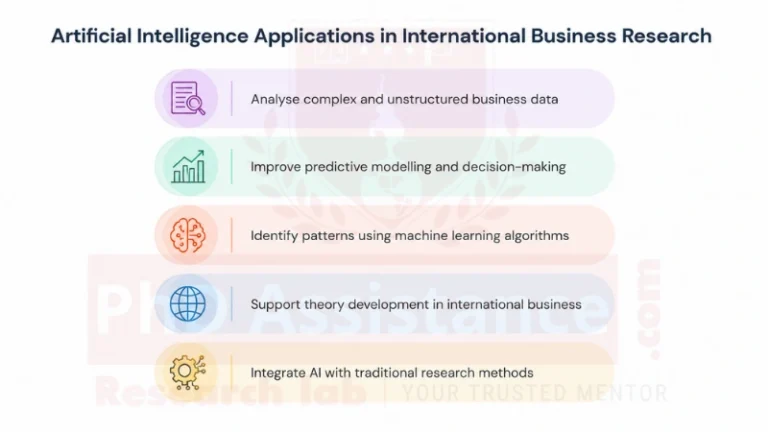
The other strength associated with the article is the importance of using AI to analyse heterogeneous and unstructured databases. In contrast to traditional statistics, AI allows us to derive useful information from non-numerical data such as texts, images, and networks. It provides researchers with more possibilities to explore various problems. Indeed, the statement is in line with Raisch et al. (2021), who noted the increasing significance of advanced analytics in business studies, and von Krogh (2018), who stressed the value of digital technology in creating knowledge.
Methodology and research design
A major strength of this paper is that it uses a theoretical/conceptual/perspective-oriented research methodology and approach that integrates past research works in order to show how artificial intelligence and machine learning approaches can revolutionise business research. Rather than focusing on gathering new data, the authors carefully analyse the latest methodological advances and reveal how different AI approaches can be used to solve complicated international business issues.
This paper covers different AI approaches like supervised learning, unsupervised learning, and multimodal learning while emphasising their importance in different global business environments. The section on Machine Learning Applications clearly shows how modern analytics techniques can analyse both structured and unstructured data and enhance the quality of research. Such an approach is in line with Raisch et al. (2021), who noted that through AI-driven analytics, researchers can find patterns in data.
Despite all that, the paper also has some limitations. First, since it is conceptual, there is no empirical validation for evaluating the practicality of the framework offered by the researchers. Even though there are many examples offered by the researchers, the lack of case studies or practical examples of using the offered approach limits the practicality of their suggestions. In addition, even though the authors mention some difficulties related to the poor data quality and algorithm transparency, more concrete advice concerning how to choose proper AI methods would enhance the methodological contribution made by the authors.
Theoretical and Interdisciplinary Analysis
It should be noted that the authors manage to link together such disciplines as international business, artificial intelligence, data science, and strategic management in order to reveal the potential of new technologies for transforming the research on global business. By doing this, they avoid considering the application of artificial intelligence only as a technical invention but use it as an instrument for complementing theory and empirics.
This supports the views by Davenport and Ronanki (2018), who noted that the use of AI together with human expertise contributes towards better performance in organisations, and Jarrahi (2018), who noted that rather than replace managerial decisions, AI should support them. In a similar vein, Brynjolfsson and McAfee (2017) stated that digital intelligence is used in making forecasts and strategy planning within organisations. The above findings support the notion that AI has become an essential methodological tool in business research.
While having many positive aspects, this theoretical framework is still very descriptive in nature. While the authors can give an understanding of several approaches in AI, there are still not enough links made between those and already well-developed international business theories. More links to other theories will make the contribution of the article to AI in Business Research clearer.
Ethical Considerations
The authors have correctly pointed out some ethical considerations that arise from the use of artificial intelligence technology in international business studies. These include factors such as algorithm transparency, data quality, interpretability of models, and ethical issues associated with the usage of artificial intelligence technologies. The authors argue that researchers should consider both accuracy and ethics in their evaluation.
However, the issues of ethics could be explored much more deeply. Certain areas such as algorithmic bias, data protection, responsibility, and equity are not touched upon even though these aspects are rather important for research using AI technologies. For example, UNESCO (2021) argues that an AI system should promote transparency, responsibility, and equity. Such consideration of wider ethical dimensions would have improved the practical value of the paper.
An additional aspect that could have been discussed at length concerns the regulation of generative AI in academic research. With the development of AI technology, it becomes essential to set the right criteria of transparency and accountability. The recent study conducted by Dwivedi et al. (2023) offers similar suggestions.
Writing Style and Structure
The article is very well organised as it provides a systematic discussion that starts from introducing the AI concepts, continues with the methodological aspects and ends with research prospects in this area. Each part of the paper is a continuation of the previous one, which makes it easier for researchers from various fields to understand technological ideas.
The writing consistently remains academic and objective within the manuscript, striking a good balance between methodology and practical applications. The descriptions of AI methods are clear and based on literature, which makes the article helpful for both experienced researchers and novices in the field. The discussion of Machine Learning methods adds value to the article, making it clearer by showing how various methods can be used to solve the problems of international business.
Despite that, some parts of the article require more empirical data and more critical comparisons with other studies. Although the article provides a comprehensive description of AI methodologies, it should include a discussion of conflicting opinions and issues.
Conclusion
In conclusion, the article makes an important contribution to the expanding body of knowledge on artificial intelligence in business studies through its detailed discussion on the application of artificial intelligence methods in future research endeavours. The inter-disciplinary nature of this study effectively illustrates the usefulness of complex analytic approaches in enhancing theoretical reasoning, research design, and managerial decisions.
Though the ideas discussed in this article are conceptually sound, the paper can still improve through empirical testing, theoretical incorporation, and further elaboration on the topic of good governance. Comparison studies using multinational firms and longitudinal analyses can be used to support the theory in this paper. However, this paper lays an excellent foundation for enhancing International Research with new analytical approaches and underlines the increasingly relevant roles of AI in international Research and Machine Learning in Business.
“Are you facing challenges in writing a high-quality critical review for your research? The PhD Assistance Research Lab offers specialised guidance tailored to doctoral scholars and early-career researchers.”
Reference
- Brynjolfsson, Erik, & McAfee, Andrew. (2017). The business of artificial intelligence. Harvard Business Review. https://hbr.org/2017/07/the-business-of-artificial-intelligence
- Davenport, Thomas H., & Ronanki, Rajeev. (2018). Artificial intelligence for the real world. Harvard Business Review, 96(1), 108–116.
- Dwivedi, Yogesh K., Hughes, Laurie, et al. (2023). So what if ChatGPT wrote it? Multidisciplinary perspectives on opportunities, challenges and implications of generative conversational AI for research, practice and policy. International Journal of Information Management, 71, 102642. https://doi.org/10.1016/j.ijinfomgt.2023.102642
- Raisch, S., & Krakowski, S. (2021). Artificial intelligence and management: The automation–augmentation paradox. Academy of management review, 46(1), 192-210.
- Jarrahi, Mohammad Hossein. (2018). Artificial intelligence and the future of work: Human-AI symbiosis in organisational decision making. Business Horizons, 61(4), 577–586. https://doi.org/10.1016/j.bushor.2018.03.007
- (2021). Recommendation on the Ethics of Artificial Intelligence. Paris: UNESCO.