
How to Fix a Stalled UK Synthetic Biology PhD Manuscript: 3 Key Steps
Sustainable Practices in Environmental Science
- What Are the Common Synthetic Biology Manuscript Problems?
- How to Fix a Stalled Synthetic Biology PhD Manuscript?
- Strengthen the Research Question and Manuscript Narrative
- Strengthen Experimental Design and Quantitative Validation
- Re-establish the Original Contribution and Research Novelty
- Manuscript Recovery Framework
- Quick Self-Check
- Conclusion

Recent Post
Introduction
A Synthetic Biology PhD manuscript can become difficult to complete when there is no clear connection between the experimental results, biological design, data analysis, and scientific contribution. This can happen when a researcher generates large amounts of data but struggles to interpret or present the findings because the research question has been changed, or the results disprove the hypothesis, or the scientific contribution is not explained properly.
This is especially important for synthetic biology and engineering biology, which involve genetic circuit design, metabolic engineering, genome design, mathematical modelling, computational biology, automation, and experimental testing.
This article explores three key steps to recover a stalled synthetic biology PhD manuscript and strengthen its scientific argument, experimental evidence, and doctoral contribution. Structured PhD Manuscript Support in UK can improve quality and ensure essential elements in a synthetic biology manuscript.
What you will learn?
Synthetic biology research involves the design, construction and testing of biological parts, devices, pathways and systems. BBSRC describes synthetic biology in terms of designing novel biological parts and systems and redesigning existing biological systems for useful purposes.
In a PhD manuscript, this means the writing should demonstrate more than successful biological engineering. It should establish:
Research Problem → Research Question → Biological Design → Experiment → Data → Analysis → Validation → Contribution
One or more of these links can be unclear in the manuscript and cause delays.
For instance, a researcher can create a genetic circuit and find it difficult to explain whether the researcher is demonstrating a biological principle, introducing a better method for engineering, or just implementing a proven design.
What Are the Common Synthetic Biology Manuscript Problems?
The common mistakes include:
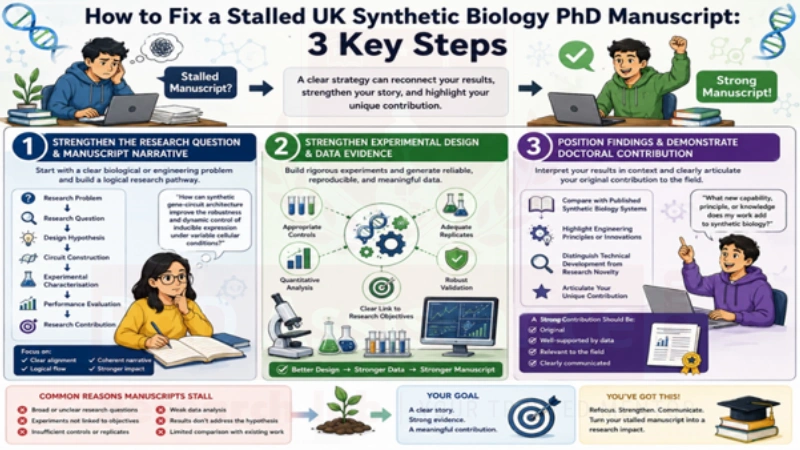
How to Fix a Stalled Synthetic Biology PhD Manuscript?
1. Strengthen the Research Question and Manuscript Narrative
A strong synthetic biology manuscript begins with a clearly defined biological or engineering problem.
A stronger question could be:
“How can synthetic gene-circuit architecture improve the robustness and dynamic control of inducible expression under variable cellular conditions?”
This creates a clear research pathway:
Research Problem
↓
Research Question
↓
Design Hypothesis
↓
Circuit Construction
↓
Experimental Characterisation
↓
Performance Evaluation
↓
Research Contribution
The manuscript should therefore be reorganised around the research question, rather than around the chronological order in which experiments were conducted.
In the UK, doctoral research is generally expected to demonstrate an original contribution to knowledge, although specific examination requirements vary between universities. Researchers should therefore check their university regulations, doctoral-school guidance and supervisor expectations when framing the research question and defining the scope of the contribution.
UK Research Example
The current UKRI Engineering Biology CDT at Bristol and Oxford aims to train researchers in scalable, robust and transformative engineering of biological systems. It builds on the earlier UKRI-funded Synthetic Biology CDT involving Oxford, Bristol and Warwick.
This illustrates the broader UK engineering-biology emphasis on robust and scalable engineering of biological systems
Practical Example:
Weak manuscript narrative:
Stronger narrative:
A design hypothesis was established → alternative circuit architectures were constructed → performance was quantitatively compared → the results identified design parameters associated with improved circuit behaviour.
The second structure provides a much clearer doctoral research argument. A Synthetic Biology PhD Manuscript Support can strengthen the research question in the PhD manuscript.
2. Strengthen Experimental Design and Quantitative Validation
Synthetic biology manuscripts often contain large quantities of experimental data. However, more data does not necessarily mean stronger evidence.
The experimental design should demonstrate that the observed effect is attributable to the biological intervention being investigated.
Researchers should consider:
If essential controls, replicates, or validation experiments were not conducted, manuscript editing alone cannot resolve the underlying evidence gap. Researchers should discuss whether additional experimental work is feasible and necessary with their supervisor or research team
UK Research and Research Integrity Context:
The importance of rigorous experimental design is reflected in UKRI guidance on research integrity, good research practice and reproducibility. UKRI-supported doctoral training also emphasises robust research practices and appropriate analytical skills.
For synthetic biology research, controls, biological replicates, quantitative analysis and validation should provide sufficient evidence for the conclusions. If essential experiments are missing, manuscript editing alone cannot resolve the evidence gap; researchers should discuss the need for additional work with their supervisor or research team.
Practical Example:
Suppose a researcher reports:
“The engineered strain increased target-product production by 35%.”
This statement does not establish whether the result is robust.
A stronger analysis would ask:
Published Research Example
A 2024 study involving researchers at the University of Oxford and Imperial College London developed a coarse-grained bacterial cell model for resource-aware analysis and design of synthetic gene circuits. The work demonstrates the importance of considering cellular resources when analysing and designing synthetic gene circuits rather than evaluating circuit behaviour in isolation.
This provides a useful example for a PhD manuscript: if a synthetic circuit changes cellular behaviour, the manuscript should consider whether the observed outcome reflects the intended circuit function or broader cellular-resource effects.
A Stronger Evidence Chain
Biological Design → Control → Replication → Quantification → Statistical Analysis → Validation
Treat experimental controls and quantitative validation as part of the research argument rather than simply as supporting information.
3. Re-establish the Original Contribution and Research Novelty
A manuscript can become stalled when the researcher reaches the results section but cannot clearly answer:
“What is the original contribution of this PhD?”
In synthetic biology, originality does not necessarily mean creating an entirely new biological system.
Doctoral contribution may arise from:
Published UK Research Example
Castle, Stock and Gorochowski’s 2024 Nature Communications perspective, “Engineering is evolution: a perspective on design processes to engineer biology,” was produced by researchers associated with the University of Bristol and BrisEngBio. The paper highlights the importance of considering evolutionary processes when designing biological systems.
This illustrates an important point for PhD researchers: the contribution may lie not simply in what was engineered, but in the principles learned about designing and controlling biological systems.
The research demonstrates how a synthetic biology study can move from:
“We built a circuit.”
towards:
“We investigated how genetic control strategies can influence the long-term evolutionary stability of engineered circuits.”
That distinction can significantly strengthen the contribution section of a PhD manuscript and make the research argument clearer during Synthetic Biology Manuscript Editing.
Manuscript Recovery Framework
Step 1 — Reframe
Research Problem → Research Question → Hypothesis
Clarify exactly what scientific uncertainty the manuscript addresses.
Step 2 — Revalidate
Design → Experiment → Controls → Data → Analysis
Ensure that the evidence genuinely supports the research claims.
Step 3 — Reposition
Results → Novel Finding → Contribution → Impact
Explain what new knowledge the research establishes.
UK Investment in Engineering Biology Research
The scale of UK investment provides a clear context for positioning original contributions in synthetic and engineering biology. UKRI reports more than £700 million invested in synthetic and engineering biology since 2007, including the £114 million Synthetic Biology for Growth programme, six multidisciplinary Synthetic Biology Research Centres and dedicated Centres for Doctoral Training.
More recently, Engineering Biology PhD programmes have been supported by UKRI at universities such as Bristol, Oxford, and Imperial College London, with training in advanced skills in engineering, computing, and other disciplines.
This context makes it useful for a PhD manuscript to explain not only what was constructed or tested, but what new scientific knowledge, engineering principle, methodology or capability the research establishes and how it contributes to the wider engineering-biology field.
Quick Self-Check
Conclusion
A stalled synthetic biology PhD manuscript does not necessarily mean that the research project has failed. In many cases, the problem lies in the connection between the research question, biological design, experimental evidence, validation and research contribution.
The technical findings of a well-executed synthetic biology project become more convincing within a PhD manuscript when the researcher clearly explains the research problem, rationale for the biological design, evidence supporting its performance, and new knowledge generated by the study.
Hard to strengthen your UK Synthetic Biology PhD manuscript? Request a Manuscript Review to identify gaps in your research question, experimental design, validation, and contribution. Get focused academic feedback to make your manuscript more rigorous, coherent, and submission-ready.
Book a Free expert consultation and receive structured PhD Manuscript Writing Support in UK.
FAQs:
- How to fix a stalled PhD manuscript?
Review the research question, manuscript structure, evidence, analysis, and original contribution. Reconnect each section with the central research objective and strengthen areas where the evidence or argument is weak.
- How to revise a synthetic biology PhD manuscript?
Reorganise the manuscript around the biological research question, strengthen experimental design and controls, improve quantitative analysis, and clearly explain the scientific contribution.
- How to improve a PhD manuscript for journal submission?
Check the manuscript against the target journal’s scope, article structure, formatting, figures, references, data requirements, and submission guidelines. For example, Synthetic Biology provides specific requirements for manuscript preparation, figures, abstracts, and pre-submission checks.
- Where can UK PhD students get manuscript editing help?
UK PhD researchers can seek support from university academic-writing services, subject-specialist editors, or professional manuscript-editing providers. Editing should improve clarity and presentation without replacing the researcher’s original scientific contribution.
- How can I strengthen my manuscript before peer review?
Conduct a pre-submission review of the research rationale, methodology, results, statistical analysis, figures, references, and limitations. Check whether the manuscript makes a clear and evidence-supported contribution before submitting it for peer review.
References
- Castle, S. D., Stock, M., & Gorochowski, T. E. (2024). Engineering is evolution: A perspective on design processes to engineer biology. Nature Communications, 15, 3640. https://doi.org/10.1038/s41467-024-48000-1
- Sechkar, K., Steel, H., Perrino, G., & Stan, G.-B. (2024). A coarse-grained bacterial cell model for resource-aware analysis and design of synthetic gene circuits. Nature Communications, 15, 1981. https://doi.org/10.1038/s41467-024-46410-9
- Gallup, O., & Steel, H. (2026). Generative design of synthetic gene circuits for functional and evolutionary properties. npj Systems Biology and Applications, 12, 62. https://doi.org/10.1038/s41540-026-00683-6
- Biotechnology and Biological Sciences Research Council. (2024, September 26). Synthetic biology. UK Research and Innovation. Synthetic biology – BBSRC/UKRI
- UK Research and Innovation. (n.d.). Engineering biology. Engineering biology – UKRI
- UK Research and Innovation. (n.d.). Synthetic biology for growth. Synthetic Biology for Growth – UKRI