
How Does the Research Problem Differ in Quantitative and Qualitative Research in Marine Biology
- Home
- Academy
- PhD Research Methodology
- Quantitative Data Analysis for In Vivo Screening
Quantitative Data Analysis
- Understanding the Therapeutic Potential of Natural Products in Disease Models
- Current Trends and Methods for Evaluating Biological Activity of Natural Compounds
- Plant-Based Natural Products in Drug Discovery and Development
- The Role of Nanocarriers in Natural Compound Delivery
- The Role of Natural Products in Innovative Drug Discovery
- Ethnobotanical Approaches in Drug Discovery
- Conclusion
- References
Recent Post
Introduction
Researchers in marine biology study ecosystems and organisms in water environments, frequently by applying two main techniques: quantitative and qualitative. Although the selection of both methods has the common goal of enhancing the knowledge of marine ecosystems, they are quite different in terms of the formulation of research problems, data collection, and analysis. Nevertheless, there are also some similarities of qualitative and quantitative research that render them complementary, because both have the same goal of promoting scientific knowledge and aiding in the development of evidence-based practices in marine biology. PhD researchers in marine biology need to be aware of these differences, as they can both make their research effective and extremely relevant.
The article under consideration difference between qualitative and quantitative data in marine biology, and it is focused on research design, data collection, and analysis, while giving key examples for PhD scholars.
1. The Research Problem in Quantitative Marine Biology
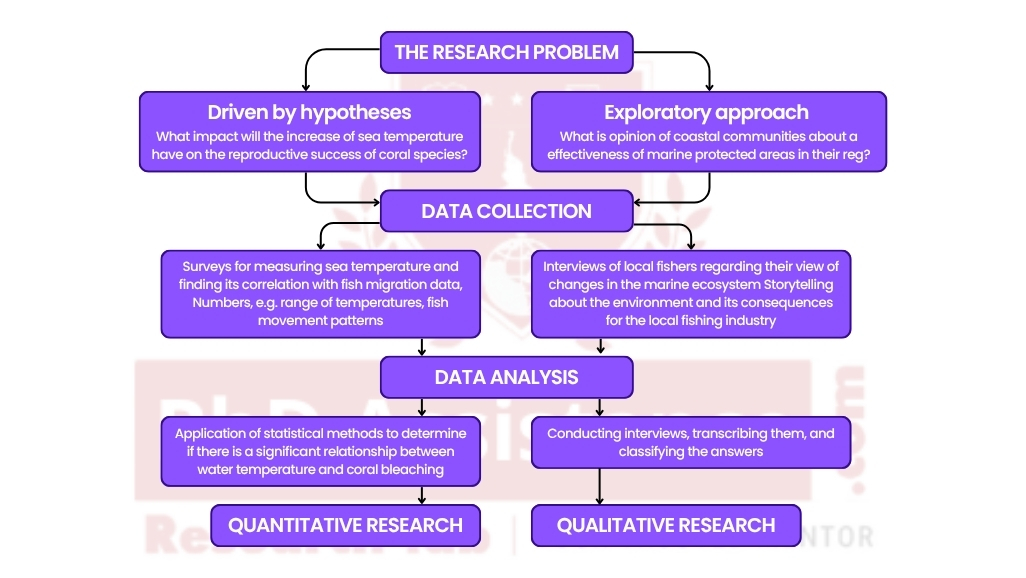
In marine biology, quantitative research is mainly driven by hypotheses, and the main goal of such research is to measure and analyse the numerical data so as to discover the relationships and patterns between variables. Research problems in this area are, therefore, precise, testable, and involve measurable phenomena such as a change in the environment or marine organisms’ interaction, population of species, etc. The similarities of qualitative and quantitative research can be seen in the beginning of the research problem formulation, where both methods are used to answer crucial questions regarding marine ecosystems.
Example:
A normal quantitative research problem in marine biology could be: “What impact will the increase of sea temperature have on the reproductive success of coral species?”
Key Characteristics:
- Driven by and testable through hypotheses.
- Dependent on the use of numerical data (for example, species counts, water temperature).
- Observational and replicable for generalisation.
Tip for PhD Researchers:
Utilise SPSS or R for the analysis of your data as statistical tools. They are useful for both confirming theories and measuring impact in the marine ecosystem among the variables.
2. The Research Problem in Qualitative Marine Biology
Marine biology qualitative research is an exploratory approach and mainly relies on comprehension of the complex, context-driven phenomena that are almost impossible to measure. Such research questions can be categorised as general and probing into certain areas of human behaviours, perceptions, and social factors that affect marine ecosystems, such as conservation policy impacts or local communities’ attitudes toward marine biodiversity.
Example:
The problem of qualitative research might be framed as follows: “What is the opinion of coastal communities about the effectiveness of marine protected areas in their region?”
Key Characteristics:
- Exploratory and descriptive nature.
- Emphasis on contextual understanding, usually through interviews or observations.
- Analysis is subjective and interpretative.
Tip for PhD Researchers:
- Conduct interviews or organise focus groups to investigate human perceptions or behaviours towards marine ecosystems. Thematic analysis can assist in pinpointing the major patterns and meanings emerging from the data.
3. Data Collection in Quantitative vs. Qualitative Research
Quantitative research is done using strict and systematic methods, which involve obtaining numerical data that may cover multiple areas such as water quality, biodiversity, or environmental conditions. Among the major techniques used are surveys, field measurements, and sensor data. This method focuses on qualitative and quantitative analysis, where data is collected and analysed for measurable relationships.
Qualitative research, in contrast, goes for the less formal data collection methods, more often than not letting the subjects’ personal experiences, opinions, or cultural backgrounds take the lead in deciding what comes first. Interviews, focus groups, and observational studies are the most typical qualitative methods.
Quantitative Example:
- Method: Surveys for measuring sea temperature and finding its correlation with fish migration.
- Data: Numbers, for instance, the range of temperatures and the patterns of fish movement.
Qualitative Example:
- Method: Interviews of local fishers regarding their view of changes in the marine ecosystem.
- Data: Storytelling about the environment and its consequences for the local fishing industry.
Tip for PhD Researchers:
- Quantitative researchers should always emphasise random sampling to ensure broad generalisation, whereas qualitative researchers should constantly place quality sampling for in-depth insights.
4. Data Analysis in Quantitative vs. Qualitative Research
Quantitative research data analysis is exclusively empirical and statistical, applying techniques such as R, SPSS, or Excel to work with data sets and determining sea phenomena by hypothesis testing and inference making. The difference between qualitative and quantitative data lies in their nature. Therefore, regression analysis, correlation, and ANOVA, among others, are frequently used by researchers conducting qualitative and quantitative analysis in marine biology.
On the other hand, qualitative research analysis is highly interpretative. Researchers analyse, categorise and interpret the data through coding or thematic analysis to reveal patterns, themes, or even the insights that connect human behaviour and the surrounding environment.
Quantitative Example:
- Analysis: Application of statistical methods to determine if there is a significant relationship between water temperature and coral bleaching.
Qualitative Example:
- Analysis: Conducting interviews, transcribing them, and classifying the answers to illuminate the main themes concerning the community’s view of marine conservation actions.
Tip for PhD Researchers:
- For quantitative analysis, use appropriate sampling techniques and carry out statistical significance tests to bolster your conclusions.
- Coding is a process in qualitative analysis that involves sorting data into themes that will allow you to grasp the wider context of your research.
5. Choosing Between Quantitative and Qualitative Approaches
The decision between quantitative and qualitative research methodologies depends primarily on the specific marine biological question and the kind of data required. On one hand, quantitative research is the best approach for the testing of hypotheses that are specifically defined and relate to measurable phenomena, while on the other hand, qualitative research is the best approach if the main goal of the study is to get acquainted with and understand the difficult, contextual factors involved. For example, quantitative and qualitative data examples might include numerical measurements such as species population sizes or environmental parameters like sea temperature.
When to Use Quantitative Research:
- To quantify environmental changes (e.g., variation in ocean salinity, temperature).
- To conduct time-series studies on species population dynamics, migratory patterns, or ecosystem health.
When to Use Qualitative Research:
- To probe into human factors, e.g. the local community’s attitudes towards marine conservation.
- To clarify the cultural, social, or psychological factors that affect marine biodiversity.
Tip for PhD Researchers:
- Consider a mixed-methods approach if it is necessary to have both quantitative data and qualitative context for a complete understanding of the marine issue.
6. Challenges in Quantitative and Qualitative Research
Both quantitative and qualitative research are encountering different difficulties. For instance, one of the biggest issues in quantitative research is that the data must be very precise, and also, adjusting for confounding variables and managing big data are considered part of the challenges. These challenges highlight a quantitative and qualitative difference in how each research type manages data complexity. Conversely, one of the main challenges in qualitative research is subjectivity, along with the possibility of biases in data interpretation and the difficulty of organising and managing different sources of data, like interviews and field notes.
Quantitative Challenges:
- Data management: The handling of large datasets can be a complex process and may require the use of robust software and statistical tools.
- Sampling issues: The samples need to be representative and unbiased, so that the results are accurate.
Qualitative Challenges:
- Data interpretation: The challenge is to make sure that the researcher’s interpretations are valid and are in line with the participants’ perspectives.
- Subjectivity: It is important to deal with the researcher’s bias and try to ensure that findings are not too much influenced by personal views.
Tip for PhD Researchers:
- In quantitative research, double-check that sample size and statistical power are adequate for strong analysis.
- In qualitative research, use triangulation by applying multiple data sources or methods to strengthen the validity of findings.
Research Approach | Quantitative Research Example | Qualitative Research Example |
Research Question | “How does ocean acidification affect the growth rates of shellfish?” | “How do fishers in coastal communities view the impact of overfishing on marine biodiversity?” |
Focus of Study | Measurable changes in the growth rates of shellfish under different pH levels | Social perspectives and local knowledge about overfishing and conservation |
Data Collection | Collecting growth data from shellfish in controlled pH environments over time | Conducting interviews with fishers to understand their experiences and views on sustainable fishing |
Data Type | Numeric data (e.g., growth rate measurements in cm/day, pH levels) | Narrative data (e.g., transcripts from interviews or group discussions) |
Methodology | Use of statistical tools (e.g., ANOVA, regression analysis) to test the effect of ocean acidification | Thematic analysis of interview data to identify recurring themes related to fishing practices |
Outcome | Quantifiable results (e.g., how much shellfish growth is impacted by acidification) | Descriptive insights (e.g., perceptions of fishers on the effectiveness of fishing regulations) |
Conclusion
The primary distinctions between the two research types, quantitative and qualitative difference, in the field of marine biology are indicated by how one frames research problems, the methods employed for data gathering, and mainly the process of interpreting the findings. The path of quantitative research is through the testing of hypotheses and the processing of numerical data to arrive at objective conclusions, whereas qualitative research intends to penetrate deep into human experiences and perceptions and to understand complex, contextual issues. Both approaches strive to provide valuable insights, whether through quantitative and qualitative data examples.
Moreover, the differences mentioned above are very important for PhD students in marine biology who have to choose the proper method to solve their unique research questions. No matter if the study is on the influence of the environment, the behaviour of species, or the opinions of the community, the chosen methodological approach will guarantee that marine biology research is both extensive and influential.
References
- Chenail, R. (2012). Textual data analysis in public health: A review. Journal of Public Health Research, 8(2), 152-160.
- Jefferson, R., McKinley, E., Griffin, H., Nimmo, A., & Fletcher, S. (2021). Public perceptions of the ocean: lessons for marine conservation from a global research review. Frontiers in Marine Science, 8, 711245.
- Refulio-Coronado, S., Lacasse, K., Dalton, T., Humphries, A., Basu, S., Uchida, H., & Uchida, E. (2021). Coastal and marine socio-ecological systems: A systematic review of the literature. Frontiers in Marine Science, 8, 648006.
- Smith, J., & Firth, J. (2011). Framework analysis in marine biology: Impact of chronic stressors on marine species. Marine Biology Journal, 44(2), 134-142.
- Wassie, T., Niu, K., Xie, C., Wang, H., & Xin, W. (2021). Extraction techniques, biological activities and health benefits of marine algae Enteromorpha prolifera polysaccharide. Frontiers in Nutrition, 8, 747928.