
How to Conduct PhD Data Analysis in Biochemistry in India: Integrating Advanced Statistical Modeling and Bioinformatics Techniques
- Home
- Academy
- Data Analysis
- How to Conduct PhD Data Analysis in Biochemistry in India: Integrating Advanced Statistical Modeling and Bioinformatics Techniques
Sustainable Practices in Environmental Science
- Understanding Biochemistry Data Analysis Requirements
- Defining Research Objectives and Data Strategy
- Selecting Appropriate Statistical Methods
- Integrating Bioinformatics Techniques
- Data Collection and Preprocessing
- Tools and Software for Biochemistry Data Analysis
- Data Analysis and Interpretation
- Ensuring Validity and Reliability
- Structuring the Data Analysis Chapter
- Common Challenges and How to Overcome Them
- Conclusion

Recent Post
Introduction
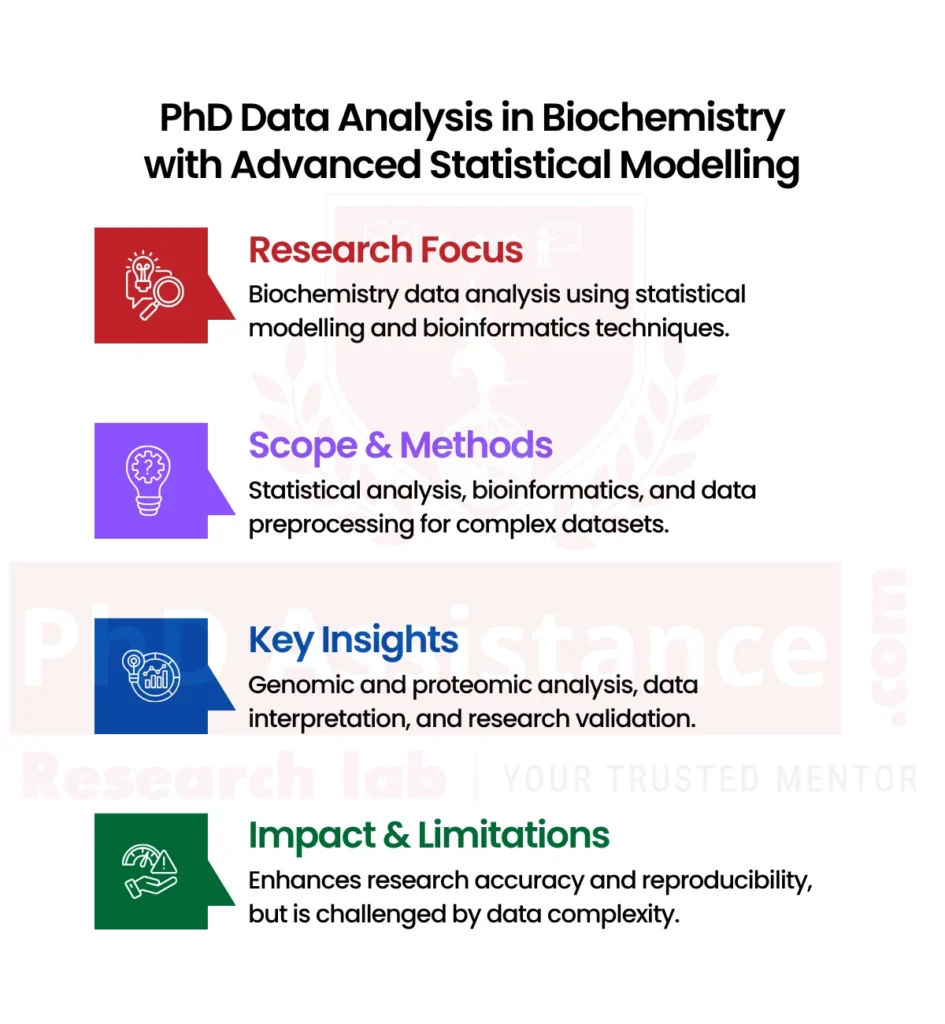
The data analysis process in a biochemistry PhD program represents the most important research phase because it establishes how accurate and trustworthy your research results will be and what their total scientific value will be. The development of experimental technologies, which include high-throughput sequencing and proteomics, has led contemporary biochemistry research to produce extensive and complex data sets that need both computational and statistical skills for analysis.
To address these challenges, researchers must integrate bioinformatics techniques with advanced statistical modelling in biochemistry research, which enables them to analyse molecular data, protein interactions and genomic sequences efficiently. The methods enhance data interpretation and improve scientific reproducibility, together with scientific validity. Indian researchers now use PhD biochemistry data analysis services India to handle their complex data requirements. The guide provides biochemistry data analysis methods that help scholars handle research challenges while achieving research integrity and publishing standards.
Understanding Biochemistry Data Analysis Requirements
statistical analysis in biochemistry research produces various types of data, which include genomic sequences, proteomics data and enzyme kinetics measurements. The correct biochemistry data analysis methods must be applied to achieve precise dataset interpretation. Researchers must first identify the nature of their data, whether it is quantitative, qualitative, or omics-based, and then select appropriate statistical and computational tools accordingly.
Academic research requires researchers to establish reproducibility standards while validating their research findings. The research institutions in India require biochemistry researchers to use statistical methods together with computational biology tools to produce results that can be published in academic journals.
Defining Research Objectives and Data Strategy
The analysis process requires researchers to establish their research questions and hypotheses together with their expected outcomes. The structured data strategy enables researchers to choose appropriate analytical methods that produce results that match their research goals.
Biostatistics applications in biochemistry research achieve better results when researchers establish their research design before starting the study. The field of enzyme activity research needs regression models, while gene expression studies require clustering and differential analysis methods. The establishment of a clear roadmap at this stage will lead to a structured analysis process.
Selecting Appropriate Statistical Methods
The selection of appropriate statistical methods serves as a critical factor that determines the trustworthiness of research results. Advanced statistical modeling in biochemistry research helps scientists discover patterns, verify research questions, and create future predictions. Data summary requires descriptive statistics, while regression analysis allows researchers to study how different variables connect with each other.
Experimental validation uses methods such as ANOVA and hypothesis testing, while multivariate analysis provides effective solutions for handling intricate biological data sets. The proper use of these methods strengthens the overall statistical analysis and ensures scientific credibility.
Integrating Bioinformatics Techniques
The development of high-throughput technologies has created a need for bioinformatics techniques for biochemistry research. The methods enable scientists to conduct efficient analysis of extensive biological datasets. The applications of sequence alignment and genome analysis, protein structure prediction, molecular docking and pathway analysis deliver a more profound understanding of biological systems. Researchers enhance their research findings by using bioinformatics together with statistical methods to analyse complex datasets and discover important biological connections.
Data Collection and Preprocessing
The research accuracy depends on the exact quality of the collected data, which researchers use for their analysis. Researchers need to clean and standardise datasets before they can start their analysis work. The process of handling missing data and outlier values requires specific standards that must be met to achieve impartial outcomes. The preprocessing stage consists of two tasks, which maintain experimental conditions and create data sets for statistical testing. The current phase requires researchers to use appropriate biochemistry PhD data analysis methods, which will establish trustworthiness and repeatability for future research.
Example:
Study: Cox, J., & Mann, M. (2008)
Cox and Mann (2008) created MaxQuant, which serves as a computational platform that proteomics researchers use to analyse mass spectrometry data. The study showed that applying accurate data preprocessing methods, which included noise filtering, normalisation, and peptide identification, led to better outcomes in protein quantification accuracy. The research demonstrates that structured biochemistry data analysis methods should be utilised during preprocessing to enable reliable results and reproducible outcomes in large-scale biological datasets..
Tools and Software for Biochemistry Data Analysis
Researchers need to select appropriate tools and software solutions because they require these resources to perform their analysis methods successfully. Researchers commonly use programming languages such as R and Python for statistical computing. Researchers also use SPSS and SAS software to perform various biostatistical applications in biochemistry. Researchers use bioinformatics tools such as BLAST and Clustal Omega for sequence analysis. Researchers use MATLAB and Cytoscape for their modelling and visualisation needs. Researchers need specific tools based on their research objectives and methodological framework because this method supports their study needs for complete, transparent and reproducible research.
Example:
Study: Love, M. I., Huber, W., & Anders, S. (2014)
Love et al. (2014) developed DESeq2, which provides a statistical approach to RNA-seq data analysis through its advanced count data modeling capabilities. The research showed that biochemistry studies benefit from advanced statistical methods because these methods enable researchers to detect differentially expressed genes through shrinkage estimation and normalization techniques. The method provides bioinformatics researchers with a reliable approach to interpret gene expression data while validating their molecular biology research hypotheses.
Data Analysis and Interpretation
After preprocessing, the next step requires researchers to study the data to achieve their research objectives. Researchers must use visualisation techniques such as graphs, charts, and heatmaps to present their findings clearly. Researchers can identify patterns through experimental and control group comparisons, which require them to use both statistical methods and subject matter expertise for result interpretation. The combination of statistical methods and biological knowledge in biochemistry research enables researchers to reach accurate conclusions which fulfill study objectives.
Ensuring Validity and Reliability
The research needs dependable results, which can only be established through multiple testing procedures. The researchers need to conduct their study through multiple test repetitions, while they should verify their results with separate data collections and compare their findings against previous studies. The procedures establish both the validity and reliability of results through testing, which results in accurate outcome confirmation. The study gains stronger verification through proper validation methods that meet international research requirements.
Structuring the Data Analysis Chapter
A well-organised data analysis chapter improves clarity and readability. The research paper needs to provide information about its data sources and analytical methods, all tools used, and how they interpret results. The chapter requires both validation techniques and a discussion about the study’s limitations. Many researchers seek professional PhD biochemistry data analysis services to refine this section, ensuring that it meets academic and publication standards.
Common Challenges and How to Overcome Them
PhD researchers face difficulty in three main areas, which include handling extensive data collections, choosing suitable statistical methods, and effectively using bioinformatics software. The solution to these problems requires researchers to engage in ongoing education while they maintain contact with their academic advisors and follow the latest scientific advancements. The research procedure becomes more efficient when researchers obtain specialized help or expert assistance to resolve their technical and research method problems.
Conclusion
PhD research on biochemistry data analysis in India needs to deploy advanced statistical methods, which biochemistry research requires, together with bioinformatics tools used for biochemical studies. Structured biochemistry data analysis methods enable researchers to produce accurate results through their research work when they apply the correct research tools. Researchers achieve excellent research results through proper planning and validation processes, which they complete with help from experts. Professional PhD biochemistry data analysis services offer research support that helps improve your research work through better quality and reliable results.
If you are conducting a PhD data analysis in biochemistry in India, expert guidance can help you apply bioinformatics techniques and advanced statistical modelling effectively.
References
- Cox, J., & Mann, M. (2008). MaxQuant enables high peptide identification rates and proteome-wide protein quantification. Nature Biotechnology, 26(12), 1367–1372. https://pubmed.ncbi.nlm.nih.gov/
- Love, M. I., Huber, W., & Anders, S. (2014). Moderated estimation of fold change and dispersion for RNA-seq data with DESeq2. Genome Biology, 15(12), 550. https://pubmed.ncbi.nlm.nih.gov/