
How Experimental Designs Shape the Study of Human Behaviour and Mental Processes: A Methodological Guide for PhD Scholars
- Home
- Academy
- PhD Data Analysis
- A Methodological Guide for PhD Scholars
A Methodological Guide for PhD Scholars

Recent Post
Introduction
In the field of experimental psychology, it is quite difficult to determine the proper sample size and the required statistical power. To help with this issue, Baker along with colleague researchers (2021) introduced power contours, a graphical method that allows changing the number of subjects and the number of repetitions in a manner that assures accurate determination of the effect. The procedure shows that not only the size of the sample but also the frequency of the observations conducted per individual contributes to the power.
Drawing on key works by Aydin (2024), Almaatouq et al. (2024), Kazdin (2021), Baker et al. (2021), and Chester and Lasko (2021), this article provides a methodological guide for PhD scholars seeking to design rigorous experimental studies. It highlights foundational principles, emerging innovations, challenges, and practical strategies to strengthen experimental research in behavioural science.
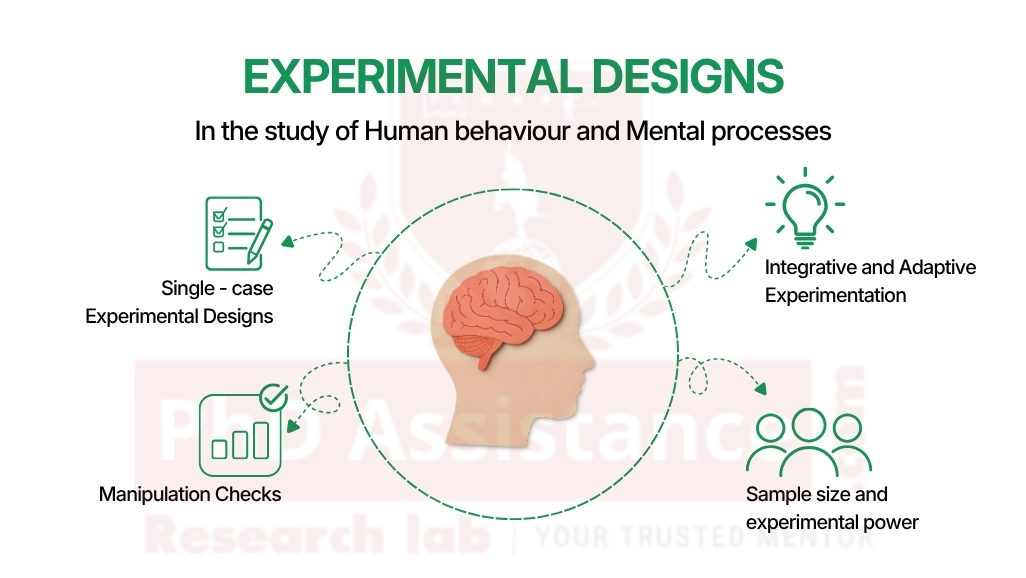
1. The Rise of Single-Case Experimental Designs (SCEDs)
Single-case experimental designs are gradually gaining popularity and acceptance in clinical and applied psychological research. Aydin (2024) mentions that SCEDs were first created to overcome the weaknesses of standard group designs, especially in situations involving rare clinical disorders, or when patients are treated one at a time. Kazdin (2021) points out that the methodological advantage of SCEDs arises from the very fact that they embrace such typical features or traits of controlled experiments as: the use of repeated measures, the assessment of the baseline, and the conduction of replication.
Key Findings
- Single-case experimental designs (SCEDs) are capable of giving precise assessments of individual-level intervention effects (Kazdin, 2021).
- Their resurgence is a response to the therapist’s demand for research methods that are more personalized, besides being the practical needs in clinical settings (Aydin, 2024).
- Today’s SCEDs have been upgraded with the digital tools enabling constant measurement to be easier than ever.
Tips for PhD Scholars
- SCEDs are recommended for small or specialized populations.
- Employ designs like ABAB reversal, multiple-baseline, or alternating treatments to signify an effect’s presence and thus establish a causal relationship..
- Increase the internal validity of your results by doing replication studies with different behaviors, settings, or participants..
2. Integrative and Adaptive Experimentation in Behavioral Science
Typical laboratory tests frequently tend to focus on the validation of one hypothesis by itself. Nonetheless, Almaatouq et al. (2024) assert that such methods do not suffice for the comprehension of intricate behavioral phenomenon. They suggest the application of integrative experiment design which incorporates throughout the process the utilization of computational models, iterative data collection, and adaptive testing to constantly modify the experimental questions.
Key Findings
- The process of integrative experimentation is characterized by the usage of model-based predictions to assist in making design decisions, which actually results in the increase of efficiency (Almaatouq et al., 2024).
- The precision of behavioral experiments is greatly improved by the application of adaptive methods, such as sequential testing or multi-armed bandit algorithms.
- However, this approach not only allows the researcher to determine the existence of an effect but also to investigate the intricacies of how and under what conditions it appears.
Tips for PhD Scholars
- Psychological testing via experimental methods should be complemented with computational modeling (e.g., Bayesian methods).
- Implement the adaptive design techniques for the purpose of manipulation refining as the data are being collected.
- Use the online behavioral platforms to execute the iterative and multi-phased experiments.
3. Strengthening Construct Validity Through Manipulation Checks
The vagueness of manipulations was one of the main threats to experiment validity. Chester and Lasko (2021) stated that many psychological experiments do not conduct proper manipulation checks and hence the construct validity is low. If it is not confirmed that the manipulation has caused the desired psychological process, the causal assertions turn into doubts.
Key Findings
- Manipulation failures are common and often go unreported (Chester & Lasko, 2021).
- Construct validation requires demonstrating that the manipulation engages the target construct through converging evidence.
- Experiments benefit from multi-method validation approaches, including behavioral and self-report indicators.
Tips for PhD Scholars
- Conduct pilot testing to verify manipulation effectiveness.
- Use both direct and indirect manipulation checks (e.g., behavioral, physiological, self-report).
- Pre-register validation procedures and hypotheses to promote transparency.
4. Optimizing Sample Size and Experimental Power
Determining appropriate sample size and statistical power is a major challenge in experimental psychology. Baker et al. (2021) introduced power contours, a visual strategy for balancing participant numbers and trial repetitions to achieve precise effect estimates. Their work underscores that power depends not only on sample size but also on the number of observations per participant.
Key Findings
- Traditional power analysis often overlooks the impact of within-subject trial numbers (Baker et al., 2021).
- Increasing repeated measures can be more efficient than increasing participant numbers.
- Power contours allow researchers to simulate the interplay between design structure and statistical precision.
Tips for PhD Scholars
- Power analysis for complex designs should be based on simulation or contour methods.
- When possible, increase the number of trials to achieve maximum accuracy.
- Do not choose sample sizes randomly or without a theoretical/legal justification.
5. Challenges and Opportunities in Experimental Research
Common Challenges
- Measurement and Construct Clarity
It is usual for PhD students to have difficult times with defining psychological constructs as well as this might lead to invalid manipulations (Chester & Lasko, 2021). (Chester & Lasko, 2021). - Ethical and Practical Limitations
Kazdin (2021) argues that the use of clinical or vulnerable populations in research causes a serious limitation to the number of experiments that can be conducted. - Complexity of Modern Designs
Empirical designs necessitate the use of complex and computationally skilled researchers (Almaatouq et al., 2024). - Data Quality and Participant Compliance
Researchers are worried about getting inconclusive data because of participants’ inattentiveness when conducting online experiments.
Tips for PhD Scholars
- Conduct experiments in such a way that they are very closely related to the specific theory being investigated.
- Apply open science methods (pre-registration, open data, replication).
- Team up with statisticians in case of complex or adaptive designs.
- Make use of attention checks and data-validation measures in case of online studies.
Summary Table
Section Title | Key Findings (from the 5 articles) | Practical Tips for PhD Scholars |
Single-Case Designs | SCEDs offer rigorous, individualized causal inference (Aydin, 2024; Kazdin, 2021) | Use ABAB or multiple-baseline designs; emphasize replication |
Integrative Experimentation | Iterative and model-based designs improve precision (Almaatouq et al., 2024) | Use computational models; adopt adaptive methods |
Construct Validity | Manipulation failures threaten causality (Chester & Lasko, 2021) | Pilot test manipulations; use multi-method checks |
Sample Size & Power | Power depends on trials and participants (Baker et al., 2021) | Use power contours; increase repeated measures |
Experimental Challenges | Ethics, complexity, and data quality remain issues | Pre-register; ensure theoretical clarity; validate data |
Conclusion
The process of uncovering the mechanisms behind human behavior and mental processes is based on experimental designs. Today’s researches not only focus on traditional group-based methods but also divert to new ones like single-case designs, adaptive experimentation and advanced power planning. Aydin (2024), Almaatouq et al. (2024), Kazdin (2021), Baker et al. (2021) and Chester and Lasko (2021) point out the essentials of methodological rigor, validated manipulations, optimal sampling strategies and flexible design structures.
For PhD researchers, the grasping of these sophisticated methodologies is a must for the creation of research that is not only credible but also replicable and of theoretical significance. The combination of the principles of rigorous experimental design and the use of modern computational tools and ethical research standards can, therefore, be a great asset for early-career researchers in terms of their contribution to psychological science and also for the deepening of our understanding of human cognition and behaviour.
References
- Aydin, O. (2024). Rise of single-case experimental designs: A historical overview of the necessity of single-case methodology. Neuropsychological Rehabilitation, 34(3), 301–334.
- Almaatouq, A., Griffiths, T. L., Suchow, J. W., Whiting, M. E., Evans, J., & Watts, D. J. (2024). Beyond playing 20 questions with nature: Integrative experiment design in the social and behavioral sciences. Behavioral and Brain Sciences, 47, e33.
- Baker, D. H., Vilidaite, G., Lygo, F. A., Smith, A. K., Flack, T. R., Gouws, A. D., & Andrews, T. J. (2021). Power contours: Optimising sample size and precision in experimental psychology and human neuroscience. Psychological Methods, 26(3), 295–314.
- Chester, D. S., & Lasko, E. N. (2021). Construct validation of experimental manipulations in social psychology: Current practices and recommendations for the future. Perspectives on Psychological Science, 16(2), 377–395.
- Kazdin, A. E. (2021). Single‐case experimental designs: Characteristics, changes, and challenges. Journal of the Experimental Analysis of Behavior, 115(1), 56–85.