
The source and why it matters
The paper under review is Xia et al. (2025), "The other side of PhD education: A systematic review of research on PhD students' development as university teachers", published in Review of Education, the review journal of the British Educational Research Association (volume 13, issue 1, article e70024, April 2025).
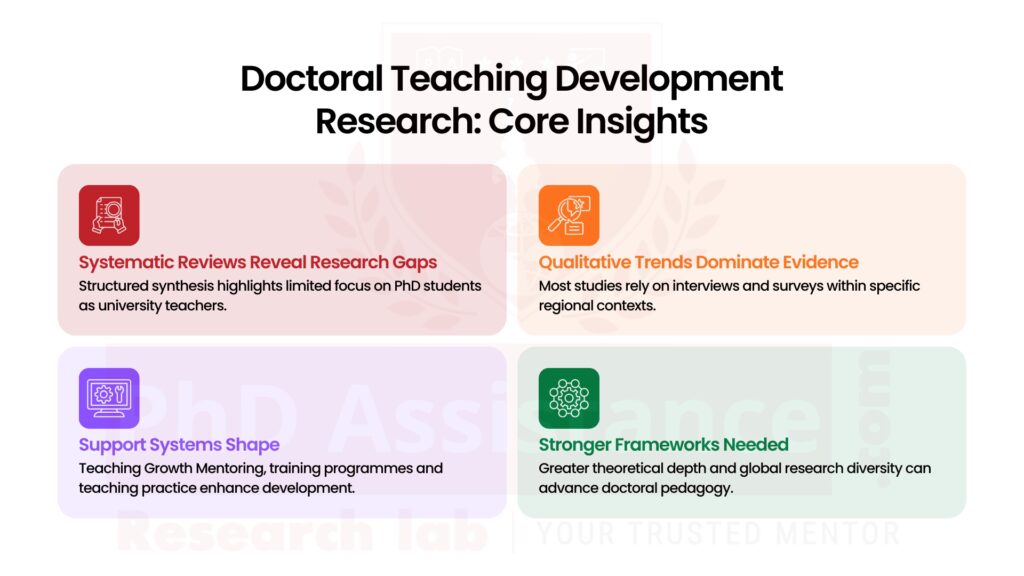
The authors begin from an imbalance. The development of PhD students as university teachers matters, they argue, both for their own academic careers and for the quality of university teaching, yet research on doctoral students' professional growth has focused mainly on their role as researchers. Much less is known about what they call the other side of PhD education (Xia et al., 2025).
The imbalance has a long history. In an influential study of aspiring faculty in the United States, Austin (2002) described graduate school as a process of socialisation to the academic career and argued that it prepared doctoral students unevenly for the full range of academic work, including teaching. In many systems doctoral students now teach seminars, run laboratories, mark assessments and supervise undergraduate projects, often as graduate teaching assistants, so the question of how they learn to teach is practical as well as academic.
What the review did and found
Xia and colleagues set three aims: to examine the characteristics of existing studies on PhD students' development as university teachers, to identify the support available, and to explore the challenges doctoral students encounter. The review is based on two literature searches, both reported following the PRISMA guidelines, which together identified 40 publications in three databases: ProQuest, Scopus and Web of Science (Xia et al., 2025).
Three conclusions stand out in the authors' summary. First, the literature is homogeneous: most included studies are qualitative and were conducted in North America. Second, the authors conclude that doctoral candidates' development as university teachers has received little attention in the literature. Third, the studies describe several types of support and a range of challenges. On this basis the authors propose a framework of courses, practica and mentoring to inform efforts to support PhD students' development as university teachers (Xia et al., 2025).
| Element | What the review reports | Questions a reader should ask |
|---|---|---|
| Aims | Characteristics of studies, support available, challenges encountered | Are the aims answered separately and in proportion? |
| Searches | Two searches; ProQuest, Scopus, Web of Science; PRISMA reporting | What dates, terms, languages and document types were included? |
| Evidence base | 40 publications, mostly qualitative, mostly North American | How far do the findings travel to other systems? |
| Synthesis | Types of support and challenges identified | Was study quality appraised, and did it shape the synthesis? |
| Output | Framework of courses, practica and mentoring | Has the framework been implemented or tested? |
Strengths
- It names a neglected subject. By framing teaching development as the other side of PhD education, the review gives a clear rationale for doctoral programmes, graduate schools and researchers to treat it as part of doctoral formation rather than an optional extra.
- It maps the field before prescribing. Describing the characteristics of existing studies, including their methods and settings, shows readers where the evidence is thin, which is often the most useful output of a review in an emerging area.
- It uses a recognised reporting standard. Reporting the searches against PRISMA makes the process easier to follow and to repeat (Page et al., 2021).
- Its framework is practical. Courses, practica and mentoring correspond to things institutions can organise, and they align with UK practice in which new teachers work towards the descriptors of the Professional Standards Framework (Advance HE, 2023).
Limitations and methodological issues
The main limits follow from the evidence base and from what a review of this kind can establish.
- A narrow and homogeneous base. Forty publications is a modest number for a topic of this breadth, and the authors themselves note that most are qualitative and North American. Graduate teaching assistant roles, contracts and training differ considerably between systems, so conclusions may not transfer to the UK, Europe, Asia or Africa without further work.
- Appraisal of included studies. PRISMA 2020 asks reviewers to report how the risk of bias or quality of included studies was assessed (Page et al., 2021). With a mostly qualitative and mixed evidence base, a tool such as the Mixed Methods Appraisal Tool (Hong et al., 2018) can show which findings rest on stronger studies. Readers should check how, and whether, quality judgements informed the synthesis.
- From synthesis to framework. The framework is derived from the literature, not tested. It names the components of support but cannot yet say which combinations, sequences or intensities work best, or for whom.
- Outcomes of teaching development. Evidence that training changes university teachers' practice exists but is limited. Gibbs and Coffey (2004) reported changes in trained teachers' approaches and in their students' approaches to learning, while Chalmers and Gardiner (2015) noted that evaluations of academic development programmes have typically examined isolated initiatives with small groups, and argued for building evaluation in from the planning stage. Doctoral teaching development faces the same evidence gap.
None of these points undermines the review's main contribution, which is to map the field and propose a direction. They determine how it should be cited: as evidence that the topic is under-researched and that courses, practica and mentoring are the main forms of support described in the literature, not as evidence that this combination improves teaching or careers.
Reading a systematic review of this kind critically
Because many doctoral researchers will cite this review in their own literature chapters, it is worth separating three questions that are easily run together. The first is whether the review is reported transparently: can a reader see which databases were searched, with what terms and limits, how records were screened and why studies were excluded? This is what PRISMA addresses (Page et al., 2021). The second is whether the included studies are trustworthy, which depends on appraising each study against criteria suited to its design (Hong et al., 2018). The third is whether the synthesis follows from the studies: whether a theme reported by one or two small qualitative studies is presented with the same weight as one that recurs across many.
Applied to Xia et al., the first question is answered by the authors' reporting, the second and third need to be checked against the full text before strong claims are built on particular findings. A careful way to cite the paper in a thesis is therefore to report what it set out to do, the size and character of its evidence base, and its framework as a proposal, and to cite individual primary studies when a specific claim about support or challenges matters to your argument.
How the review sits in the wider literature
Studies outside the review's core databases add context that a doctoral reader may find useful. In the UK, Chadha (2013) described redesigning a graduate teaching assistant programme at a research-intensive university around GTAs' own choices and discipline-based teaching, with preliminary evidence from evaluations and focus groups that the revised curriculum met their needs better. Winter et al. (2015) found that institutional and cultural factors shaped access to teaching opportunities, particularly for international doctoral students.
Equity and labour conditions are the dimension most often missing from programme-level frameworks. Rao et al. (2021), studying doctoral students who teach at two English universities, argued that neoliberal restructuring has expanded doctoral teaching and that institutional differences create unequal access to pedagogical support and to opportunities to build a teaching identity. Feldon et al. (2023) similarly examine how institutional structures and unequal access to social and cultural capital shape who progresses towards the professoriate. A framework of courses, practica and mentoring will work differently depending on who is offered teaching, on what terms and with how much time.
What it means for doctoral researchers who teach
The framework can be turned into a personal development plan. The table adapts it for individual use; the adaptations are ours.
| Component | What to look for | What to record |
|---|---|---|
| Courses | An introductory teaching programme, GTA training or a module leading to a recognised teaching award | Sessions attended and one change you made to your teaching as a result |
| Practica | A sequence of teaching responsibilities that grows from tutorials or labs towards designing a session or assessment | What you taught, to whom, and how you gathered feedback |
| Mentoring | An experienced teacher who observes you and discusses your practice | Observation notes and the actions you agreed |
| Reflection | A short written reflection after each block of teaching | What worked, what did not, and what the evidence was |
An illustrative example
Consider a hypothetical second-year doctoral researcher in sociology who has been asked to lead weekly seminars. She joins her university's introductory teaching programme (course), asks to take over one lecture in her second term after leading seminars in the first (practicum), and arranges for the module leader to observe one seminar each term (mentoring). After each term she writes a one-page reflection drawing on student comments and the observation notes. By the end of the year she has evidence for a teaching fellowship application, and a protected weekly limit on preparation time agreed with her supervisor. The example is illustrative: it shows how the framework's components can be combined, not what any particular institution offers.
In the UK, a record of this kind can also support an application for recognition against the Professional Standards Framework, whose first descriptor covers those with experience across some dimensions of teaching and learning (Advance HE, 2023). Check your own institution's route and requirements, which vary.
Teaching experience also matters at the end of the doctorate. If you are preparing for academic interviews or a viva in which your wider development may come up, see the related reviews on doctoral well-being and careers beyond academia.
Common mistakes when citing or applying this review
- Citing it as evidence that courses, practica and mentoring improve teaching quality; it proposes the framework but does not test it.
- Generalising findings from a mostly North American, mostly qualitative literature to every national system.
- Treating PRISMA compliance as a quality guarantee rather than as a description of how the review is reported.
- Taking on teaching without agreeing limits with your supervisor, so that preparation time crowds out research.
- Teaching for years without keeping any record of feedback, observation or reflection.
Key takeaways
- Xia et al. (2025) reviewed 40 publications and found little research on PhD students' development as university teachers.
- The evidence base is mostly qualitative and North American, which limits how far its conclusions travel.
- The proposed framework of courses, practica and mentoring is a sound starting point but has not yet been tested.
- Evaluation of teaching development, and attention to unequal access to teaching, are the main gaps (Chalmers & Gardiner, 2015; Rao et al., 2021).
- Doctoral researchers can use the framework now to plan, record and reflect on their own teaching.