
Critical Review: Methodological rigour in quantitative L2 research: A focus on interventionist experimental studies.
Critical Review: Methodological rigour in quantitative L2 research: A focus on interventionist experimental studies.
Introduction
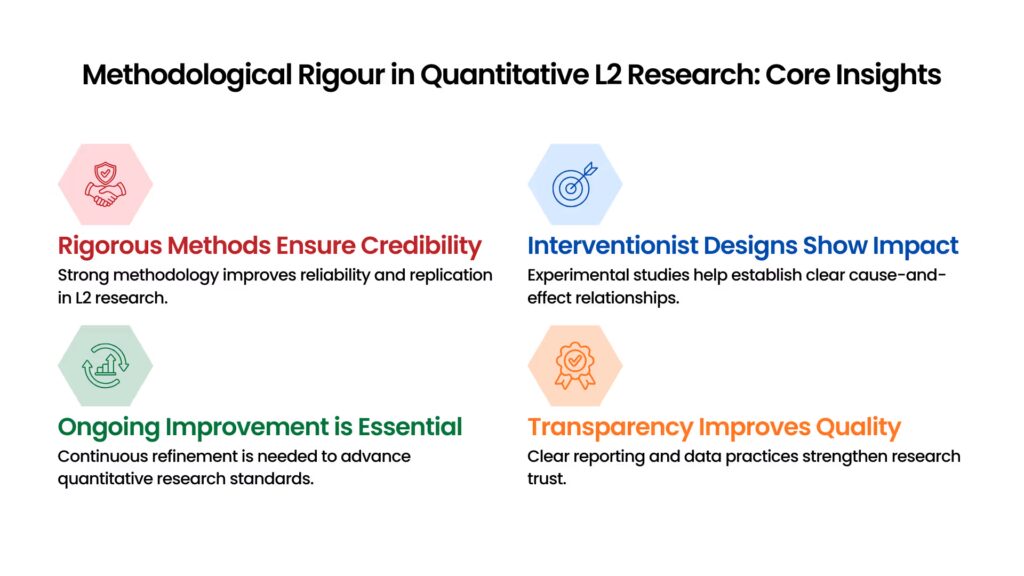
Researchers establish their work’s credibility through methodological rigor which provides the basis for their assessment of research replication and theoretical contributions in quantitative research for applied linguistics studies. The field of second language research has developed a stronger need for interventionist experimental designs because researchers need those methods to demonstrate direct cause-and-effect relationships. The article by Jahanbakhsh et al. (2025) provides a large-scale methodological synthesis of interventionist quantitative L2 studies published over a twelve-year period, which enables researchers to systematically evaluate research quality across major academic journals. The critical review assesses everything about the article, which includes its conceptual relevance, research design, and methodological framework, evidence use and overall contribution to L2 research methodological standards.
Summary of the Article
The investigation analyses 791 experimental studies with interventionist designs that researchers published from 2011 to 2022 in eight main L2 academic journals. The researchers utilised a complete coding system, which they created through their earlier research work, to evaluate five research quality measurement variables in their study.
The research results demonstrate that different academic fields show different rates of progress. The research identified better results for pretesting methods and comparison group practices and effect size reporting, but the study discovered persistent issues with the power analysis process and assumption testing process, data sharing process and advanced data visualisation techniques. The authors explain that researchers developed a better understanding after 2010, but scientists still need to learn complete quantitative research best practices.
Critique
Significance and Contribution to the Field
The article makes a meaningful contribution to the literature on responsible AI education by shifting attention from abstract ethical guidelines to practical, research-oriented training. The research demonstrates how doctoral research workflows can implement responsible AI principles through their primary strength. The authors create an effective teaching framework for AI and information retrieval education by using ethical reflection to assess research practices, which include case study design, mixed-methods evaluation and stakeholder analysis.
The article shows its effect on teaching methods; however, the content only documents information. The work functions as an event report instead of an empirical research study, which restricts its capacity to produce generalizable theoretical knowledge about learning outcomes and teaching effectiveness across different situations.
Methodology and Research Design
The course design shows a clear organisational structure which effectively connects its learning objectives with instructional activities and group work. The research results gain credibility through the application of mixed methods, which combine qualitative reflection with collaborative discussion and post-course surveys. The requirement for researchers to submit positionality statements together with their ethical risk assessments establishes a new standard that supports early-career researchers in developing their reflexive skills.
The course needs a better methodological evaluation to improve its existing strengths. The survey sample size is small, and participation rates vary across activities, which constrains the generalisability of the findings. The training program lacks both pre-course benchmarking and longitudinal follow-up assessments, which hinders the evaluation of training outcomes and long-term effects on behaviour change.
Argumentation and Use of Evidence
The article makes a substantial contribution to applied linguistics by offering one of the most comprehensive methodological syntheses of interventionist quantitative L2 research to date. The research study uses its extensive database together with its long-term research approach and its organized coding system to effectively track research practice patterns which continue to exist within the field. The study provides field-wide insights that benefit researchers and journal editors and reviewers and doctoral students through its analysis of academic articles beyond their specific journal boundaries.
The article serves as a diagnostic assessment because it does not provide a theoretical framework which would advance knowledge. The study identifies needed improvements but it fails to deliver a unified framework which would connect research methodologies with theoretical progress and research outcomes. The research study delivers its greatest value through its ability to describe and assess research work rather than through its power to explain.
Ethical Considerations and Omissions
The article discusses transparency together with data sharing and reporting ethics, but it treats ethical issues in research as procedural elements instead of fundamental research values. The study contains insufficient information about how methodological flaws will impact participant safety, research fairness and knowledge transfer. The study would have achieved stronger normative results through a better research ethics framework.
Writing Style and Structure
The article is written in a clear, systematic, and academically rigorous style. The structure follows a logical progression from literature review to methodology, results, and discussion. The visual aids enhance readability because they help users understand complex longitudinal trends better.
The statistical details become too dense at points, which makes it difficult for readers who lack experience with methodological synthesis studies to understand the content. The document required more signposting, together with summary tables which displayed essential information to improve reading accessibility without losing research integrity.
Conclusion
Jahanbakhsh et al. (2025) present their study, which assesses the research methods used in quantitative L2 research studies. The research results demonstrate two different outcomes because the researchers achieved significant advancements in their methods, yet their study methods still contained errors, which made it impossible to prove their results across different situations. The article serves as an essential reference point for improving research design, reporting standards, and transparency in applied linguistics.
The study maintains a descriptive focus, yet it provides solid evidence that supports upcoming research methods changes while proving that researchers must keep evaluating power analysis, along with assumption verification, data distribution and graphical documentation. The article establishes itself as a major development in research methods studies because it delivers essential methods to enhance the quality of quantitative L2 research.
Reference:
Jahanbakhsh, A. A., Banitalebi, Z., Larson-Hall, J., & Shiiba, A. (2025). Methodological rigor in quantitative L2 research: A focus on interventionist experimental studies. Research Methods in Applied Linguistics, 4, 100273. https://www.sciencedirect.com/science/article/abs/pii/S2772766125000941
Methodology and Research Design