
Critical Review of Where and how machine learning plays a role in climate finance research
Introduction
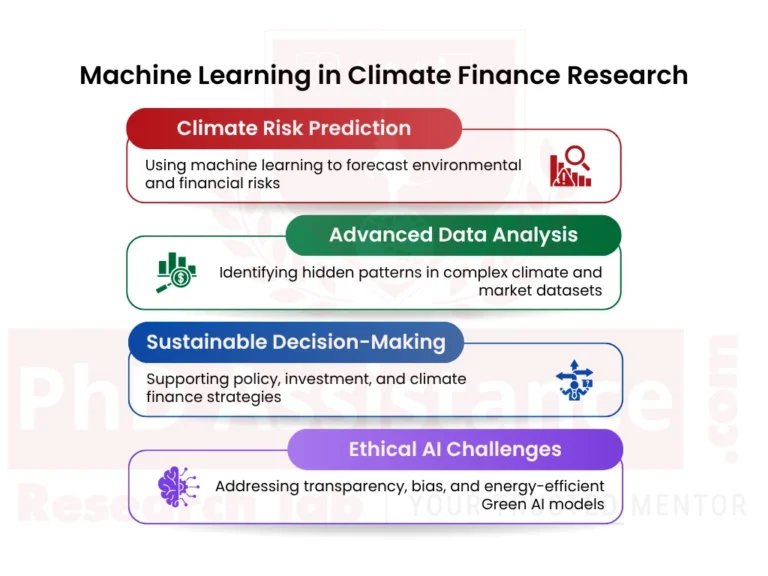
The rapid development of artificial intelligence technology has produced significant impacts on environmental research and financial studies. Machine learning functions as a valuable resource for climate research because it helps scientists investigate intricate climate research problems. Researchers encounter problems with traditional statistical methods because those methods lack the capacity to analyse large non-linear datasets, yet machine learning techniques succeed in discovering hidden patterns from those datasets.
The research examines the application of Machine learning in climate research to assess environmental dangers that affect economic systems. Researchers use climate machine learning to improve their understanding of climate systems and the economic effects that result from climate change. The development of analytical instruments becomes necessary because climate change effects continually modify the economic systems of the world.
The use of artificial intelligence in climate research improves prediction accuracy and aids scientists in making better choices. The review process examines the article’s research methods and results and its overall contributions while showing both its advantages and its disadvantages.
Summary of the article
The article provides a systematic review of machine learning in climate change prediction. The study employs Natural Language Processing methods which include Latent Dirichlet Allocation (LDA) to examine a vast collection of academic research papers.
The authors use this method to discover seven important research fields which include natural hazards, biodiversity, agricultural risk, carbon markets, energy economics, ESG factors and climate data. These areas demonstrate how climate modeling using machine learning is applied to understand environmental and financial risks.
The research shows that machine learning methods have increased in popularity because they enable better solutions for complex data sets and improved prediction accuracy. The study shows that machine learning methods are essential for climate change prediction because they help forecast environmental changes and guide policy development. The research shows that different academic disciplines use advanced modeling techniques which involve neural networks and random forests as their leading modeling method.
The article presents three main challenges which include data quality problems and model interpretability issues and the high computational requirements needed to make machine learning systems work effectively.
Critique
Significance and contribution of the field
The article makes an important contribution by offering a structured overview of machine learning applications in climate finance. The study provides new insights into climate data analysis using machine learning by showing existing research trends and actual research deficiencies.
The study’s main advantage comes from its ability to create interdisciplinary knowledge through the combination of financial science and environmental science and data science. Researchers need to study climate-related research because its outcomes affect multiple fields of study.
The study includes a restricted scope because it concentrates on climate finance research. The findings provide useful information yet researchers must conduct further studies to discover how climate science applications extend to other fields.
Methodology and research design
The study follows the SPAR-4-SLR protocol, which ensures a systematic and transparent literature review process through clearly defined stages of data collection, organisation, and analysis. The research gains better research trustworthiness through its structured system.
The authors use Latent Dirichlet Allocation for topic modelling which enables them to discover hidden patterns and thematic structures in their extensive dataset. The combination of quantitative analysis and qualitative interpretation further strengthens the study by providing both statistical insights and meaningful contextual understanding. The mixed-method approach provides researchers with two methods to study research trends and thematic relationships between different topics.
The use of specific databases together with fixed keyword selection will lead to selection bias because it restricts which studies can be included in the research. The topic modelling results require expert judgement for their interpretation, which creates potential threats to both objectivity and finding consistency.
Argumentation and Use of Evidence
The article presents a clear, logical, and well-structured argument that demonstrates how machine learning technology helps advance AI in climate research. The research uses multiple existing studies to show how data-driven methods have become essential for solving complicated environmental and financial problems.
The use of empirical evidence and statistical techniques strengthens the credibility and validity of the findings. The study conducts a comprehensive analysis of research trends and methodological developments through its examination of extensive literature. The theoretical findings of the research lack practical value because the study fails to present sufficient detailed real-world case studies, which would demonstrate its theoretical concepts through actual industry evidence. The argument would become more convincing through the inclusion of such examples.
Ethical considerations and omissions
The article addresses ethical concerns related to the environmental impact of machine learning, particularly its high energy consumption. The article introduces “Green AI” as a solution to create environmentally friendly computational methods which operate with reduced energy requirements.
The discussion remains confined to its present boundaries. The essential elements of data bias and algorithmic transparency with accountability requirements for responsible AI use in climate research remain unexplored at this time.
Writing Style and Structure
The article presents its content in an organized structure which consists of distinct sections that help readers navigate the research methodology. The document establishes its academic foundation through its comprehensive explanation of essential concepts and research methods.
The content becomes difficult to understand because it contains advanced technical details which require machine learning knowledge for comprehension. The process of creating more understandable text through simplified complex explanations will make reading easier while preserving academic integrity.
Conclusion
The research demonstrates how machine learning technology has become essential for climate finance operations, while the technology has the capacity to enhance research and decision-making activities. The research demonstrates that machine learning methods can successfully examine intricate data sets to create climate change forecasts.
The article presents its constraints, which include problems with data accuracy and limitations of research methods, as well as ethical issues. The research field needs these challenges solved because they prevent scientists from using Machine learning for climate science work.
The research needs to study methods that will create accurate data and make research models understandable for their use across different scientific disciplines. The article provides crucial details about machine learning applications while establishing a research base for upcoming studies in this domain.
Reference
Alonso-Robisco, A., Bas, J., Carbo, J. M., de Juan, A., & Marques, J. M. (2025). Where and how machine learning plays a role in climate finance research. Journal of Sustainable Finance & Investment, 15(2), 456–497. https://doi.org/10.1080/20430795.2024