
Critical Review of Lactylation in cancer biology Unlocking new avenues for research and therapy
Introduction
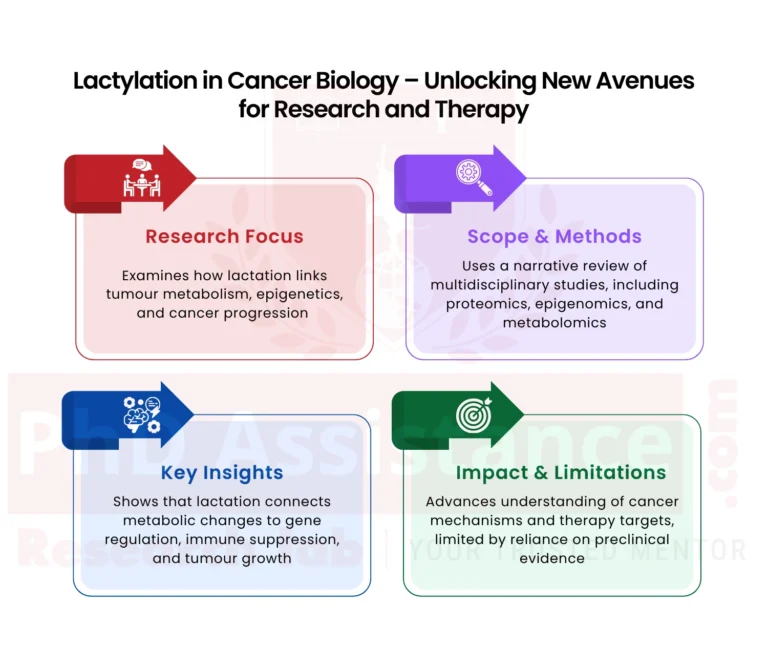
This review connects three different scientific fields that study how lactylation affects cancer biology tumour metabolism, and epigenetic mechanisms. Hou and his team investigate an emerging scientific area that shows that lactate functions as a metabolic product of the Warburg effect while it serves as a substance that controls cancer epigenetic changes. The article shows how lactate-based protein lactylation connects metabolic changes to transcription regulation, immune response, and cancer development.
The main argument shows how lactate processing in tumours alters the tumour microenvironment through the process of lactylating both histone and non-histone proteins. The authors demonstrate how lactylation in cancer biology serves as a common mechanism that connects metabolism changes to both oncogenic gene expression patterns and immune system evasion.
Summary of the article
The review presents a complete study of lactylation, which serves as a new post-translational modification and its developing functions in cancer research. The study starts with an explanation of lactylation as it exists in the context of metabolic changes that occur during cancer development through altered glycolytic pathways and the production of lactate during periods of hypoxia and nutrient deficiency.
The study investigates how tumors use lactate through the processes of lactate production and its movement via monocarboxylate transporters and its function as a signaling molecule through G-protein-coupled receptors.
The research examines histone lactylation in cancer through the description of specific histone modifications at H3K18la and H4K12la which control the expression of oncogenes and metabolic enzymes and immune system genes.
Non-histone lactylation extends its effects beyond histone proteins to include metabolic enzymes and transcription factors and RNA-binding proteins and cell-cycle regulators.
The molecular “writers” and “erasers” and “readers” of lactylation work together with traditional epigenetic regulators to form their interactive system.
The study investigates how lactylation causes immune system suppression in the tumor microenvironment through its effects on T cells and macrophages and cancer-associated fibroblasts and myeloid-derived suppressor cells.
The study explores three therapeutic approaches which involve targeting lactate metabolism and lactylation enzymes and combining both of these elements with immunotherapy treatments.
Critique
Significance and contribution of the field
This review makes a substantial contribution to cancer biology by consolidating lactylation in cancer as a core regulatory mechanism rather than a peripheral metabolic curiosity. The integration of histone lactylation in cancer with tumor metabolism and epigenetic regulation represents a conceptual advance that broadens existing models of oncogenic signaling.
The article establishes lactylation as a link between metabolic reprogramming and immune system suppression which shows its importance for understanding treatment resistance and immunotherapy response.
The study’s multiple cancer type coverage enables wider applicability which benefits the entire oncology research community. The research focuses mainly on associative findings. The study shows mechanistic details for certain pathways but most of its results depend on correlational evidence from preclinical studies which demonstrates the need to interpret clinical results with caution.
Methodology and research design
The methodology of the narrative review requires researchers to combine major literature sources because they need to establish their research through particular systematic methods. The article exhibits its strongest point through its extensive coverage which uses proteomics and epigenomics and metabolomics and functional studies as sources.
The authors create unified mechanistic models through their analysis of experimental results which specifically address epigenetic modifications in cancer controlled by lactylation. The inclusion of detailed tables and figures enables better understanding of the material while showing how thoroughly the authors studied primary research sources.
The absence of clear inclusion requirements together with the missing quality assessment of research studies results in potential selection bias problems. The implementation of a more structured review methodology together with a systematic evidence strength classification system will help improve both reproducibility and critical balance.
Argumentation and Use of Evidence
The metabolic reprogramming in cancer creates a direct link to epigenetic remodeling through lactylation according to the argument which maintains logical coherence and has strong backing.
The review shows how lactate buildup leads to transcriptional activation and immune evasion and tumor advancement through various pieces of evidence. The research findings from proteomic studies and targeted mutagenesis and functional testing support the evidence which shows how histone lactylation happens in cancer.
The research findings depend on in vitro experiments and animal testing because the results remain unconfirmed through clinical studies. The study includes patient longitudinal research and human tumor functional testing but these elements exist in insufficient quantity which affects their immediate application to clinical practice.
Ethical considerations and omissions
The article focuses on molecular mechanisms and therapeutic potential while their ethical aspects receive only brief treatment. The research needs to explore off-target effects and long-term epigenetic consequences and metabolic therapy accessibility as ethical issues to improve its translational discussion.
The research makes extensive use of immune modulation but fails to assess the complete risks that systemic immune system changes will bring.
Writing Style and Structure
The review follows a structured organization which advances through its content from metabolism to epigenetics and then to immune regulation before ending with clinical applications. The writing demonstrates high scholarly rigor but is densely packed with technical detail which may challenge readers who lack knowledge of advanced cancer metabolism and epigenetics.
The authors use figures and tables as their primary strength because these elements help users understand complex signaling networks. The manuscript requires sections to present information more clearly through condensed synthesis because this approach will help readers understand the content better while maintaining its essential information.
Conclusion
The study by Hou et al. establishes a fundamental overview of lactylation research in cancer biology which shows how cancer cells use this process to control their energy production and genetic activity and their ability to fight off immune responses. The review demonstrates that lactate metabolism in tumors functions as an energy source which provides energy but also uses epigenetic changes to create new transcriptional activity and modify the tumor microenvironment.
The article highlights how targeting lactylation-related pathways presents a therapeutic opportunity which becomes more effective when combined with immunotherapy. The scientific field faces two major obstacles because researchers have not yet proven these lactylation pathways in clinical settings and they still need to study how lactylation functions in different types of tumors.
Researchers should focus on human research and long-term study and better methods to target therapies in order to achieve clinical advantages from their research results. The review delivers essential knowledge for cancer biology research which creates new possibilities for scientific investigation and treatment development.
Reference
Hou, X., Hong, Z., Zeng, H., Zhang, C., Zhang, P., Ma, D., & Han, Z. (2025). Lactylation in cancer biology: Unlocking new avenues for research and therapy. Cancer Communications, 45, 1367–1406. https://doi.org/10.1002/cac2.70054