Critical review of Faculty Qualifications in Professional Disciplines Beyond the PhD
Introduction
The current state of higher education institutions experiences major changes because academic institutions try to achieve two goals for their students, which require both scholarly understanding and practical work experience. The current professional field requires academic institutions to evaluate which Faculty qualifications in professional disciplines should meet their needs. Universities have used doctoral degrees as their main requirement for hiring faculty members since their establishment. The education system needs to change because current work requirements mandate more practical training for students than educational institutions currently provide.
The article explores the tension between academic tradition and professional relevance by examining the role of subject expert integration in academia. The article shows how professional experience and PhD requirements create ongoing disputes because PhD requirements create obstacles for students who need practical knowledge to succeed in their future work activities. The authors believe that the academic credential system should change to include professional expertise as a valid qualification, which should exist together with traditional academic degrees. The critical review assesses the article through its conceptual arguments and methodological approach, which explores how industry experts participate in higher education.
Summary of the Article
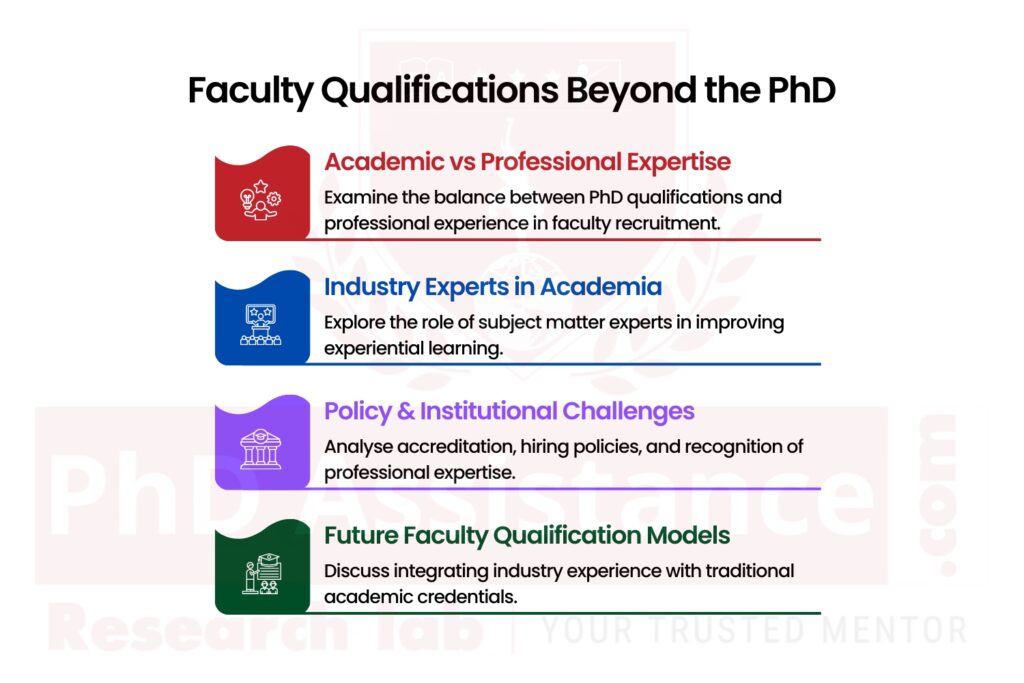
It critiques the traditional reliance on doctoral qualifications as the primary faculty recruitment criterion. The research shows that PhD holders make substantial research contributions, but multiple professional fields need practical experience, which academic training cannot provide. The authors propose that professional disciplines should broaden their faculty qualification requirements to include practitioners who possess real-world expertise because this will improve both curriculum development and student educational outcomes.
The discussion shows that higher education industry experts provide real-world knowledge, which improves experiential learning and creates stronger links between academic content and workplace skills. The article uses experiential learning and professional identity development theories to show that integrating subject matter experts into academic settings enhances teaching quality and prepares students better for their future careers.
The research design examines both institutional problems and accreditation difficulties, which they claim create barriers because expert knowledge is not properly recognised by existing systems. The researchers propose academic credential reforms that should include professional accomplishments and certification programs, and industry work experience as valid measures of academic knowledge. The researchers argue that existing PhD requirements need to be balanced against professional experience to create better hiring practices, which should include all candidates.
Critique
Significance and Contribution to the Field
An important academic standard proves that professional fields need more flexible faculty hiring processes. The article demonstrates growing demand for practice-based educational programs through its dedicated research of subject matter expert implementation in academic settings. The evaluation of industry professionals who work in higher education institutions shows how these organisations can improve their student employment outcomes and academic program development.
It contains an advocacy-based viewpoint as its primary framework. The text demonstrates how professional experts bring advantages to academic positions, yet fails to examine the obstacles that universities must confront when they want to combine research activities with their teaching and operational responsibilities. The research study will gain greater academic value when its arguments receive equal treatment in the academic field.
Methodology and Research Design
The article follows a conceptual and integrative review approach, drawing on existing literature from higher education policy, professional education, and pedagogical theory. The authors use this method to investigate the ongoing argument about professional experience compared to PhD credentialing while presenting their academic credentialing reform proposal.
The theoretical discussion reaches a high level of development, yet its findings suffer from a lack of original research data. The arguments depend on two main sources, which include conceptual analysis and illustrative examples, instead of using systematic evidence. Future research that combines empirical studies with comparative analysis will provide stronger evidence to support the expansion of faculty qualifications in professional disciplines.
Argumentation and Use of Evidence
It presents a clear and logically structured argument supporting subject matter expert integration in academia. The study establishes a link between theoretical frameworks and real-world problems in higher education while demonstrating that expert knowledge improves educational results. The emphasis on aligning academic programs with industry needs reinforces the relevance of experts in higher education.
The evidence presented in the study only provides descriptive information about the subject matter. The article would benefit from broader empirical studies examining how professional experience vs PhD qualification influences teaching quality, research productivity and institutional performance across different disciplines. The inclusion of comparative data would enhance the credibility of its assertions.
Ethical Considerations and Omissions
It establishes that professional experience recognition should be evaluated as a faculty qualification requirement in professional fields because it may improve academic diversity and access. Organisations should implement this recognition system because it will help them hire more diverse candidates, who will lead to increased enrolment in university programs. The analysis of ethical and structural issues still requires further development because existing research only provides limited information on these matters.
Insufficient examination was conducted on how academic institutions maintain their independence from corporate power while they evaluate which academic credentials should be changed. A deeper exploration of these issues would provide a more comprehensive analysis of integrating industry experts in higher education.
Writing Style and Structure
The presentation of content through an academic writing style that follows a structured organisational pattern. The material establishes an understanding of concepts that researchers and higher education professionals can use in their work. The discussion maintains its primary focus on how academics use subject matter expertise and how professionals value their work experience compared to doctoral degree holders.
The writing remains interesting to readers, but some parts of the text show more support for their arguments than they do for their critical assessment of different viewpoints. The analysis would improve if researchers examined opposing viewpoints and different interpretations of their topic.
Conclusion
The article presents a crucial viewpoint that requires colleges to revise their faculty qualification standards because professional fields and educational standards continue to change. The study shows institutions need to acknowledge various expertise types because their workforces now need to incorporate subject matter experts into their academic programs.
It shows how professional experience requirements and PhD educational standards, together with academic credential changes, affect future academic hiring practices and curriculum development needs. The article delivers valuable theoretical insights, but its theoretical framework prevents researchers from testing its concepts through empirical research. Research should investigate how hiring industry specialists into higher education programs affects student performance, institutional development and academic achievement standards.
Initiation of important dialogue about maintaining academic traditions in this study, while creating professional-academic connections, which provide essential knowledge for policymakers, educators and researchers who aim to update higher education systems.
Reference:
Mazza, A., & Pearsall, A. (2026). Beyond the PhD: Reconceptualising faculty qualifications in professional disciplines through subject matter expert integration. World Journal of Arts, Education and Literature, 3(1), 20–31. https://wasrpublication.com/index.php/wjael/article/view/224/207
Methodology and Research Design