
Critical Review of “American Made: The Role of Economic History in the Training of PhD Candidates”
Introduction
The field of economic history has served as a fundamental element needed for PhD studies in economics throughout history. Graduate education used to teach economic history together with economic theory and econometrics as essential subjects. The program enabled doctoral students to assess economic systems through historical analysis, which included their study of economic development throughout time via scientific investigation. The presence of economic history within doctoral curricula has gradually declined in many economics programs.
Haupert (2026) analyses how economic history in PhD training has evolved its status as a component of United States PhD educational programs. The author explains how the field of economics developed its research methods through the creation of cliometric methods, which enable researchers to analyse historical data using statistical methods. Researchers use these methods to examine economic theories while building historical databases and studying patterns of economic growth and institutional evolution over extended periods.
Doctoral programs have decreased their emphasis on economic history as an essential subject despite its academic value. The decline of this field threatens both the future of doctoral research in economic history and the overall intellectual growth of economists. The chapter investigates how economic history exists in current PhD programs while studying the consequences that result from its decline for graduate academic programs.
Summary of the article
It examines how economic history functions in economics PhD programs throughout the United States. Haupert demonstrates that economic history has served as a crucial element for developing economic research through its provision of research methods that enable researchers to conduct practical studies. Researchers in the discipline use historical data to develop economic theories that enable them to study extended periods of economic evolution.
PhD scholars in economic history research benefit from economic history because it provides essential research materials and research methods. PhD students use cliometric methods to study historical economic events, which include changes in institutions and industrial growth, and the evolution of economic inequality. Theoretical research receives enhanced support through these methods because they establish empirical study foundations based on historical background.
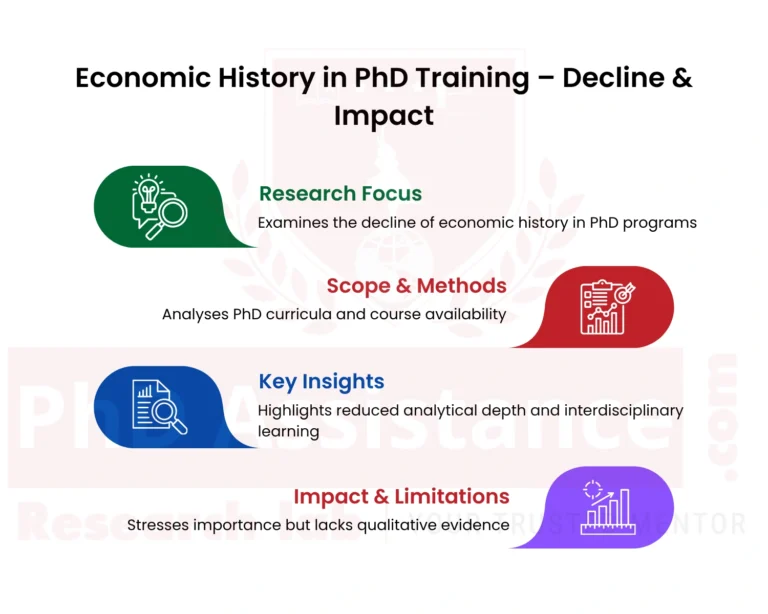
The current condition of economic history research for PhD scholars through their study of fifty economics PhD programs located throughout the United States was investigated in the study. The analysis assesses the availability of economic history courses throughout these programs while also determining whether students can select this field as their doctoral specialisation. The research shows that only a few programs today maintain economic history courses, while even fewer programs require or permit students to study that subject.
Critique
Significance and contribution of the field
The chapter provides an important contribution to discussions about the structure of doctoral education in economics. The author shows how curriculum changes affect future economists’ analytical development by studying the decline of economic history.
The PhD scholars should conduct their research through economic history research, which studies institutional development, economic growth, and inequality. Historical analysis enables scholars to evaluate economic processes across long time periods, which can strengthen both their empirical research and their theoretical understanding.
The research study examines how doctoral programs offer economic history courses. The study does not assess how these courses affect academic research production and research specialists’ professional development. The research study should investigate whether economic history training results in different research methods and publication patterns among doctoral students who complete their doctoral degrees.
Methodology and research design
Fifty economics PhD programs through descriptive analysis to determine how economic history is included in their doctoral programs was examined in this study. The method demonstrates how common economic history courses are taught at the graduate level.
The methodology demonstrates a successful execution of its testing process to show how economic history research institutions currently operate. The research design presents a framework for evaluation, which has specific limitations. The analysis focuses only on curriculum structures and does not investigate how economic history training influences PhD research methodology in economics or doctoral research practices.
The research fails to collect any qualitative data, which comes from student and faculty sources. The research study would have benefited from using interviews and surveys because these methods would show the reasons behind the decline in economic history’s value in doctoral programs and the way scholars view its value.
Argumentation and Use of Evidence
A clear argument that the decline of economic history within doctoral programs will decrease the intellectual diversity found in economics training. The chapter demonstrates how economic history supports empirical research by unifying historical data with economic theoretical frameworks.
The study of fifty doctoral programs provides strong evidence that confirms the author’s arguments. The results show that graduate programs have started to decrease their economic history course offerings, which supports the argument that academic institutions have begun to withdraw their backing for this field.
The chapter mainly depends on descriptive evidence. The analysis would gain strength from including extra data, which shows how the decline of economic history research impacts doctoral education in economic history and research conducted by economics departments.
Ethical considerations and omissions
The chapter indirectly raises questions about doctoral education because it examines the concept of intellectual diversity. The universities that decrease economic history’s significance in their graduate programs will create a situation where doctoral students face limited access to different viewpoints.
Economic history provides an interdisciplinary perspective that connects economics with history, politics, and social institutions. The field needs to remain part of doctoral curricula because it helps develop better analytical skills for future economists and enables researchers to use multiple research methods.
The chapter fails to examine all institutional elements that lead to economic history’s current decline. The curriculum choices of educational institutions may be affected by faculty specialisation and funding priorities, together with their increased focus on econometric methods. The discussion would benefit from additional analysis of these elements.
Writing Style and Structure
The chapter presents an organised structure with clear writing, which enables readers to understand the author’s argument. The discussion progresses logically from historical context to empirical analysis and policy implications.
The doctoral education system uses empirical data together with theoretical concepts to demonstrate its current economic history research status. The analysis needs to include a comprehensive investigation of how economic history affects the development of economic history literature review and doctoral research methodology.
Conclusion
The chapter provides an essential study of how economic history has lost its importance as a subject for PhD studies in economics doctoral programs. The findings show that multiple universities have decreased their offering of economic history courses, which results in decreased academic variety for their graduate programs.
Economic history serves as an essential component for PhD research methodology because it combines historical data with quantitative research methods. The platform provides scholars with a complete literature review system, which enables them to study the development of economic systems and policies throughout history.
The study shows that doctoral programs should evaluate how economic history should be taught in their academic programs. The practice of maintaining economic history as a separate discipline in graduate programs will help improve research quality in doctoral studies while providing essential analytical methods to future economists.
Reference
Haupert, M. (2026). American Made: The Role of Economic History in the Training of PhD Candidates. In The State of Economic History (pp. 1–21). Springer. https://link.springer.com/chapter