Critical Review: Community College to PhD Pathways and Doctoral Preparation
Introduction
The academic field needs proper research training together with sufficient academic support and institutional resources, which help students from all backgrounds to pursue their doctoral studies. Although higher education institutions have increased their efforts to achieve better diversity results, the academic field still shows inadequate representation of professionals who were trained at community colleges. Academic programs that create clear pathways from the Community College PhD Scholars Program Impact have become necessary to develop research capabilities while creating inclusive academic environments.
Evaluation of the Community College to PhD (CC2PhD) Scholars Program, which aims to prepare community college students for upper-division research and doctoral study. The article investigates how structured research training, mentoring and doctoral preparation planning influence PhD Alumni Research Development and readiness for PhD pathways. The critical review assesses the article through its conceptual framework and methodology, and its findings and doctoral education research contribution.
Summary of the Article
A mid-term evaluation of the CC2 PhD Scholars Program Outcomes was conducted two years after participants completed the initiative. The programme aimed to equip community college students with research experience and doctoral preparation before transferring to four-year universities.
A combination of qualitative research and descriptive quantitative research methods was used in this study. The researchers conducted surveys and semi-structured interviews with seven programme alumni who completed their studies, which resulted in the researchers using thematic analysis to interpret their research preparation and doctoral readiness experiences.
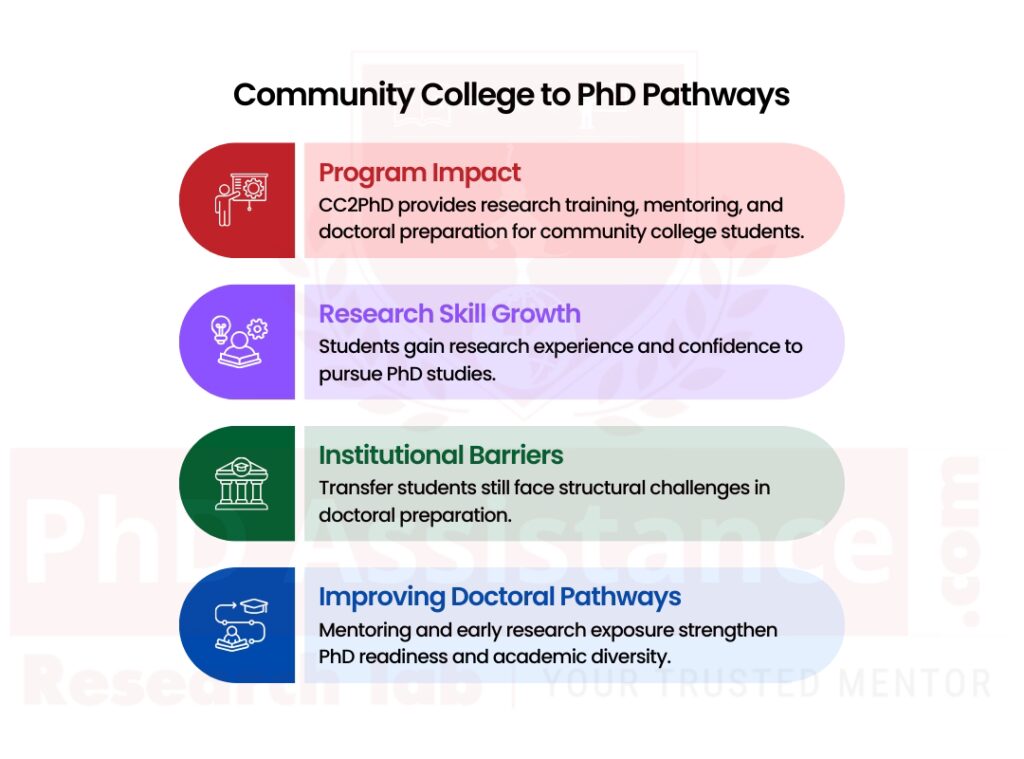
The programme impact evaluation identified six primary themes. Participants reported better knowledge of academic career pathways, which helped them decide their doctoral study choices. The participants showed increased confidence to pursue research opportunities, together with developed research skills. Alumni showed higher rates of PhD preparation activities, while they started their research planning earlier than before. The ongoing transfer status institutional barriers, together with structural barriers, still hinder academic progress.
The findings demonstrate that structured mentoring, together with research training and doctoral planning support, helped participants develop research skills while they managed their doctoral studies. The research results showed that participants built research experience and navigated their doctoral studies through research training. The research system barriers, however, continued to exist throughout the study.
Critique
Significance and Contribution to the Field
The evaluation of the program found six main themes, which served as its fundamental research areas. The participants acquired a better understanding of academic career pathways, which enabled them to make their doctoral study decisions. The participants developed research skills that made them more confident to follow research opportunities. Alumni increased their PhD Preparation Program Impact while they began their research planning activities earlier than they had in the past. Academic progress remained blocked because of ongoing institutional barriers, which existed together with structural barriers.
The findings demonstrate that structured mentoring, together with research training and doctoral planning support, helped participants develop research skills while they managed their doctoral studies. The research results showed that participants built research experience and navigated their doctoral studies through research training. The research system barriers, however, continued to exist throughout the study.
Methodology and Research Design
The assessment of mid-term programme outcomes through the analysis of descriptive survey data and qualitative interview results is presented as part of the Two-Year Follow-Up PhD Study. The alumni experiences were documented through semi-structured interviews, which provided detailed personal accounts that the survey responses used as background information.
Thematic analysis enabled researchers to identify common patterns that showed student research readiness and their progress through doctoral studies. The study achieves methodological strength because it documents all steps that researchers used to select participants, collect data, and conduct analysis.
The ability to generalise results from this study is restricted by particular limitations. The small sample size of seven participants restricts broader institutional applicability. The programme director, who serves as the lead researcher, creates a possibility that he will interpret the results with bias. Future investigations would benefit from larger sample sizes, comparative institutional data and longitudinal tracking of doctoral admission outcomes.
Argumentation and Use of Evidence
The arguments follow logical reasoning because they use participant stories and research results as their basis. The direct quotations show how participants identified program advantages through their development of research skills and proposal writing abilities, and their doctoral planning activities.
The evidence shows that participants acquired research skills and the Doctoral Pathway Program Evaluation because their academic planning and PhD admissions process awareness improved. The program would receive better empirical evidence through the comparison of data between participants and non-participants, along with the inclusion of research output and doctoral admission statistics.
Ethical Considerations and Omissions
It maintains ethical standards through three methods, which include obtaining informed consent, protecting participant confidentiality and providing clear information about research goals. The participants received complete information about their rights, which allowed them to choose whether to participate in the study.
The focus on higher education structural inequalities which receive only minimal examination through its core research. The research needs to examine systematic inequalities that affect access to research opportunities and doctoral training because transfer students face institutional obstacles.
Writing Style and Structure
The presentation maintains an academic structure that supports reader navigation through program context, research methods, study results and their analysis. The text achieves better readability through its organised structure, which presents information in a consistent manner.
The text displays complex methodological explanations, which create difficulties for readers who lack experience in program evaluation research. The analytical framework needs better theoretical integration to create more precise connections between theoretical perspectives and empirical data.
Conclusion
The study demonstrates how structured research preparation programmes help community college students achieve their doctoral degree goals. The combination of mentoring and research training, together with early doctoral planning, helps transfer students advance their research work while building their academic confidence.
Academic initiatives that specifically target Community College PhD Program Review need to be implemented because they help students transition from community college to PhD programs while increasing academic diversity. The research needs to use bigger sample sizes, together with time-based studies, which help researchers assess how doctoral students progress through their academic and professional lives. A practical reference resource that helps educators was provided to programme designers and policy makers to develop better doctoral programmes and research opportunities.
For PhD scholars searching for professional support in developing a research manuscript, the PhD Assistance Research Lab offers specialised academic guidance tailored to doctoral scholars and early-career researchers.
Book a free consultation to receive expert guidance to transform your ideas into a high-quality, submission-ready research paper with confidence.
Reference:
Nguyen, D. V., Gaddis, S. M., & Rios-Aguilar, C. (2025). Two-year follow-up of the Community College to PhD scholars program: Impact on alumni’s research and PhD preparation. Journal of Further and Higher Education.
Methodology and Research Design