
Critical review of The Role of Accessible Program Information in Attracting Diverse PhD Students to Social Work Programs
Introduction
The accessible program information needs to reach doctoral applicants who want to study social work PhD programs. The ability of doctoral programs to attract students depends on universities providing transparent and accessible academic program details, which students use to choose their programs. The social work field depends on doctoral programs to develop its future scholars, educators, and professional practitioners. Program information needs to achieve equitable access because it helps universities increase doctoral student enrolment while improving their graduate admissions processes for underrepresented groups.
The article investigates how public data from top social work Doctoral program recruitment in the United States impacts their ability to attract PhD candidates from various underrepresented groups. The authors use the PhD Student Navigation System as their framework to assess whether program websites offer adequate support and transparent information that helps applicants through the doctoral application process. The institutional websites that serve as the primary information source for applicants make PhD student recruitment depend on their accessibility and well-organised information.
It investigates diversity problems within doctoral education while demonstrating that restricted access to doctoral program details establishes fundamental barriers that stop underrepresented students from pursuing doctoral studies.
Summary of the article
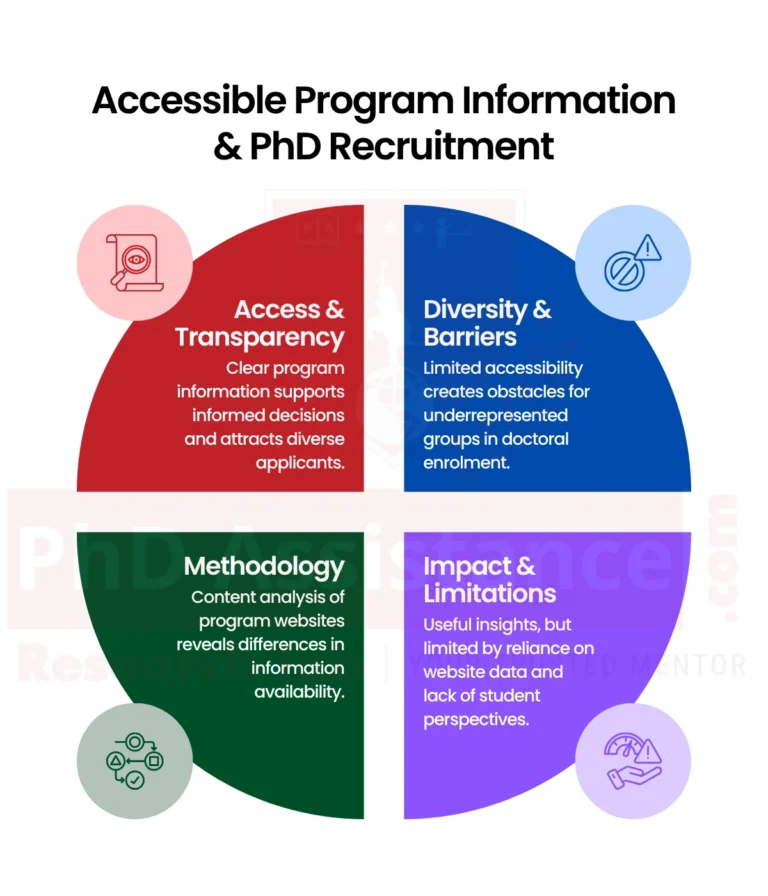
This evaluates how easily people can access public information that exists in major social work PhD programs throughout the United States. The authors performed a content analysis of institutional websites to assess how well critical information exists that doctoral candidates need and which doctoral programs use to attract students.
The different programs use different methods to share details about their doctoral admissions process and their program structure, their faculty research areas, their funding options and their application procedures. The institutions that present complete program details in an easy-to-use format stand in contrast to those institutions that either hide essential details or present inadequate information to help prospective students assess doctoral programs.
The results show that restricted availability of accessible doctoral program details creates obstacles for potential applicants from historically underrepresented groups who depend on public resources to make their academic choices. The process of PhD student recruitment requires program transparency to serve as a vital element that aids successful student acquisition efforts.
The need to study prospective PhD student requirements and experiences, which currently receive insufficient attention in higher education research. Institutions that study applicant behaviour toward doctoral program details can create recruitment methods that increase doctoral program diversity through their newly developed supportive approaches.
Critique
Significance and contribution of the field
The restricted availability of accessible doctoral program details creates obstacles for potential applicants from historically underrepresented groups who depend on public resources to make their academic choices. The process of PhD student recruitment requires program transparency to serve as a vital element that aids successful student acquisition efforts.
They stress the need to study prospective PhD student requirements and experiences, which currently receive insufficient attention in higher education research. Institutions that study applicant behavior toward doctoral program details can create recruitment methods that increase doctoral program diversity through their newly developed supportive approaches.
The institutional accessibility functions as a vital element of its research framework. The research study shows limited results because it fails to explain how institutional policies, mentorship programs and financial assistance systems connect with PhD student recruitment strategies. The study would benefit from research expansion that examines institutional practices that relate to diversity recruitment.
Methodology and research design
The content analysis methods was used to assess how accessible social work doctoral programs display their program information on their websites. The PhD Student Navigation System framework enables an effective study of prospective students’ behaviour when they access doctoral program information during their application process.
The design shows more than one restriction despite its methodological advantages. The analysis depends only on information from public websites, which does not show all recruitment activities that institutions conduct. The analysis depends solely on publicly available website information, which does not completely show all recruitment activities that institutions conduct. The analysis needs to include virtual information sessions and outreach programs, and academic mentorship initiatives that doctoral programs use for their PhD student recruitment process.
It examines program websites while neglecting to study how prospective students interact with them. The research would have benefited from using applicant interviews or surveys because these methods would have shown how accessibility to information affects doctoral program results.
Argumentation and Use of Evidence
The study required better research evidence, which would demonstrate how access to information affects both the growth of diversity in doctoral programs and the effectiveness of Inclusive graduate admissions practices that promote inclusion.
The descriptive findings showed that social work PhD programs have different levels of information access for their students. The results support the authors’ argument that limited program transparency may hinder the recruitment of diverse doctoral applicants.
The analysis of the study depends mostly on descriptive information, which cannot explain its content. The study examines how doctoral programs deliver their information, but fails to show how these differences affect applicant diversity and admission results.
Ethical considerations and omissions
The awareness of Diversity in doctoral education, particularly regarding the representation of diverse populations within social work academia. The authors emphasise that providing better information access will help universities create more inclusive doctoral programs.
Accessible program communication serves as a vital element that helps universities attract doctoral candidates while assisting applicants who come from various academic, cultural and socioeconomic backgrounds. The research fails to establish institutional accountability requirements that demand that universities develop recruitment methods that effectively promote student diversity and equity.
The practical implications would benefit from additional exploration of ethical duties that accompany open admissions standards, together with fair information delivery to potential students.
Writing Style and Structure
It exhibits proper organisation and clear writing, which enables readers to follow its arguments through a logical sequence. The research maintains structural consistency through its conceptual framework, which also delivers results to readers in an understandable format.
The discussion section needs to develop its critical analysis of research results because it currently lacks sufficient depth. The first parts of the text execute descriptive reporting, which leads to a shallow analysis of doctoral education diversity and doctoral program research.
Conclusion
The demonstration of how program information accessibility affects social work programs’ ability to recruit diverse PhD students was done in the study. The research shows how different types of publicly accessible program details which students will join doctoral programs through their visibility of different types of publicly accessible program details which students’ decision to join doctoral programs through their visibility.
The article shows that better accessible doctoral program information will make PhD student recruitment processes more transparent, while it will help strengthen graduate admissions procedures. The program information needs to be presented in a way that people from different backgrounds can understand it because this will help attract more doctoral candidates who come from diverse backgrounds.
Future research should investigate prospective PhD students’ experiences directly and explore how information accessibility interacts with mentorship opportunities, financial support, and institutional diversity initiatives. The study will create a complete understanding of university practices that enable doctoral programs to achieve diversity while they develop their admission procedures.
Reference
Neimanas, N., Cunningham-Williams, R. M., & Fields, L. (2026). The Role of Accessible Program Information in Attracting Diverse PhD Students to Social Work Programs. Journal of Social Work Education, 1–10. https://doi.org/10.1080/10437797.2025.2601