
Life Cycle Assessment of Green Ammonia as a Hydrogen Carrier for Maritime Fuel Applications
Info: Life Cycle Assessment of Green Ammonia as a Hydrogen Carrier for Maritime Fuel Applications Topics I phdassistance.com
Published: 26th August in Life Cycle Assessment of Green Ammonia as a Hydrogen Carrier for Maritime Fuel Applications Topics I phdassistance.com
Share this:
Related Services
Our academic writing and marking services can help you
Introduction
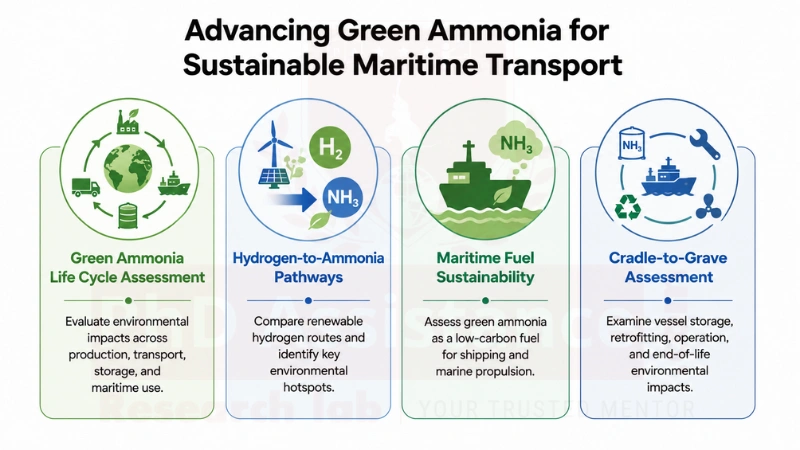
The growing demand for carbon-free fuels to run ships has led to a greater interest in ammonia as a substitute for fossil fuels in ships and a means to transport hydrogen as an energy source. Given that there are existing techniques for transporting and storing ammonia, the fuel is ideal for renewable energy transportation over large distances by sea. Nevertheless, the environmental sustainability of ammonia must be examined from all aspects, including hydrogen production, ammonia synthesis, transport, storage, and use in maritime activities. The Green Ammonia Life Cycle Assessment can help evaluate these environmental impacts.
Proposed PhD Topic 1: Comparative Life Cycle Assessment of Renewable Hydrogen Pathways Converted to Ammonia for Marine Transport
Background Context:
The rising demand for low-carbon maritime fuels has increased interest in green ammonia as hydrogen carrier for transporting renewable hydrogen over long distances. The existing technology for storing and transporting ammonia makes the substance a promising choice for international maritime energy logistics. In a life cycle assessment comparing different renewable hydrogen pathways through electrolysis powered by wind energy, gasification of forest residues, anaerobic digestion of food waste, and reforming landfill gases, Cho, Strezov, and Evans (2024) found that the pathways had different impacts on the environment and that process energy consumption was among the key contributors to global warming effects. This highlights the importance of assessing hydrogen production, ammonia synthesis, maritime transport, and ammonia cracking as an interconnected system.
PhD-Level Verification:
While the current literature review highlights different renewable hydrogen routes using ammonia as the carrier, there is still scope for further research on the integration of hydrogen production, ammonia production, ammonia transportation, ammonia cracking process, and the eventual supply of hydrogen. This represents a research gap in assessing the environmental impacts of hydrogen carriers for maritime applications. This research could be developed into a PhD thesis.
Research Questions:
Contributions at the PhD-Level:
Suggested Readings:
Cho, H. H., Strezov, V., & Evans, T. J. (2024). Life cycle assessment of renewable hydrogen transport by ammonia. International Journal of Hydrogen Energy, 94, 1018–1035.
Proposed PhD Topic 2: Time-Horizon-Based Life Cycle Assessment of Blue and Green Ammonia for Maritime Hydrogen Supply Chains
Background Context:
Green and blue ammonia are becoming popular options in relation to low-carbon energy systems and for use in marine transport. However, the environmental performance of these ammonia types is contingent upon several aspects, including the source of electricity, methane leakage, carbon capture efficiency, and the climate time frame for assessment. Mayer et al. (2023) compared blue and green ammonia using techno-economic and life cycle assessments. The results indicate that leakage of methane can greatly affect the short-term climate performance of blue ammonia, whereas green ammonia is dependent on the availability of renewable electricity. These results indicate that traditional climate metrics might be unable to account for environmental differentiation between different ammonia types. As a result, a time-horizon-specific life cycle assessment could provide a more informative evaluation of Green Ammonia Maritime Fuel.
PhD-Level Verification:
However, this consideration has not yet been incorporated into the maritime fuel and hydrogen carrier applications. This represents a research gap in developing a time-horizon-based life cycle assessment framework for ammonia. A PhD thesis might consider other climate metrics in addition to GWP20 and GWP100 in relation to methane leakage, renewable power generation, ammonia transportation, and maritime fuel use.
Research Questions:
PhD-Level Contributions:
Suggested Readings:
Mayer, P., Ramirez, A., Pezzella, G., Winter, B., Sarathy, S. M., Gascon, J., & Bardow, A. (2023). Blue and green ammonia production: A techno-economic and life cycle assessment perspective. iScience, 26, 107389.
Proposed Dissertation topic 3: Well-to-Wake Life Cycle Assessment of Green Ammonia and Hydrogen for Marine Propulsion
Background Context:
Hydrogen and ammonia have attracted attention as potential alternatives to traditional fossil-derived marine fuels due to their ability to decrease greenhouse gases and other emissions. However, an analysis of their sustainability must be based on evaluation of the entire life cycle rather than just emissions produced through fuel utilisation at the operational stage of vessels. Thus, Dong et al. (2024) performed a comparative study of the life cycle assessment of the propulsion systems of ammonia- and hydrogen-powered ships, considering different ways of their production and the marine engines used. The results indicated that both hydrogen and ammonia could reduce global warming potential and other environmental impacts when compared with traditional marine fuels. Still, while hydrogen was problematic in terms of its storability and energy density, ammonia had benefits in this regard. This fact makes ammonia a particularly interesting fuel type for use in ships as well as a carrier for hydrogen.
PhD Level Verification:
Although LCA studies have compared hydrogen and ammonia propulsion in shipping, a gap remains in evaluating the combined role of ammonia as both a maritime fuel and a hydrogen carrier in a single well-to-wake study. This represents a research gap in assessing the overall environmental impact of ammonia as a maritime fuel.
Research Questions:
PhD-Level Contributions:
Suggested Readings:
Dong, D. T., Schönborn, A., Christodoulou, A., Ölcer, A. I., & González-Celis, J. (2024). Life cycle assessment of ammonia/hydrogen-driven marine propulsion. Proceedings of the Institution of Mechanical Engineers, Part M, 238(3), 531–542.
Proposed Dissertation Topic 4: Multi-Criteria Life Cycle Optimisation of Green Ammonia–Hydrogen Fuel Blends for Sustainable Port Operations
Background Context:
Ports are important sites for the decarbonisation of maritime transport since tugboats and other harbour vessels often run in coastal areas where emissions of fuel can pollute the local environment. Alternative fuel options like hydrogen and ammonia have been considered to decrease the carbon emissions of marine vessels and support the development of green shipping. Bayer et al. (2025) analysed hydrogen and ammonia fuel pathways for tugboat engines using techno-economic analysis, life cycle assessment, and multi-criteria decision-making approaches. The findings of the study showed that green fuel pathways could deliver significant environmental advantages; however, these advantages required higher expenses. Also, different fuel configurations can lead to some compromises in terms of the relationship between environmental aspects, cost, and the operation of the engine. This information is important for analysing the optimised configurations of hydrogen and ammonia rather than considering each fuel separately.
PhD-Level Verification:
The current research has addressed both techno-economic analysis and life cycle assessment of hydrogen-ammonia fuel blends, yet further research is needed to determine the optimal fuel ratio. This is a research gap in Ammonia Maritime Fuel optimisation.
Research Questions:
Contributions at the PhD-Level:
Suggested Readings:
Bayer, M. U., Bilgili, L., Alkan, S., Atak, Ü., & Çelik, V. (2025). Techno-economic and life-cycle assessment of hydrogen–ammonia fuel blends in tugboat engines for sustainable port operations. Sustainability, 17, 10285.
Proposed Dissertation Topic 5: Cradle-to-Grave Life Cycle Assessment of Green Ammonia-Fuelled Ships Including Storage, Retrofitting and End-of-Life Impacts
Background Context:
Ammonia has emerged as a potential future marine fuel because it contains no carbon and therefore does not produce direct CO₂ emissions during combustion. At the same time, the environmental sustainability of ammonia-fueled ships goes far beyond their use and includes issues of fuel production, transportation, storage, bunkering, modifications, fuel usage, and end-of-life disposal. Wang et al. (2025) performed a cradle-to-grave life cycle assessment of ammonia-fueled ships involving all the steps of fuel production, transportation, storage, bunkering, vessel operation, and recycling of a vessel at the end of its life cycle. In addition, various environmental impacts were considered, such as global warming, acidification, and eutrophication. Importantly, the study emphasised the necessity of considering vessel modification, storage, bunkering, and fuel consumption, as well as changes in the cargo capacity of the vessel. This provides a basis for developing an integrated life cycle assessment model for ammonia.
PhD-Level Verification:
Current research on the life cycle assessment of ammonia-powered ships has advanced; however, vessel modification, storage facilities, operations, and disposal have yet to be brought into one overall system. This represents a knowledge gap in developing a cradle-to-grave assessment of ammonia as a marine fuel. A PhD research project can analyse these components on different types of ships and determine which life-cycle phase will contribute most to environmental impact.
Research Questions:
PhD-Level Contributions:
Suggested Readings:
Wang, H., Zhou, P., Jeong, B., Mesbahi, A., Mujeeb-Ahmed, M. P., Jang, H., Giannakis, A., Sykaras, K., & Papadakis, A. (2025). Life cycle analysis of ammonia-fuelled ship – case ship studies for marine vessels. Journal of Cleaner Production, 520, 146105.
Need assistance finalising your dissertation topic in green ammonia and maritime fuel research? Selecting a strong, researchable topic can be challenging — but you don’t have to do it alone.
Our research consultants can help refine your ideas, identify literature gaps, and guide you toward a topic that aligns with current academic trends and your programme requirements.
Contact us to begin one-on-one topic development and refinement with PhdAssistance.com Research Lab.
FAQs:
- What is the life cycle assessment of green ammonia?
It evaluates the environmental impacts of green ammonia from renewable hydrogen production and ammonia synthesis through transportation, storage, use, and end-of-life stages. - What are the environmental impacts of green ammonia as a maritime fuel?
Green ammonia can reduce greenhouse gas emissions, but impacts may arise from renewable electricity production, ammonia synthesis, transportation, storage, and potential nitrogen-related emissions. - How sustainable is green ammonia for maritime transport?
Its sustainability depends on renewable energy sources, production efficiency, transportation requirements, engine technology, and emissions throughout the complete life cycle. - How does green ammonia compare with conventional marine fuels?
Green ammonia can reduce life-cycle greenhouse-gas emissions compared with fossil marine fuels when produced using low-carbon renewable energy, although the overall benefit depends on the production pathway, transport, storage, engine technology, and other life-cycle impacts. - How can green ammonia help decarbonise the shipping industry?
Green ammonia can replace carbon-intensive marine fuels and support lower-emission shipping, particularly when produced using renewable energy and managed through efficient fuel and vessel systems.
Share this:
Cite this work
PhDAssistance. (n.d.). Cybersecurity in business Dissertation Topics Retrieved January 28th, from https://phdassistance.com/topic/cybersecurity-business/
Jalolova, M., and Musawwir, M. “Cybersecurity in business Dissertation Topics for PhD Scholars.” PhDAssistance, https://phdassistance.com/topic/cybersecurity-business/ Accessed 28th January 2026.
Jalolova, M., and Musawwir, M. “Cybersecurity in business Dissertation Topics for PhD Scholars.” PhDAssistance, PhDAssistance, Web. 28th January 2026.
Jalolova, M., and Musawwir, M., n.d. Cybersecurity in business Dissertation Topics for PhD scholars. [online] Available at: https://phdassistance.com/topic/cybersecurity-business/ [Accessed 28th January 2026].
Jalolova M., Musawwir M. Cybersecurity in business Dissertation Topics for PhD scholars [Internet]. PhDAssistance; [cited 2026 28th January]. Available from: https://phdassistance.com/topic/cybersecurity-business/
Jalolova, M., and Musawwir, M. (n.d.). Cybersecurity in business Dissertation Topics for PhD scholars. Retrieved 28th January 2026, from https://phdassistance.com/topic/cybersecurity-business/
Jalolova, M., and Musawwir, M., Cybersecurity in business Dissertation Topics (n.d.) https://phdassistance.com/topic/cybersecurity-business/ accessed 28th January 2026.
Study Resources
Free resources to assist you with your university studies!