

Call for Papers: Advanced Modalities in Drug Development: Radiopharmaceuticals, ADCs, Delivery Systems and Biodistribution of Next-Generation Gene and Cell Therapies
August 13, 2026
Deep Learning-Based Early Detection of Sepsis Using Electronic Health Record Time-Series Data
August 14, 2026Why Do PhD Psychology Students Struggle With Qualitative Research Methodology?
- August 14, 2026
- Qualitative Research Methodology
Summary:
This blog explores key challenges in qualitative psychology PhD research in Qatar, including methodology selection, sampling, data analysis, reflexivity, and ethics. It also provides practical guidance for developing rigorous research aligned with Qatar’s multicultural and multilingual context.
Introduction
Qualitative research is critical for psychologists because it enables researchers to gain insight into various aspects of the human experience such as human behaviours, perception, emotion, and context. But qualitative research methodology is very difficult for PhD psychology students to master because they must make numerous related decisions about their research design and methods of analysis.
However, for PhD research in Qatar, these issues may become even more complicated since the researcher will be working with multicultural and multilingual communities, hospitals, universities, and communities. The increasing interest of Qatar towards health, mental health, wellbeing, and social research provides additional opportunities for psychology researchers to tackle locally related research questions.
PhD students in psychology who require assistance in qualitative research methodology, data collection, and research design can get guidance from the customised PhD Qualitative Methodology help in Qatar at PhD Assistance Research Lab.
What you will learn from this blog?
- How to choose an appropriate PhD Research Methodology for your research question.
- Why psychology PhD students commonly struggle with qualitative research methodology.
- How to select suitable participants and sampling strategies for Qatar-based research.
- How to manage qualitative data collection, coding, analysis, and interpretation.
How to Choose a PhD Psychology Research Methodology?
Develop your research problem and research questions. Identify the research type that is either exploratory, explanatory, theoretical, or single case study. Identify the research method that matches your research type, for example, phenomenology, grounded theory, case study, and thematic research.
In the case of PhD research conducted in Qatar, take into consideration such aspects as culture, accessibility of the subjects, ethics and available research resources. Analyse existing studies to justify the choice of PhD Psychology Research Methodology.
What Makes Qualitative Research Difficult for Psychology PhD Students?
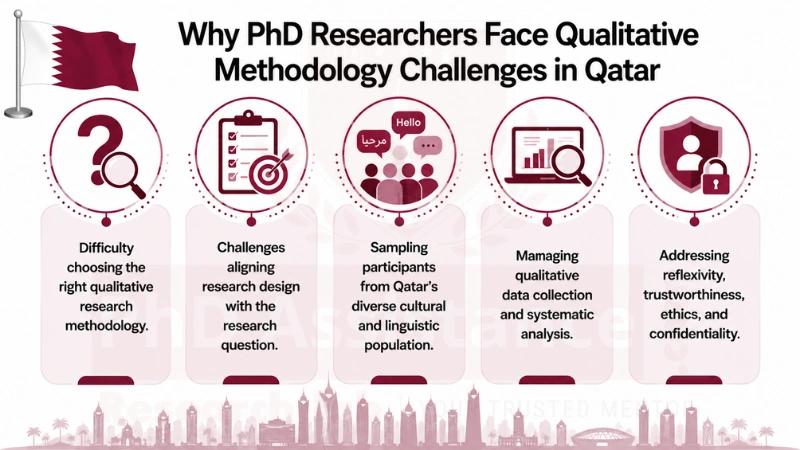
1. Choosing the Wrong Methodology
The methodology in psychological or health-related doctoral research in Qatar must be chosen in accordance with the research question and must provide relevant information. The Doctoral Research Program at Qatar University focuses on research skills and methodology
You need to:
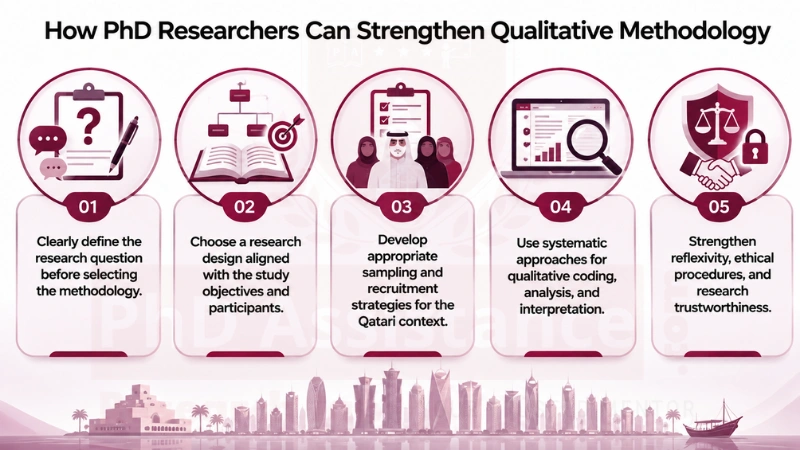
- Have a well-articulated research question before adopting a qualitative methodology.
- Make sure the methodology is aligned with your objectives, participants, and possible contributions to knowledge.
- Justify your methodological choice using relevant psychology and qualitative research literature.
- Explain why alternative qualitative approaches are less appropriate for your research.
A qualitative study carried out by Qatar University on resilience and burnout among health professional students during COVID-19 used qualitative focus groups and framework analysis. The study was conducted with 43 students across eight focus groups, illustrating how the research question informs data collection and analysis methods (El-Awaisi et al., 2024).
2. Difficulty Connecting PhD Qualitative Research in Psychology With Qatar's Research Context
There are varied participants, clinical environments, and sociocultural settings in psychological and health-related research conducted in Qatar. This can benefit the nation in terms of issues like health, psychology, well-being, and society; therefore, it is vital to understand the local setting in qualitative research.
You need to:
- Take into consideration the multicultural/multilingual nature of Qatari society while designing your research study.
- Make sure to relate your research to issues that are pertinent to health/mental well-being/social concerns.
- Consider the local environment in terms of health/education/community while recruiting participants.
- Understand the possible cultural/societal factors affecting participants’ experiences.
PhD qualitative research in Psychology was performed at Hamad Medical Corporation’s Mental Health Service, focused on language and communication barriers between Arabic-speaking patients and English-speaking or limited-Arabic-speaking mental health professionals. Interviews, observation, and archival research were conducted in this study to illustrate the need for a multilingual context in psychological research in Qatar (Alkhatib, 2024).
3. Difficulty With Sampling and Participants
Qualitative psychology research in Qatar could include participants from diverse cultural, linguistic, and demographic backgrounds. Selecting participants capable of giving valuable information is important.
You need to:
- Define clear inclusion and exclusion criteria for participant selection.
- Select a sampling strategy that directly fits your research objectives.
- Justify the sample based on the depth and relevance of information required.
- Consider cultural, linguistic, demographic, and accessibility factors.
A study into the mental health of university students in Qatar consisted of 812 participants recruited from the university population of Qatar and included demographic and mental health characteristics. The profile of the participants in this study shows the reason for which researchers must define their target population while exploring the topic of psychological well-being in Qatar (Al-Jayyousi et al., 2025).
4. Difficulty With Qualitative Data Analysis
Psychology researchers can obtain significant amounts of interview, focus group, or narrative data, which must be systematically analysed. A clear methodology of analysis is vital to ensure the connection of the evidence obtained from the participants to the research findings.
You need to:
- Select an analytical approach that matches your research design and objectives.
- Create a systematic approach for organising and coding qualitative data.
- Recognise and interpret relationships and patterns in the data.
- Explain how codes are developed into broader themes or interpretations.
Explore the guidance at PhD Assistance Research Lab to get clarity on PhD Qualitative Research in Psychology.
5. Difficulty Demonstrating Reflexivity and Trustworthiness
The qualitative study in psychology is based on the interpretation of the participants’ experiences; thus, the perspective of the researcher becomes an important factor. Students need to prove that their results have been achieved through an organised process.
You need to:
- Recognise how your academic background and perspectives may influence the research.
- Maintain reflexive records throughout data collection and analysis.
- Document important methodological decisions and changes.
- Explain how researcher influence is considered during interpretation.
HBKU’s PhD programs cover Advanced PhD Qualitative Research Methods, which covers research paradigms, ontological and epistemological problems, qualitative, quantitative and mixed methods of investigation and research ethics. This indicates the necessity to understand the assumptions behind research methods, not just the methods themselves (El-Awaisi et al., 2024).
6. Difficulty Meeting Ethical and Institutional Expectations
Psychological research may include confidential information about an individual’s mental health, background, behaviour, and general wellness. Those carrying out psychological research in Qatar need to take into consideration confidentiality, informed consent, and ethical considerations in research.
You need to:
- Make provision for an informed consent process before participants’ involvement.
- Ensure that the identity of the participants is protected.
- Consider any psychological risk to the participants.
- Develop a system for collection and management of research data.
Researchers at HBKU carried out a qualitative study in Qatar about decision-making in intensive care units, including families and healthcare workers of HMC. The project shows how difficult it is to carry out qualitative research with families, healthcare providers and various cultural and linguistic backgrounds and the emotionally complex situation of the clinic (AlSayed Hassan et al., 2025).
Quick Self-Check
- Is my Qatar-based target population clearly defined?
- Does my sample align with my research question and methodology?
- Have I considered Arabic-English language and cultural factors?
- Have I addressed relevant ethical, confidentiality, and data-protection requirements?
- Does my research address a clearly defined psychological, health, wellbeing, or societal need in Qatar?
Conclusion
Psychology PhD students based in Qatar must choose the appropriate methodology to ensure their research is thorough. Alignment between the research questions, methodology, sampling, data collection, qualitative analysis, and research objective is imperative.
It is necessary to consider the multicultural and multilingual context of Qatar, availability of participants, ethics, and validity. Proper handling of all these challenges will be helpful in improving the quality of psychological research in Qatar.
Struggling with qualitative research methodology for your PhD in Qatar? Connect with our experts at PhD Assistance Research Lab for professional guidance on research design, qualitative analysis, reflexivity, and ethical planning to develop a rigorous and well-justified research methodology.
Book a Free Expert Consultation and receive structured PhD Qualitative Methodology Services in Qatar.
FAQs:
- How do you choose a qualitative research method for a PhD?
Choose a method based on your research question, objectives, participants, and the type of data you need to collect. Ensure the method is supported by relevant qualitative and psychological research literature. - Which qualitative research methods are suitable for psychology PhD research?
Common methods include interviews, focus groups, observation, case studies, ethnography, phenomenology, and narrative research. The most suitable method depends on the psychological phenomenon and research question being investigated. - How do you select the right qualitative research design?
Select a design that aligns with your research objectives, philosophical assumptions, participants, and intended contribution to knowledge. Consider whether you want to explore experiences, meanings, behaviours, processes, or social contexts. - What are common qualitative methodology mistakes in PhD research?
Common mistakes include choosing a methodology before developing a clear research question, using unsuitable sampling methods, and providing weak justification for methodological decisions. Poor data analysis, limited reflexivity, and inadequate attention to ethics are also frequent problems. - How do you justify qualitative methodology in a psychology PhD?
Explain why qualitative research is appropriate for understanding participants’ experiences, perceptions, meanings, or social contexts related to your research question. Support your choice with established methodological and psychological literature and explain why alternative approaches are less suitable. - How can PhD students improve their qualitative research methodology?
Students can improve by developing a clear research question, aligning the research design with their objectives, and using systematic data collection and analysis procedures. They should also strengthen reflexivity, ethical practices, sampling strategies, and methodological justification.
References
- Al-Jayyousi, G. F., Shraim, M., O’Hara, L., Zolezzi, M., Al-Wattary, N., El-Awaisi, A., El Hajj, M. S., Mukhalalati, B., Abdul Rahim, H., & Alsayed Hassan, D. (2025). Mental health of university students: A cross-sectional study from Qatar. Scientific Reports, 15(1), 36237. https://doi.org/10.1038/s41598-025-20202-7
- Alkhatib, D. (2024). Language and communication barriers in the mental health service of Hamad Medical Corporation: An exploratory study [Master’s dissertation, Hamad Bin Khalifa University]. HBKU Research Portal. HBKU Research Portal
- AlSayed Hassan, D., Hssain, A. A., & Daher-Nashif, S. (2025). Decision making in intensive care units in Qatar: A qualitative study [Applied research project]. Hamad Bin Khalifa University, Hamad Medical Corporation, & Keele University. https://elmi.hbku.edu.qa/en/projects/decision-making-in-intensive-care-units-in-qatar-a-qualitative-st/?
- El-Awaisi, A., Ismail, S., Sulaiman, R., Kane, T., El Hajj, M. S., & Shraim, M. (2024). A qualitative exploration of health profession students’ experiences of resilience and burnout using the Coping Reservoir Model during the COVID-19 pandemic. Teaching and Learning in Medicine, 36(3), 256–268. https://doi.org/10.1080/10401334.2023.2209073
- El-Awaisi, A., Yakti, O. H., Elboshra, A. M., Jasim, K. H., AboAlward, A. F., Shalfawi, R. W., Awaisu, A., Rainkie, D., Al Mutawa, N., & Major, S. (2024). Facilitators and barriers to interprofessional collaboration among health professionals in primary healthcare centers in Qatar: A qualitative exploration using the “Gears” model. BMC Primary Care, 25, 316. https://doi.org/10.1186/s12875-024-02537-8
