
Call for Papers: Optimisation, Control Theory, and Artificial Intelligence: Converging Methodologies for Engineering Applications
Introduction
The fast development of intelligent technologies has revolutionised modern engineering due to the incorporation of optimisation methods, control theory, and artificial intelligence into a cohesive solution approach. As engineering systems are getting more and more complex, new approaches are being developed to solve nonlinear dynamical, uncertain, high-dimensional, and real-time problems. These changes contributed to the development of Artificial Intelligence in Engineering, providing intelligent automation, predictive modelling, adaptive control, and data-based optimisation in different industrial sectors.
This Special Issue encourages researchers to submit original studies devoted to the investigation of the interconnection between optimisation, control theory, applied mathematics, and artificial intelligence to solve newly arising engineering problems. Emphasis should be placed on the theoretical results, computational approaches, and applications that can increase system intelligence, robustness, stability, and decision-making capabilities.
Why publish in this issue?
The present Special Issue represents a good platform for scientists who combine their efforts around optimisation, control, and intelligent computing. Selected articles will be published in a prominent international journal, which will ensure wider recognition of advanced research in engineering.
Key advantages:
Scope
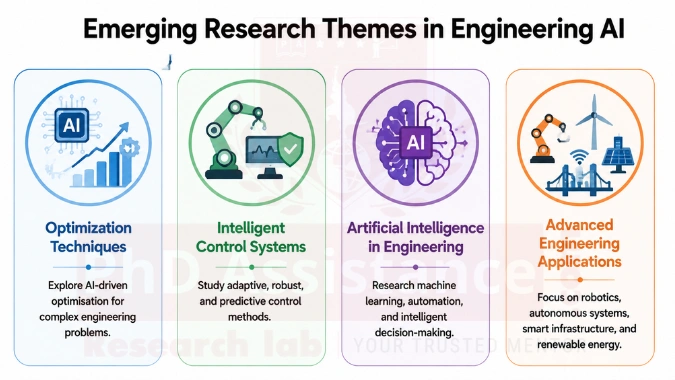
The scope of this Special Issue includes theoretical, computational, and application papers of research work in the field of optimisation, control, artificial intelligence, and applied mathematics that focus on recent problems in these fields and illustrate their impact in different branches of engineering such as autonomous systems, smart infrastructures, robotics, energy, health care, and cyber-physical systems.
Contact PhD Assistance Research Lab today to publish your research papers in Scopus and PubMed-indexed journals!
Know More About This Issue
With the ever-increasing complexity of engineering systems, it is necessary for methods of optimisation that incorporate intelligent learning and control together. Traditional methods of optimisation and control fail when it comes to dealing with highly dynamic environments marked by uncertainty and fast-changing information. There is a growing trend towards using artificial intelligence techniques in combination with mathematics to develop intelligent engineering systems.
The purpose of this Special Issue is to unite researchers from various disciplines of optimisation, applied mathematics, artificial intelligence, and engineering science to contribute novel theories and engineering solutions. Methods that utilise data analysis and mathematical approaches to create robust and scalable engineering models are especially appreciated. Submissions related to intelligent automation, autonomous systems, renewable energy, robotics, transportation, manufacturing, biomedical engineering, and smart infrastructure are particularly encouraged.
Key factors
How We Support Your Submission
PhD Assistance Research Lab offers full publication assistance to enable researchers to draft manuscripts that can be published in international journals or Special Issues. Our skilled professionals work hand in hand with researchers to make sure that the quality, technical accuracy, and impact of their research are improved.
Our services include:
Our publication experts will edit your paper to ensure that it meets the demands of the Special Issue on Optimisation, Control Theory, and Artificial Intelligence: Converging Methodologies for Engineering Applications.
Journal Guidelines:
If you are a researcher interested in publishing research papers in the journal titled “Optimisation, Control Theory, and Artificial Intelligence: Converging Methodologies for Engineering Applications,” then you can get help from the PhD Assistance Research Lab to publish your manuscript.
Free Guide: How to Write the Journal Manuscript
Book a free consultation to get guidance from the PhD Assistance Research Lab for writing a credible research manuscript and submitting it to a high-quality journal.
Reference
Elsevier. (2026, April 27). Call for papers: Optimization, control theory, and artificial intelligence: Converging methodologies for engineering applications. Engineering Applications of Artificial Intelligence.