

Why UK PhD Supervisors Reject So Many AI Research Proposals
July 22, 2026
Critical Review of How to Integrate Nanotechnology into Chemical Engineering Education: Curriculum Standards, Research Trends, Pedagogical Challenges, and Future Prospects
July 24, 2026Why Statistical Data Analysis Is So Challenging for UAE PhD Public Health Researchers
- July 23, 2026
- Data Analysis
Introduction
Statistical analysis of data is an integral component of Public Health PhD research, which helps researchers in recognising health patterns, assessing intervention measures, and developing evidence for healthcare policies. Many PhD researchers in the UAE have difficulty in conducting statistical analyses due to the nature of healthcare data, multilingual communities, regulations, and the sophistication of statistical methods used.
As explained by Creswell and Creswell (2023), conducting rigorous statistical analyses plays a critical role in the generation of credible answers to research questions. The researcher needs to ensure compatibility between their analytical process and research methodology.
As the UAE improves its health care system and research facilities, a lot is expected from PhD researchers to carry out statistically sound research. The PhD Assistance Research Lab offers PhD Data Analysis Help in UAE to conduct statistical analysis for public health research.
What you will learn from this blog?
- Why statistical data analysis is challenging for UAE Public Health PhD researchers.
- The major obstacles affecting research quality.
- Practical strategies for improving statistical analysis.
- How expert guidance can strengthen research outcomes.
Why PhD Statistical Analysis Matters for Public Health PhD Research
UAE has invested in healthcare information technology infrastructure by launching several platforms such as Malaffi for Abu Dhabi and Nabidh for Dubai, along with the federal healthcare platform named Riayati. These platforms have improved interoperability in the healthcare domain, but they were not built for any research purposes; therefore, getting de-identified datasets is quite difficult even after acquiring permission from many healthcare authorities.
While many PhD scholars are familiar with the concept of statistics, its application in sophisticated procedures in software such as SPSS, R, STATA, or SAS becomes problematic without practical experience. Incorrect statistics or their interpretation may result in problems with the validity of the research conducted. PhD scholars often get expert PhD Statistical Analysis Help in UAE to solve these issues with data interpretation.
Why is Statistical Analysis So Challenging for UAE PhD Public Health Researchers?
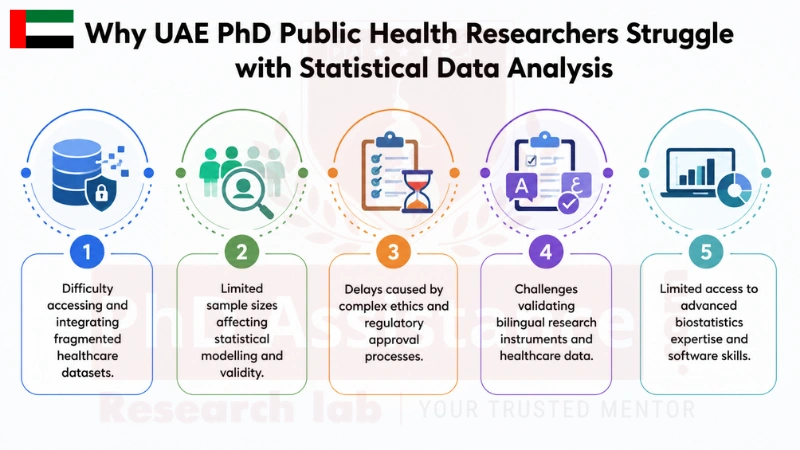
1. Fragmented Health Data Systems Despite Rapid Digitalisation
The UAE has invested heavily in technology-based healthcare platforms such as Malaffi in Abu Dhabi, Nabidh in Dubai, and the national Riayati platform to enhance healthcare interoperability. Although these platforms have enhanced the coordination of care delivery, their primary intention was not to facilitate research. This means that getting the de-identified data sets for research often involves securing approvals from different health agencies, and data from private health organisations might remain out of reach.
This poses further difficulties for PhD students in conducting statistical analysis. Data collected from different health care systems often exhibit differences in coding conventions, variables, and formats of data.
What research shows:
According to the World Health Organisation (2021), the fragmentation of health information systems affects data consistency and interoperability and leads to problems with conducting health research and making evidence-based decisions.
Tips:
- Assess data compatibility before merging multiple datasets.
- Standardise variable definitions and coding systems.
- Perform comprehensive data cleaning before analysis.
- Document all data harmonisation procedures to improve research transparency.
2. Limited Sample Sizes for Emirati Population Research
Most of the public health research done in the UAE usually involves the UAE population or some specific patient groups. The problem is that the population is usually rather limited; hence, it is difficult to achieve an adequate sample size for further statistical modelling. This problem becomes even more pronounced while studying rare diseases and specialised clinical cases where standard statistical methods make false assumptions.
Therefore, researchers often must apply other techniques like Fisher’s exact test, Bayesian analysis, or exact logistic regression when dealing with small sample sizes to obtain valid results.
What research shows:
Peduzzi et al. (1996) have shown that insufficient sample sizes can adversely affect the stability and precision of regression models, making it more likely for there to be biased results.
Tips:
- Conduct sample size calculations during study planning.
- Choose statistical methods appropriate for small datasets.
- Consider combining data across multiple years where appropriate.
- Clearly report sample size limitations when interpreting findings.
3. Multi-Layered Ethics and Regulatory Approval Processes
Ethical clearance is often a requirement for conducting public health research in the UAE, since various regulatory bodies exist at the federal and emirate levels. Various approvals may be required when conducting multi-centre studies that involve hospitals, universities or other healthcare institutions. The approval process may take a lot of time, thus giving the researcher a limited amount of time for performing detailed statistical analysis.
This leads to many PhD students having to perform complicated statistical analyses under reduced time limits. The shortage of time allotted for cleaning and validation can lead to mistakes in analysis as well as reduced overall quality of the research output.
What research shows:
According to the UAE National Guidelines for Research Ethics, ethical review is very important to protect participants during research while at the same time maintaining scientific integrity.
Tips:
- Begin ethics applications as early as possible.
- Prepare complete documentation to minimise review delays.
- Develop a statistical analysis plan before data collection
- Allocate sufficient time for data cleaning and statistical analysis after approvals are obtained.
4. Bilingual Research Instruments and Measurement Validity
Health-related research conducted in the UAE is often associated with people coming from diverse cultures and speaking diverse languages. Although numerous health-related questionnaires have already been tested and are considered validated, most of these instruments were initially developed in English. Thus, when translating them into Arabic or other common languages used in the country, special attention should be paid to translating, back-translating, and validating them.
The lack of validation of translated instruments could undermine reliability, generate measurement bias, and impact the validity of the statistics generated, thus undermining the credibility of the study.
What research shows:
According to Beaton et al. (2000), translations require systematic procedures for achieving cross-cultural equivalence. Such processes include translation, back translation, cultural adaptation, and psychometric validation.
Tips:
- Use validated translation and back-translation procedures.
- Assess internal consistency using reliability statistics.
- Conduct pilot testing before full-scale data collection.
- Evaluate construct validity across different language groups.
Connect with the experts at PhD Assistance Research Lab for strengthening your Public Health research with accurate, reliable statistical analysis.
5. Limited Access to Biostatistics Mentorship
While doctorate-level training has increased tremendously at universities in the UAE, provision of mentorship in specialised areas such as biostatistics is not even. Many individuals know statistics theoretically but have problems in applying their knowledge practically while using complex analysis tools like multilevel modelling, survival analysis, structural equation modelling, or longitudinal data analysis.
Without proper Public Health Data Analysis Help in UAE from experts, scholars will find it difficult when choosing relevant statistical methods, understanding the outputs of computer programs, and justifying the choice made for analysis while evaluating the thesis.
Example: According to the Association of Schools and Programs of Public Health, proficiency in advanced biostatistics is one of the main criteria necessary for the development of reliable and evidence-based studies in public health that would impact healthcare policy and practice.
Tips:
- Statistical help should be sought before conducting research and not after data analysis.
- Increase knowledge about both statistical theory and programming.
- Test assumptions on the models being used before concluding.
- Keep notes on all analytical processes carried out.
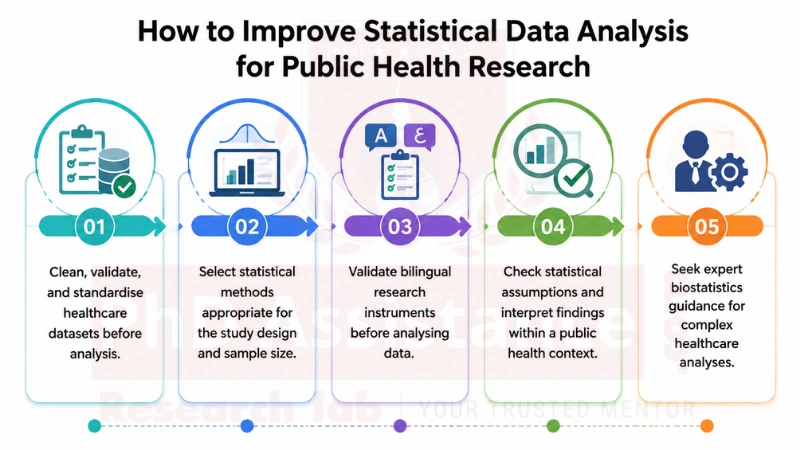
Strategies to Improve Statistical Data Analysis Successfully
- Clean and validate datasets before analysis.
- Check statistical assumptions before applying analytical models.
- Use appropriate methods for handling missing data and small sample sizes.
- Validate bilingual research instruments before analysis.
- Interpret findings within the public health context.
- Seek expert statistical guidance for complex analyses.
- Seek Structured PhD Data Analysis Services in UAE to make your statistical analysis effective and meaningful.
Conclusion
Statistical data analysis has become one of the most difficult steps in conducting PHD studies in the UAE. This process is complicated by such factors as the handling of healthcare data sets, regulation, languages, and statistical techniques.
The use of proper statistical techniques together with high-quality data, as well as conducting a proper analysis through a systematic process, will yield reliable and valid results that will help in making evidence-based policies around public health. The process of conducting proper statistics will help in making valid research, thereby contributing positively to the area of public health.
Looking to strengthen your Public Health PhD research in the UAE? Connect with our statisticians to get support with epidemiological study design, biostatistics, and healthcare data analysis to deliver high-quality public health research.
Book a Free Expert Consultation and receive personalised Dissertation Data Analysis Services in UAE for UAE Public Health Research.
References
- Association of Schools and Programs of Public Health. (2023). Framing the future 2030: Education for public health. https://aspph.org
- Beaton, D. E., Bombardier, C., Guillemin, F., & Ferraz, M. B. (2000). Guidelines for the process of cross-cultural adaptation of self-report measures. Spine, 25(24), 3186–3191. https://doi.org/10.1097/00007632-200012150-00014
- Creswell, J. W., & Creswell, J. D. (2023). Research design: Qualitative, quantitative, and mixed methods approaches (7th ed.). SAGE Publications. https://www.scirp.org/reference/referencespapers?referenceid=3784840
- Peduzzi, P., Concato, J., Kemper, E., Holford, T. R., & Feinstein, A. R. (1996). A simulation study of the number of events per variable in logistic regression analysis. Journal of Clinical Epidemiology, 49(12), 1373–1379. https://doi.org/10.1016/S0895-4356(96)00236-3
- World Health Organization. (2021). WHO guideline: Recommendations on digital interventions for health system strengthening. World Health Organization. https://www.who.int
FAQs:
1. Why is statistical data analysis difficult for Public Health PhD researchers in the UAE?
Statistical data analysis can be challenging due to fragmented healthcare data systems, limited access to research datasets, small sample sizes, complex ethical approval processes, multilingual research populations, and the need for advanced statistical techniques.
2. Which statistical software is commonly used for Public Health PhD research?
Researchers commonly use SPSS, R, STATA, SAS, and Python for statistical analysis. The choice depends on the research design, data complexity, and the analytical methods required.
3. How can researchers improve the quality of their statistical analysis?
Researchers can improve analysis quality by cleaning and validating data, selecting appropriate statistical tests, checking model assumptions, using validated research instruments, and consulting biostatistics experts when handling complex analyses.
4. Why is choosing the correct statistical method important in Public Health research?
Using the appropriate statistical method ensures accurate interpretation of results, improves research validity, reduces bias, and strengthens evidence for healthcare policy and public health decision-making.
5. When should PhD researchers seek statistical analysis support?
Researchers should seek statistical guidance during the research planning stage, including study design, sample size calculation, data collection planning, and statistical analysis
