
Call for Papers: From Molecules to Holistic Effects: Unveiling the Scientific Basis of Traditional Chinese Medicine for Pain, Chronic Diseases, and Bioactive Compound Biosynthesis
Introduction
Traditional Chinese Medicine (TCM) encompasses complex formulations, extracts, and bioactive compounds that are increasingly being investigated using modern biomedical and systems-level approaches. Advances in molecular biology, multi-omics, network pharmacology, synthetic biology, and metabolic engineering have created new opportunities to understand the biological effects and mechanisms of TCM.
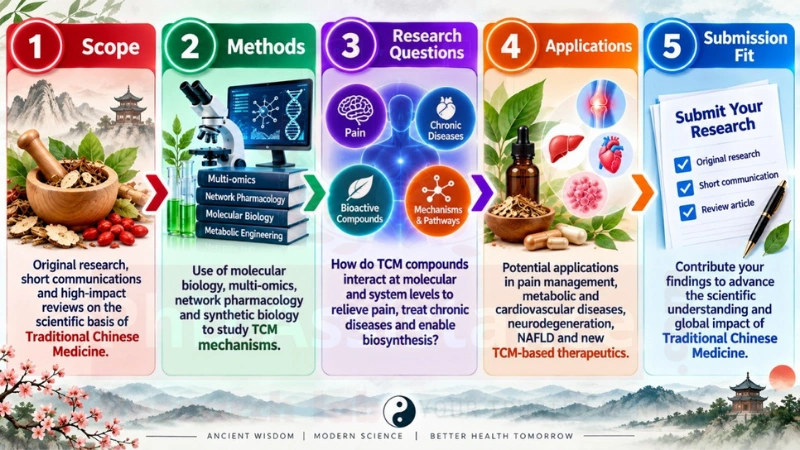
This Special Issue invites researchers to submit original studies investigating the mechanisms of action of TCM in pain management and chronic diseases, as well as new approaches for the biosynthesis of TCM bioactive compounds. It invites research studies covering phytomedicine, pharmacology, biotechnology, molecular biology, systems biology, and translational medicine.
Research Areas Covered by This Special Issue
This Special Issue provides an opportunity to explore diverse aspects of TCM research, from molecular mechanisms and therapeutic efficacy to bioactive components, biosynthesis, quality control, and emerging applications.
Key advantages:
Scope
Research Articles, Short Communications, and Review Articles addressing the scientific basis of Traditional Chinese Medicine are encouraged for submission to the Special Issue. Studies integrating pharmacology, molecular biology, biotechnology, systems biology, phytomedicine, and clinical or translational research will be especially relevant to this TCM Research Call for Papers.
Topics of interest include, but are not limited to:
Research Areas and Potential Approaches
| Research area | Suitable focus | Possible approaches |
|---|---|---|
| Pain | Nociception, neuroinflammation, sensitisation | Molecular biology, pharmacology |
| Chronic disease | Metabolic, cardiovascular, neurodegenerative disease |
Clinical, experimental, systems biology |
| Multi-component mechanisms | Formulae, extracts, multi-target effects | Network pharmacology, multi-omics |
| Bioactive biosynthesis | Secondary metabolites | Synthetic biology, metabolic engineering |
| Translation & quality | Biomarkers, standardisation, safety, delivery | Analytical, preclinical, clinical |
Know More About This Issue
Traditional Chinese Medicine (TCM) involves multi-component formulations that may influence multiple biological targets and pathways. Recent research has applied network pharmacology and systems approaches to investigate these complex mechanisms and connect TCM compounds with potential therapeutic pathways.
Clinical research has also examined Traditional Chinese Medicine in chronic disease settings. Systematic reviews have evaluated TCM interventions for chronic pain conditions, including fibromyalgia (Cai et al., 2023). Research in type 2 diabetes with non-alcoholic fatty liver disease has also investigated outcomes such as glucose metabolism, lipid profiles, liver function, and insulin resistance (Peng et al., 2022). Research on Jinlida, a TCM formulation used as an add-on treatment for type 2 diabetes, has also synthesised evidence from randomised controlled trials (Zhao et al., 2022).
An umbrella review of systematic reviews of randomised controlled trials reported potential benefits across several cardiovascular conditions, while also noting limitations in the quality and certainty of the available evidence (Li et al., 2024). A 2024 systematic review and meta-analysis also examined TCM as part of treatment strategies for chronic coronary syndrome, providing further evidence for ongoing investigation in this area (Ma et al., 2024).
How We Support Your Submission
PhD Assistance Research Lab supports researchers with manuscript development, scientific editing, structuring and submission preparation while preserving researcher authorship and responsibility.
Our services include:
1. Scientific Manuscript Development and Editing
2. Research Design & Methodology
3. Journal Formatting & Manuscript Structuring
4. Academic Language Editing & Proofreading
5. Pre-Submission Review & Submission Support
Special Issue Submission Information
Journal Guidelines:
Verify all information against the latest official Elsevier CFP before submitting your paper.
If your research addresses the scientific basis of Traditional Chinese Medicine for pain, chronic diseases, or bioactive compound biosynthesis, consider submitting your manuscript to this Special Issue.
Is My Paper a Fit?
Your manuscript may be a good fit if it:
Check Your Manuscript’s Fit for This Special Issue
Get guidance on manuscript scope, structure, formatting and pre-submission preparation, including how to prepare for and respond to peer-review requirements.
The free guide covers manuscript preparation, formatting, Peer review, and pre-submission readiness
FAQs:
1. What is the focus of the Traditional Chinese Medicine Special Issue?
This Special Issue focuses on the scientific basis of TCM, including molecular mechanisms in pain and chronic diseases, bioactive compound biosynthesis, quality control, and translational research.
2. What article types are accepted for this Special Issue?
The Special Issue welcomes original research articles, short communications, and review articles covering TCM, pain research, chronic diseases, bioactive compounds, and related biotechnology.
3. What areas are covered by Traditional Chinese Medicine Research?
Research areas include TCM mechanisms in pain management, metabolic and chronic diseases, network pharmacology, multi-omics, bioactive compound biosynthesis, quality control, and clinical applications.
4. What topics are relevant to Traditional Chinese Medicine and Pain Research?
Relevant topics include acute, chronic, neuropathic, and inflammatory pain, nociceptive pathways, neuroinflammation, sensitisation, and interactions between TCM bioactive compounds and pain-related targets.
5. How can I publish an article in this Special Issue?
Authors can submit their manuscripts through the journal’s Editorial Manager® submission system by selecting the article type “VSI: Scientific Basis of TCM” during submission and following the journal’s latest Guide for Authors.
Reference
- (2026). From Molecules to Holistic Effects: Unveiling the Scientific Basis of Traditional Chinese Medicine for Pain, Chronic Diseases, and Bioactive Compound Biosynthesis. Submission deadline: 30 September 2027. Phytomedicine | ScienceDirect.com by Elsevier – Phytomedicine | ScienceDirect.com by Elsevier
- Zhao, X., Liu, L., & Liu, J. (2022). Treatment of type 2 diabetes mellitus using the traditional Chinese medicine Jinlida as an add-on medication: A systematic review and meta-analysis of randomised controlled trials. Frontiers in Endocrinology, 13, 1018450. https://doi.org/10.3389/fendo.2022.101
- Cai L, Chen Z, Liang J, Song Y, Yu H, Zhu J, Wu Q, Zhou X and Du Q (2023) Effectiveness of non-pharmacological traditional Chinese medicine combined with conventional therapy in treating fibromyalgia: a systematic review and meta-analysis. Front. Neurosci. 17:1097475. doi: 10.3389/fnins.2023.1097475
- Li, J., Jiao, R., Su, W., Chen, W., Hu, X., Xu, S., Xu, L., Yao, W., Liu, K., You, H., & Zhao, J. (2025). Traditional Chinese medicine for non-alcoholic fatty liver disease: An overview of systematic reviews with evidence mapping and metabolic outcome assessment. Frontiers in Pharmacology, 16, 1675793. https://doi.org/10.3389/fphar.2025
- Peng, S., Liu, L., Xie, Z., Zhang, X., Xie, C., Ye, S., Zhang, X., Liang, X., Wang, H., & Liu, Y. (2022). Chinese herbal medicine for type 2 diabetes mellitus with nonalcoholic fatty liver disease: A systematic review and meta-analysis. Frontiers in Pharmacology, 13, 863839. https://doi.org/10.3389/fphar.2022.
- Li, X., Yu, T., Jiang, Q., Tan, J., & Liu, K. (2024). The Efficacy of Traditional Chinese Herbal Medicine Across Multiple Cardiovascular Diseases: An Umbrella Review of Systematic Reviews of Randomised Controlled Trials. Journal of Cardiovascular Pharmacology, 83(4), 340–352. https://doi.org/10.1097/FJC.0000000
- Ma, X. H., Chen, Y., Huang, X. Y., Jiang, J. R., Liu, X., An, D. Q., & He, R. R. (2024). Characteristics and efficacy of traditional Chinese medicine in the therapeutic strategy of chronic coronary syndrome: A systematic review and meta-analysis. Phytomedicine: international journal of phytotherapy and phytopharmacology, 129, 155579. https://doi.org/10.1016/j.phymed.2024.1