
Critical Review of Mapping the carbon finance research: A bibliometric exploration of innovation in sustainable finance
Introduction
Climate change has necessitated a greater need for innovative financing schemes that facilitate environmental sustainability and economic development that does not cause greenhouse gas emissions. Innovative financial schemes like carbon pricing, ETS, carbon credits, and green finance have become important instruments for minimising greenhouse gases while at the same time fostering sustainable economic development.
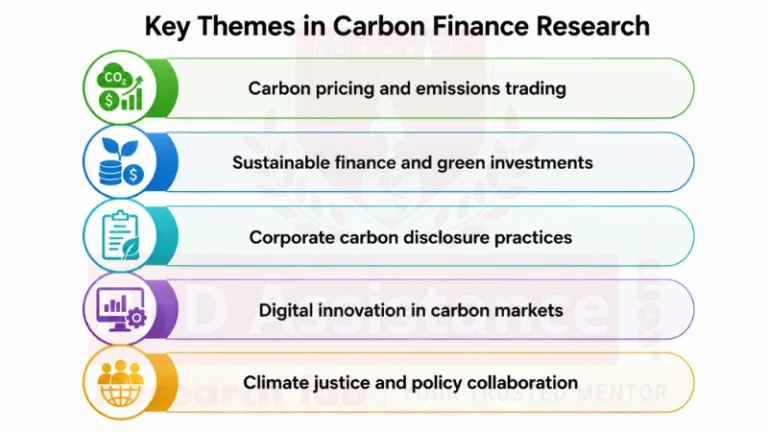
Mapping the Carbon Finance study: A Bibliometric Exploration of Innovation in Sustainable Finance. In this paper, Roshid et al. (2025) explore the development of Carbon Finance Research using bibliometrics. The authors use publication patterns, important researchers, nations, organisations, and collaboration patterns to explain the intellectual structure of Carbon Research. Some of the important research themes identified by the study include carbon pricing, corporate carbon disclosure, digital innovation, and climate justice.
Through systematic literature mapping, the paper adds to the existing research on Sustainable Finance by exploring new directions for future research and providing useful information for researchers, policymakers, and practitioners who want to develop sustainable financial systems.
Summary of the article
This article focuses on the history of carbon finance using the Carbon Finance Bibliometric Analysis approach to study the growth and intellectual structure of the field. Through their analysis of scholarly articles, the authors were able to determine influential authors, journals, institutions, countries, and collaboration networks involved in the development of carbon finance. Through their bibliometric analysis, the study can present an in-depth analysis of the evolution of research in carbon finance.
Several key research areas include carbon pricing, emissions trading systems (ETS), carbon markets, corporate carbon disclosures, and the financialization of environmental resources. This paper also examines some of the newly emerging areas such as digital innovations, climate justice, and the linking of carbon finance with sustainable finance initiatives. Results reveal that Europe, China, and the United States have been the prominent countries that have spearheaded the progress of Carbon research, with the role of international cooperation having greatly aided knowledge development in this area.
The researchers find that carbon finance has developed from a policy tool used to decrease greenhouse gas emissions to a strategy that can help facilitate sustainable development. In summary, the paper presents several interesting findings about carbon finance development as well as knowledge gaps in the area, which may be useful to both researchers and practitioners interested in sustainable finance.
Critique
Significance and contribution of the field
One of the most significant advantages of the paper is the relevance of the theme of carbon finance, which has gained much attention as a topic of research because of its crucial importance in tackling climate change and promoting low-carbon economic growth. With the help of bibliometrics, the research presents a review of the development of the intellectual base of the topic along with some of its emergent themes, which contribute to Sustainable Finance Innovation.
This paper adds to existing studies conducted by Su et al. (2023) and Mashari et al. (2023) on global trends in carbon finance and the link between green finance and carbon trading, respectively. Nevertheless, Roshid et al. advance these studies with additional themes like digital innovations, climate justice, and a multidisciplinary approach, which help to expand the boundaries of existing research.
The results obtained in this paper also correlate with previous works by Chen and Ma (2024) and Jiang et al. (2023), where carbon finance was found to increase the efficiency of the green economy and sustainable economic development. At the same time, Bhatnagar and Sharma (2022) emphasised the fast growth of green finance literature, and the current paper proves the growth of carbon finance in Sustainable Finance Research.
Although there are these benefits, the article maintains a predominantly descriptive approach to its analysis and fails to provide any adequate discussion on alternative approaches. For instance, Campiglio (2016) posits that carbon prices by themselves will not be able to bring about a low-carbon transition without suitable financial policy instruments in place, while according to Tariq and Hassan (2023), robust environmental regulations are crucial.
Methodology and research design
The research methodology used in this study is that of Carbon Bibliometric Analysis, and this is a suitable methodology for analysing an emerging field of research. The use of bibliometrics will allow researchers to find influential papers, authors, institutions, collaboration networks, and research themes using statistical methods. According to Donthu et al. (2021), the use of bibliometric methodologies is a systematic way of analysing research performance and finding future research directions. Also, Bhatnagar and Sharma (2022) showed the effectiveness of bibliometric analysis in analysing the research on green finance.
One of the major advantages of the methodology is that it allows synthesising a considerable amount of literature on the issue and provides a complete picture of the development of carbon finance. In this respect, by analysing publication trends, citation networks, and collaborations, the paper manages to find out important authors and key themes. This finding is supported by the results presented in the work by Su et al. (2023), where bibliometric methods were used to analyse the global development of carbon finance.
Even with these advantages, there are some drawbacks to this approach. The choice of databases and citation analysis is important in bibliometrics and can limit the inclusion of pertinent literature and create language and citation bias. According to Keathley-Herring et al. (2016), database content can be quite influential on the results of the bibliometrics. Moreover, depending only on quantitative measures does not help much with the theory-based assessment of the studies. A combination of bibliometric study and systematic literature review would be more beneficial for carbon research.”
Theoretical and Interdisciplinary Analysis
An interdisciplinary approach has been employed in the article through incorporation of various theories from finance, environmental economics, sustainability, and innovation to understand the history of carbon finance. Through looking at the correlation between carbon pricing, emission trading schemes, corporate carbon disclosures, and sustainable finance, the study can establish the role that financial methods play in climate change adaptation. Carbon Finance Trends identified also serve to illustrate the growing linkage between environmental and financial studies.
These results are in line with the study by Campiglio (2016), which stresses the significance of financial systems in facilitating the transition towards a low-carbon economy besides carbon pricing. Likewise, Mohsin et al. (2021) highlighted the significance of low-carbon finance in ensuring sustainable economic development, whereas Chen & Ma (2024) reported that carbon finance increases green economic efficiency through financial innovations. These findings validate the notion presented in the article about how carbon finance has become an interdisciplinary field of research.
Nonetheless, the theoretical section could have benefited from applying well-known theories like the Triple Bottom Line or the Institutional Theory to demonstrate the linkages among financial innovation, environmental governance, and sustainable organisations. Even though the paper successfully identifies the trends in Carbon Finance, there is a need for more theoretical analysis that would increase its contribution to sustainable finance studies.
Ethical Considerations
The article acknowledges the need for ethics in carbon financing through the issues of transparency, accountability, and equitable access to financial mechanisms that are sustainable. The article also recognises the significance of international cooperation and climate justice in ensuring environmental and financial accountability.
The discussions are consistent with those of Raymond (2024), who notes that the integrity of carbon markets is maintained by having transparent and regulated carbon trading. In the same manner, Oh (2023) emphasises that legal and regulatory mechanisms are vital in ensuring the integrity of the market, preventing any unethical practices such as insider trading and market manipulation.
However, the ethical debate could have been further improved by bringing into consideration problems such as greenwashing and the credibility of carbon offset projects. Such an assessment of the ethical challenges involved would have helped in achieving a better balance between all aspects of carbon finance for sustainable development.
Writing Style and Structure
The structure of the paper is very good, and there is an evident logical sequence from the introduction to the conclusion. Bibliometric visualisation, thematic classification, and network analysis allow one to enhance the presentation of results and comprehend the development of research on carbon finance efficiently. Language is clear and easy to understand.
Nevertheless, some paragraphs of the paper should contain a more detailed analysis instead of a description of the results of the bibliometric analysis. It was done quite well, but an analysis of the theoretical and practical implications of such patterns and themes would make the paper much better and more analytical.
Conclusion
A useful contribution made by Roshid et al. (2025) is their review in the area of Finance Research through the presentation of a comprehensive bibliometric analysis of the knowledge base of the area, along with its potential future research trends. It is clearly illustrated in the study that carbon finance has evolved as an element of sustainable finance, from being a market-driven environmental tool.
Despite the success of the article in highlighting important trends in publishing, contributors, and themes, the descriptive tone of the paper, coupled with the minimal theoretical approach used, hinders the effectiveness of the critical analysis presented by the author. The inclusion of other theories and discussions of the ethical issues surrounding the topic, among others, would have contributed more to the study.
Overall, it provides a useful base for further research and contributes to the comprehension of Sustainable Financial research. Future research may apply mixed methods and various sources of information to get more details about the dynamic connection between carbon finance, sustainable development, and climate governance.
“Are you facing challenges in writing a high-quality critical review for your research? The PhD Assistance Research Lab offers specialised guidance tailored to doctoral scholars and early-career researchers.”
Reference
- Bhatnagar, S., & Sharma, D. (2022). Evolution of green finance and its enablers: A bibliometric analysis. Renewable and Sustainable Energy Reviews, 162, 112405. https://doi.org/10.1016/j.rser.2022.112405
- Campiglio, E. (2016). Beyond carbon pricing: The role of banking and monetary policy in financing the transition to a low-carbon economy. Ecological Economics, 121, 220–230. https://doi.org/10.1016/j.ecolecon.2015.03.020
- Chen, Y., & Ma, G. (2024). The characteristics and mechanisms of carbon finance development on green economic efficiency: An empirical analysis based on endogenous economic growth model. Frontiers in Environmental Science, 12. https://doi.org/10.3389/fenvs.2024.1420708
- Donthu, N., Kumar, S., Mukherjee, D., Pandey, N., & Lim, W. M. (2021). How to conduct a bibliometric analysis: An overview and guidelines. Journal of Business Research, 133, 285–296. https://doi.org/10.1016/j.jbusres.2021.04.070
- Jiang, L., Niu, H., Ru, Y., Tong, A., & Wang, Y. (2023). Can carbon finance promote high-quality economic development: Evidence from China. Heliyon, 9(12), e22698. https://doi.org/10.1016/j.heliyon.2023.e22698
- Keathley-Herring, H., Van Aken, E., Gonzalez-Aleu, F., Deschamps, F., Letens, G., & Orlandini, P. C. (2016). Assessing the maturity of a research area: Bibliometric review and proposed framework. Scientometrics, 109(2), 927–951. https://doi.org/10.1007/s11192-016-2096-x
- Lu, J., Li, H., & Yang, R. (2024). Low carbon finance drives corporate carbon emissions reduction: A perspective from issuing carbon neutral bonds. Technological Forecasting and Social Change, 203, 123404. https://doi.org/10.1016/j.techfore.2024.123404
- Mashari, D. P. S., Zagloel, T. Y. M., Soesilo, T. E. B., & Maftuchah, I. (2023). A bibliometric and literature review: Alignment of green finance and carbon trading. Sustainability, 15(10), 7877. https://doi.org/10.3390/su15107877
- Mohsin, M., Taghizadeh-Hesary, F., Panthamit, N., Anwar, S., Abbas, Q., & Vo, X. V. (2021). Developing low carbon finance index: Evidence from developed and developing economies. Finance Research Letters, 43, 101520. https://doi.org/10.1016/j.frl.2020.101520