
Generative AI and Data-Driven Innovation Strategies in Sustainable Business Ecosystems Dissertation Topics I phdassistance.com
Info: Generative AI and Data-Driven Innovation Strategies in Sustainable Business Ecosystems Dissertation Topics I phdassistance.com
Published: 29th june in Generative AI and Data-Driven Innovation Strategies in Sustainable Business Ecosystems Dissertation Topics I phdassistance.com
Share this:
Related Services
Our academic writing and marking services can help you
Introduction
Generative AI has revolutionised how businesses innovate, develop strategies and create sustainable value across sectors. Smart automation combined with extensive analytic processes that can improve decision making, optimise business procedures, create knowledge and better support team members within Generative AI in Sustainable Business Ecosystems. This facilitates innovativeness, whilst addressing firms to dynamic sustainability objectives and digital transformation aims. Nevertheless, challenges are evident with the integration of AI into strategic sustainability and ecosystem-wide efforts. The literature emphasises that firms require the in-depth frameworks that integrate Generative AI with Sustainable Business Practice to provide sustainability, resilience, innovativeness and competitive advantage in ever-changing Business Ecosystems.
Proposed PhD Topic 1: Generative AI-Driven Data-Driven Innovation Strategies for Sustainable Business Transformation in Digital Business Ecosystems
Background Context:
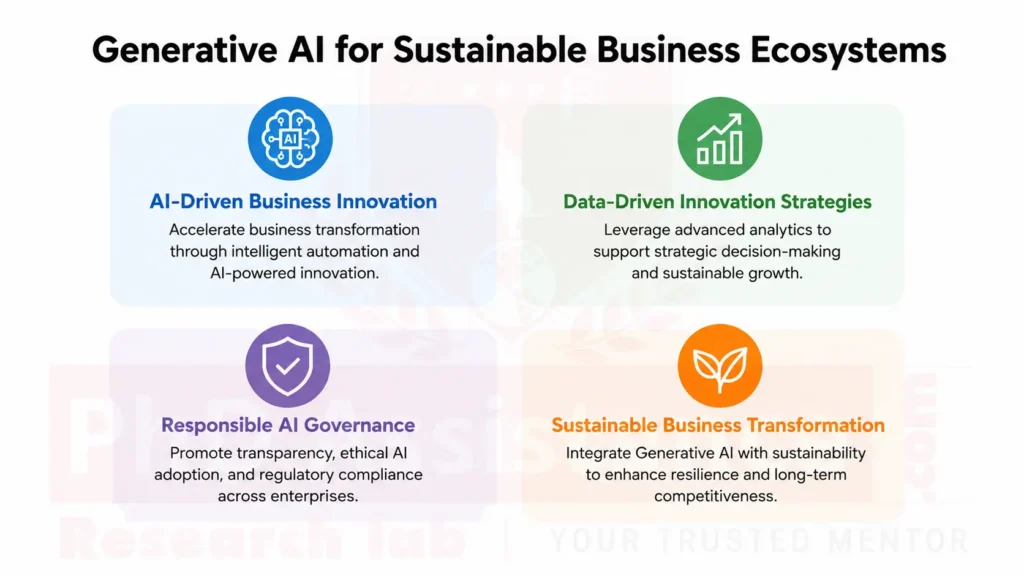
Generative AI impacts how organisations innovate, which is characterised by machine intelligence and capabilities such as automated knowledge discovery, autonomous operation, and prediction, and smart operations and enhanced data-enabled decision-making (Zhuge et al., 2022). Digital enterprises utilise data-driven innovation approaches to augment operational effectiveness, value delivered to customers, environmental benefit, and sustained competitiveness in online competitive environments (Buerger et al., 2021). Utilising generative AI-based business innovation practices, organisations can transform their business model, re-engineer processes, and facilitate sustainable value generation (Schaltegger & Zasuwa, 2020). As indicated in Bachmann et al. (2025), digital sustainability requires a combination of the digital transformation and the sustainable principles, despite few business models designed to facilitate the combination. Henceforth, additional examination into Data Analytics for Sustainable Growth, which can sustain the business transformation, is warranted.
PhD-Level Verification:
Previous research has investigated Generative AI, digital business models, and sustainability individually. But scarce research has investigated an integration framework for business ecosystems considering AI-driven Business Innovation, Data-Driven Innovation Strategies, and sustainability. Furthermore, the study of Data Analytics for Sustainable Growth, which contributes to Sustainable Business, lacks empirical validation, thus presenting an area of opportunities for Doctoral studies.
Research Questions:
Contributions at the PhD-Level:
Suggested Readings:
Bachmann, N., Thienemann, A.-K., Tüzün, A., Brunner, M., Tripathi, S., Pöchtrager, S., & Jodlbauer, H. (2025). The Evolution of the Business Model Canvas for Digital Sustainability. Procedia Computer Science, 253, 1012–1023.
Proposed PhD Topic 2: Responsible Generative AI Governance for Data-Driven Innovation Strategies in Sustainable Enterprise Ecosystems
Background Context:
The rapid implementation of Generative AI increases organisational innovations by enabling intelligent automation, knowledge creation, and data-driven decision-making. Therefore, organisations depend on AI-Powered Business Innovation, as well as Data-Driven Innovation methods for better productivity and improved competitive results. Yet issues regarding transparency, accountability, ethics, and regulatory conformity challenge our adoption of AI with greater ethics. As Chen and Wang (2025) stated, there is a need for such mechanisms integrated with transparency, accountability, data management practices, and compliance measures for effective governance. Still, most of the firms have no integrated governing mechanism which ensures both sustainable, innovative, as well as trustworthiness of data. Thus, there is a need for further study to establish how Data Analytics for Sustainable Growth contributes to responsible AI implementation and to Sustainable Business throughout enterprise ecosystems.
PhD-Level Verification:
Today’s studies explain AI governance, ethics and enterprise data management at separate levels. Some researchers integrate responsible AI governance into Data-Driven Innovation methods, innovation of Sustainable Businesses. Besides, the lack of empirical explanations about governance framework impacts on the sustainable impact for AI-Driven Business Innovation, Data Analytics for Sustainable Growth, and Business Transformation can provide an area for doctoral dissertation research.
Research Questions:
PhD-Level Contributions:
Suggested Readings:
Chen, Z., Wang, Y., & Zhao, X. (2025). Responsible Generative AI: Governance Challenges and Solutions in Enterprise Data Clouds. Journal of Computing and Electronic Information Management, 18(3), 59–65.
Proposed Dissertation topic 3: AI-Powered Business Innovation and Data Analytics for Sustainable Growth in National and Organisational Innovation Ecosystems
Background Context:
AI in the business world is enhancing decision-making for businesses by making it more predictable and driving intelligent automation and long-term strategies across businesses and nations. More organisations use Data Analytics for Sustainable Growth in order to increase innovation potential and productivity of their business in the future. In addition, organisations use AI-Powered Innovation to sustain their long-term competitiveness and accelerate digital transformation and the overall economic development. Organisations are facing difficulty in managing sustainable economic transformation while trying to achieve the goals for innovation, regulation and sustainable business development. According to Sourav et al. (2025), the generative capabilities of AI, which are expected to support economic expansion, are still not paired with integrated frameworks interconnecting data-driven business strategies, governance, and Sustainability in business, which can lead to the Sustainable Transformation using AI-led innovative approaches.
PhD Level Verification:
The vast majority of the existing research focused on Generative AI, business analytics in technology perspectives or economic perspectives. A very few have integrated the Data-Driven Innovation methods. Also, very little is confirmed with empirical proof on how AI-Powered Innovation creates Data Analytics for Sustainable Growth and Sustainable Transformation.
Research Questions:
PhD-Level Contributions:
Suggested Readings:
Sourav, M. S. A., Asha, N. B., & Reza, J. (2025). Generative AI in Business Analytics: Opportunities and Risks for National Economic Growth. Journal of Computer Science and Technology Studies, 7(11), 224–247.
Proposed Dissertation Topic 4: Generative AI Adoption Frameworks for Sustainable Business Transformation among Small and Medium Enterprises
Background Context:
SMEs starting to adopt Generative AI for Productivity Boost, Innovation Methods, Customer Engagement, or increased operational agility. Simply put, AI Powered innovation can support SMEs’ in adopting Data Driven innovation ways of working that is more robust against disruption, more skilled in sustainably aligned growth. Notwithstanding increasing AI access, numerous impediments persist for SMEs, such as deficient digital capacities, integration costs, governance constraints, and unclear regulatory directives. Even though the use of generative AI could potentially democratise the adoption of advanced technology, the actual impact remains questionable and relies on the long-term perspective, and its support system” (Bran et al., 2025:4). Consequently, this study proposes Data Analytics for Sustainable Growth to investigate how it may foster Sustainable Business within SME ecosystems.
PhD-Level Verification:
Existing research primarily addresses either AI adoption barriers or SME innovation. However, research on AI-powered innovation, data-driven strategies, governance, and sustainable practices among SMEs is sparse and underdeveloped, and the empirical research on how data analytics for sustainable growth enables SME’s sustainable transformation is rare, which would be an excellent PhD topic.
Research Questions:
Contributions at the PhD-Level:
Suggested Readings:
Bran, F., Bodislav, D. A., Călin, A. M., & Mănescu, A. M. (2025). Empowering SMEs through Generative AI: Opportunities, Challenges, and Strategic Implications for Sustainable Innovation. European Journal of Sustainable Development, 14(4), 27–38.
Proposed Dissertation Topic 5: Generative AI-Enabled Business Ecosystem Intelligence through Data-Driven Innovation Strategies for Sustainable Business Transformation
Background Context:
Currently, business ecosystems are more interconnected due to digitisation, joint innovation, and the efforts made for sustainability. The use of Generative AI can open new opportunities to develop ecosystem intelligence by enabling a knowledge generator, providing support for decisions, and allowing ecosystem visualisation. The organisations can support collaboration and enhance the performance of the ecosystem, and initiate sustainable business by considering Data-Driven Innovation methods. The problem is the lack of existing models for integrated ecosystem intelligence frameworks, which, as Tani et al. (2025) suggest, can be developed using the visualisation capabilities of Generative AI for a higher strategic awareness, but lack detailed evidence of how those help foster innovation in a business ecosystem, or help sustainability. There is an opportunity for PhD Research in that regard.
PhD-Level Verification:
The prior research on Generative AI for visualisation of ecosystem & Generative AI for business modelling separately. But there is hardly any prior work that covers Data-Driven Strategies & AI-Powered Innovation & ecosystem intelligence & sustainability in an integrative way. There is hardly any empirically supported research that showcases how data analytics can lead to sustainable transformation for the ecosystem.
Research Questions:
PhD-Level Contributions:
Suggested Readings:
Tani, T., Yläkujala, A., Metso, L., Sinkkonen, T., & Kärri, T. (2025). Prompt Engineering P2X Business Ecosystem with Generative AI. Procedia Computer Science, 256, 20–27.
Need assistance finalising your dissertation topic? Selecting a strong, researchable topic can be challenging — but you don’t have to do it alone.
Our research consultants can help refine your ideas, identify literature gaps, and guide you toward a topic that aligns with current academic trends and your programme requirements.
Contact us to begin one-on-one topic development and refinement with PhdAssistance.com Research Lab.
Share this:
Cite this work
PhDAssistance. (n.d.). Cybersecurity in business Dissertation Topics Retrieved January 28th, from https://phdassistance.com/topic/cybersecurity-business/
Jalolova, M., and Musawwir, M. “Cybersecurity in business Dissertation Topics for PhD Scholars.” PhDAssistance, https://phdassistance.com/topic/cybersecurity-business/ Accessed 28th January 2026.
Jalolova, M., and Musawwir, M., n.d. Cybersecurity in business Dissertation Topics for PhD scholars. [online] Available at: https://phdassistance.com/topic/cybersecurity-business/ [Accessed 28th January 2026].
Jalolova M., Musawwir M. Cybersecurity in business Dissertation Topics for PhD scholars [Internet]. PhDAssistance; [cited 2026 28th January]. Available from: https://phdassistance.com/topic/cybersecurity-business/
Jalolova, M., and Musawwir, M. (n.d.). Cybersecurity in business Dissertation Topics for PhD scholars. Retrieved 28th January 2026, from https://phdassistance.com/topic/cybersecurity-business/
Jalolova, M., and Musawwir, M., Cybersecurity in business Dissertation Topics (n.d.) https://phdassistance.com/topic/cybersecurity-business/ accessed 28th January 2026.
Study Resources
Free resources to assist you with your university studies!